
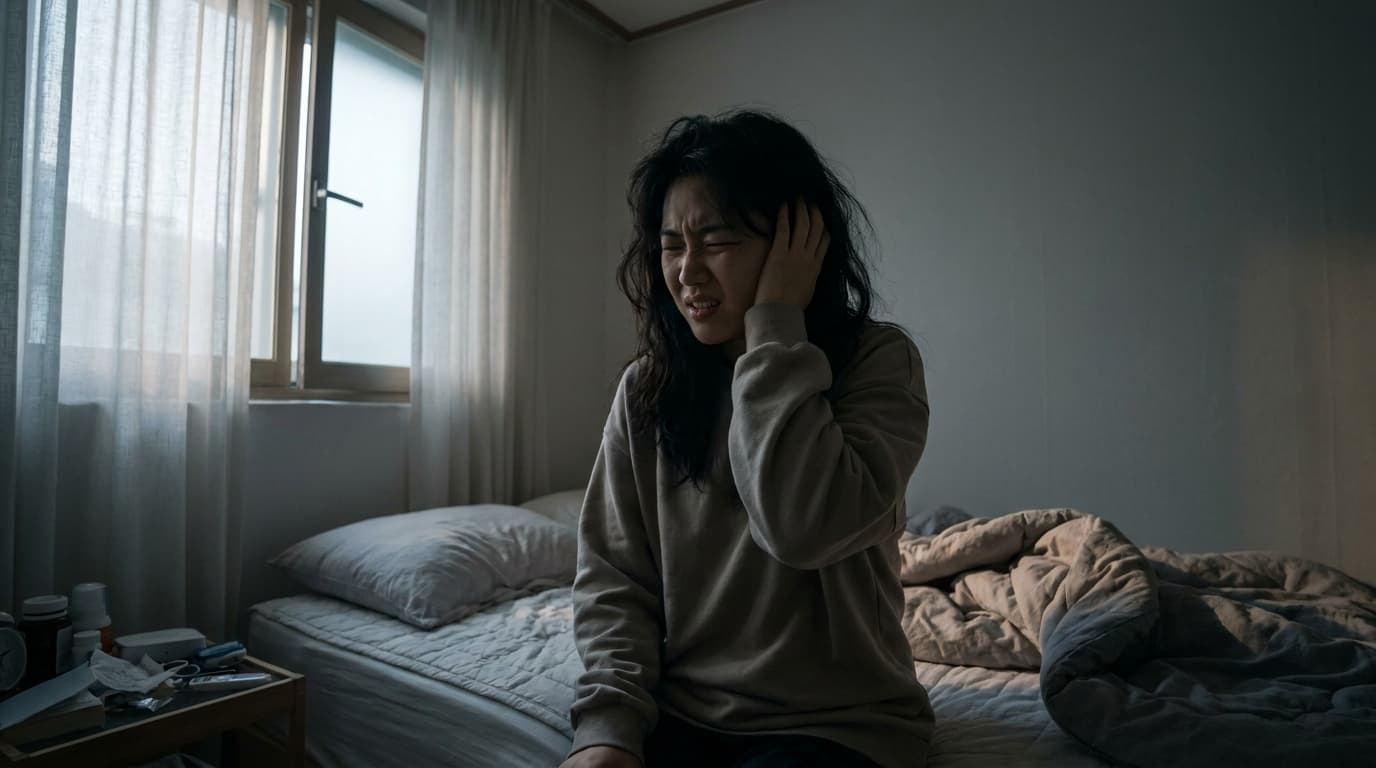
귀에서 삐 소리가 나요, 혹시 나도 모르게 자율신경이 무너지고 있나요?
Hello, this is Dalimchae Korean Medicine Clinic. # Ringing in your ears, could your autonomic nervous system be collapsing without you knowing? On a quiet night, when going to bed or during daily life, have you ever felt anxious when you suddenly heard a ringing 'beep' or buzzing sound in your ears? If sounds that others cannot hear are heard only by you, it is easy to dismiss them as simply being tired. However, if these symptoms repeat or grow louder, this may not be a simple phenomenon, but an important warning signal from our body. Especially for modern people experiencing continuous stress and tension, the complaint of 'ringing in your ears' is often closely related to autonomic nervous system imbalance. 💡 **[Core Answer]** Top 3 most common causes of tinnitus with ringing in the ears: 1 Autonomic imbalance due to excessive stress / 2 Inner ear function decline and auditory nerve damage / 3 Brain sound processing function abnormality and blood circulation problem Dalimchae Korean Medicine Clinic solves the root cause of this tinnitus with autonomic stabilization treatment, creating an environment where the brain does not excessively react to sounds and the body can recover on its own. ## Why does tinnitus ringing keep happening? Tinnitus is the perception of sound in the ears or head when there is no external sound stimulus. While 'ringing in your ears' is the most common expression, it can appear in various forms such as cicada sounds, flowing water, wind, bells, or mechanical sounds. While tinnitus sometimes appears as a symptom of a specific disease, in many cases no special abnormality is found upon examination and it is diagnosed as 'unknown cause'. However, in Korean medicine, tinnitus is not viewed merely as a problem of the ear itself. Tinnitus is understood as a symptom that appears when the balance of our entire body is broken, especially when the autonomic nervous system is affected by stress and overwork. The brain does not clearly distinguish between physical pain and emotional suffering, and physical pain and emotional distress share neural networks within the brain. Therefore, complaints of 'ringing in your ears' often appear when systemic fatigue and stress accumulate alongside the ears. In particular, chronic stress excessively activates the sympathetic nervous system of the autonomic nervous system, which increases the sensitivity of the auditory nervous system and greatly amplifies subtle nerve signals into tinnitus. ## Beyond simple ringing, what is the relationship between tinnitus and the autonomic nervous system? The autonomic nervous system is a network that automatically controls vital functions necessary for life maintenance, such as heartbeat, blood pressure, digestion, breathing, and body temperature regulation, without conscious effort. This autonomic nervous system consists of the sympathetic nervous system responsible for activity and tension, and the parasympathetic nervous system responsible for rest and recovery. Both systems must work in balance to maintain a healthy body and mind. If the balance of the autonomic nervous system collapses due to continuous stress, lack of sleep, or overwork, it enters an 'autonomic imbalance' state where the sympathetic nervous system is excessively hyperactive and parasympathetic function declines. This autonomic imbalance can cause brain hypersensitivity and affect blood flow to the ears, worsening tinnitus symptoms such as 'ringing in your ears'. In fact, tinnitus patients often show high stress indicators and autonomic imbalance in heart rate variability (HRV) analysis. A 2013 study published by a research team at Kyung Hee University College of Korean Medicine presented important results on the autonomic nervous system state of tinnitus patients. Published in 'Evidence-Based Complementary and Alternative Medicine', this study compared and analyzed HRV parameters between 40 tinnitus patients (19 acute, 21 chronic) and 40 healthy controls. The results confirmed that high-frequency components (HF) and total power (TP) of HRV significantly decreased in the tinnitus group (p\<0.05), while the low-to-high frequency ratio (LF/HF) significantly increased. This means that tinnitus patients experienced decreased parasympathetic activity and sympathetic overactivity, i.e., 'vagal withdrawal and sympathetic overactivity'. In particular, chronic tinnitus patients showed a stronger tendency for autonomic nervous system changes than acute tinnitus patients. The researchers concluded that these results provide evidence that oriental medical treatments such as acupuncture or qigong are effective in regulating cardiac autonomic function. Based on these data, Dalimchae Korean Medicine Clinic focuses on restoring overall autonomic balance as well as the ears in tinnitus treatment to help fundamentally resolve symptoms. Additionally, a randomized controlled trial on non-pulsatile chronic tinnitus by Rogha et al. published in the 2015 'International Journal of Medical Research & Health Sciences' specifically demonstrates the effect of acupuncture. This study conducted 15 sessions of acupuncture on 88 non-pulsatile chronic tinnitus patients (44 acupuncture group, 44 placebo group), confirming statistically significant improvements in both the Visual Analog Scale (VAS) for tinnitus intensity and the Tinnitus Severity Index (TSI) (p\<0.001). Specifically, in the acupuncture group, the TSI score significantly improved from an average of 43.84 to 24.82, and the VAS score from an average of 9.56 to 2.88 after 15 treatments. The researchers concluded that acupuncture is effective in reducing the volume and severity of non-pulsatile chronic tinnitus and can be a useful treatment method. Through this, Dalimchae Korean Medicine Clinic helps tinnitus symptoms like 'ringing in your ears' naturally stop through autonomic stabilization and improvement of qi and blood circulation around the ears based on scientific evidence. ## How does Korean medicine diagnose and treat tinnitus? At Dalimchae Korean Medicine Clinic Songdo Branch, the tinnitus symptom of 'ringing in your ears' is approached from an integrated perspective, viewing it not simply as an ear problem, but as an imbalance of the whole body, especially malfunction of the brain and autonomic nervous system. **Dalimchae Korean Medicine Clinic Autonomic Stabilization Treatment Principle** Tinnitus often originates from a state of excessive tension in the brain and autonomic nervous system. Dalimchae Korean Medicine Clinic's **autonomic stabilization** treatment focuses on cooling this body's 'overheated engine' and normalizing the 'circuit breaker switch'. When autonomic balance collapses, the brain cannot rest and easily becomes sensitive, which can further amplify and perceive tinnitus sounds. In Korean medicine, this is also explained through the perspective of 'Su-seung-hwa-gang' (Water rises, fire descends). Clear energy should rise to the head and the lower abdomen should be warm, but when stress and overwork cause heat to surge to the head and the lower limbs to become cold, brain and autonomic nervous system disorders such as tinnitus, insomnia, dizziness, and headache easily appear. Dalimchae Korean Medicine Clinic focuses on lowering excessive heat in the nervous system and creating an environment where the brain can rest. To this end, customized herbal medicines tailored to individual constitution and symptoms are prescribed to regulate unbalanced autonomic nerves and stabilize sensitive nerves. In addition, acupuncture and pharmacopuncture treatments improve qi and blood circulation around the ears and stimulate tinnitus-related acupoints to relieve symptoms. Chuna manual therapy helps correct neck and jaw imbalances when they affect tinnitus, relieving nerve compression and restoring autonomic function. This complex oriental medicine treatment enhances overall body resilience so that tinnitus symptoms can be naturally controlled. Many people visiting the Songdo Tinnitus Clinic experience not only tinnitus symptom improvement but also overall health enhancement through autonomic balance recovery at Dalimchae Korean Medicine Clinic. Quite a few people also complain of headaches or dizziness together, which like tinnitus are representative symptoms of autonomic imbalance. Therefore, Dalimchae Korean Medicine Clinic Songdo Branch establishes an integrated treatment plan considering these related symptoms as well. ### Tinnitus Self-Checklist If 3 or more of the following items apply to you, you may suspect tinnitus due to autonomic imbalance, and we recommend receiving professional consultation at Songdo Autonomic Nervous Clinic. * You frequently hear specific sounds such as ringing, cicadas, or running water in your ears. * Tinnitus sounds become louder when you are in a quiet place or going to bed at night. * Tinnitus symptoms worsen when you are stressed or tired. * Sleep quality drops, such as difficulty falling asleep or frequently waking up due to tinnitus. * Headaches, dizziness, or stiff neck accompany tinnitus. * Emotional swings become severe, or anxiety and depression are frequently felt. * Indigestion or chest tightness and palpitation symptoms exist. * Hospital examinations diagnosed no special abnormalities. **Criteria:** * **3 or more items apply:** Suspected autonomic imbalance type tinnitus. We recommend considering autonomic stabilization through oriental medicine complex treatment. * **5 or more items apply:** High possibility of quality of life deterioration due to symptoms. We recommend immediate hospital visit for precise diagnosis and treatment plan establishment. **Q. How long should tinnitus be treated?** A. The duration of tinnitus treatment depends on the symptom onset timing, severity, accompanying symptoms, and individual body resilience of the patient. Generally, acute tinnitus can improve within a relatively short period, but chronic tinnitus may require steady treatment for 3 to 6 months or more. Dalimchae Korean Medicine Clinic presents the most effective recovery path through personalized treatment plans. **Q. I have both tinnitus and dizziness, can they be treated together?** A. Yes, tinnitus and dizziness often appear together as they can share common causes such as autonomic imbalance or brain function abnormalities. Dalimchae Korean Medicine Clinic's autonomic stabilization treatment addresses the root causes of both tinnitus and dizziness, effectively improving accompanying symptoms. **Q. The hospital says 'normal', but the tinnitus continues. Will Korean medicine treatment help?** A. Tinnitus with no special abnormalities found in western medical examinations may be closely related to subtle imbalances in the autonomic nervous system or abnormalities in the brain's sound processing function. Korean medicine focuses on overall body balance recovery, providing effective treatment for tinnitus even when examination results are normal. **Q. Are there any side effects when taking herbal medicine?** A. Dalimchae Korean Medicine Clinic's herbal medicine is carefully prescribed considering the patient's constitution and symptoms, using only clean herbal medicines that have passed strict Ministry of Food and Drug Safety standards. Side effects are generally low, but if you feel any discomfort during taking, you can consult with medical staff to adjust the prescription. Tinnitus like 'ringing in your ears' is not a problem that can be solved by enduring. You no longer need to ignore the signals your body has been sending for a long time. When approached in the right direction, the body responds faster than you think. Bring the symptoms you are currently experiencing just as they are. Dalimchae Korean Medicine Clinic Songdo Branch will help you find the cause together and recover your peaceful daily life. Where life blooms. Herbal medicine is Dalimchae Korean Medicine Clinic. Check symptoms similar to yours first through Dalimchae Korean Medicine Clinic homepage AI consultation! This article is health information compiled together by Dalimchae medical staff based on questions frequently received in the treatment room. Medical Supervision | Brain & Autonomic Nervous System Treatment Standard Dalimchae Korean Medicine Clinic Songdo Branch Korean Medicine Doctor Oh Hyunmin (Tinnitus Column)