
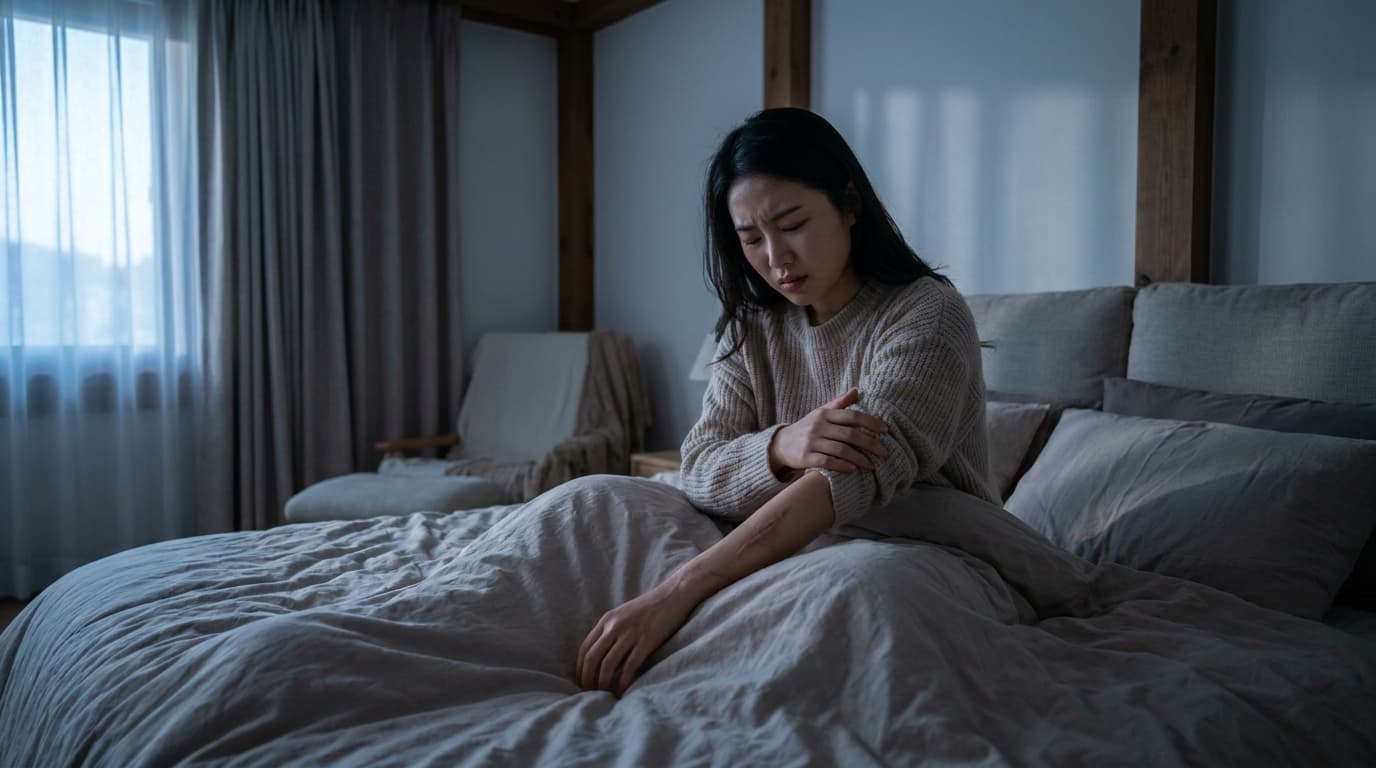
Why does my shingles scar still hurt? Finding answers in Korean medicine
Are you struggling with persistent pain, such as stabbing or burning sensations, or abnormal sensations that make even light contact with clothing difficult, even though you thought your shingles had healed? Many people suffer from insomnia and recurring pain with minor movements. You may have wondered, "Do I just have to bear this?" or "Am I the only one?" while visiting various hospitals. However, this chronic pain following shingles does not go away on its own; it is a clear warning signal from your body.
💡 [Key Answer] 3 most common causes of "persistent pain in shingles scar area": ① Nerve Damage / ② Central Nervous System Sensitization / ③ Chronic Inflammation Dalimchae Clinic calms the overheating of the nervous system and restores autonomic balance to treat the root of neuralgia.
Why does shingles scar pain persist?
Shingles is a disease caused by the reactivation of the varicella-zoster virus, which causes extreme pain along with characteristic blisters during the acute phase. However, pain often persists even after the blisters disappear and the wounds appear to have healed, which is called 'post-herpetic neuralgia (PHN).' This pain occurs when the virus damages the nerve ganglia where it was latent, leading to functional abnormalities in the nervous system. In particular, a phenomenon called 'central nervous system sensitization' occurs, where damaged nerves continuously send abnormal signals to the central nervous system, increasing sensitivity to pain and causing extreme pain even with minor stimuli.
In addition, the inflammatory response caused by the shingles virus in the nervous system can lead to chronic inflammation, causing functional decline in surrounding tissues and worsening pain. This is not a problem that can be solved simply by the skin wound healing; it requires recovery and functional readjustment of the entire nervous system.
How is Korean medicine treatment for post-herpetic neuralgia performed?
In Korean medicine, the approach to post-herpetic neuralgia is not just about alleviating pain but improving the imbalance of the nervous system and the overall decrease in immunity that cause the pain. In particular, shingles is described using terms like 'Jeon-yo-hwa-dan' (纏腰火丹) or 'Sa-gwan-chang' (蛇串瘡) based on its characteristic ribbon or snake-like appearance, and causes are seen as liver fire (肝火), damp-heat (濕熱), and qi-stagnation and blood-stasis (氣滯血瘀).
A network meta-analysis study published in 「Frontiers in Neurology」 in 2023, which analyzed 29 randomized controlled trials involving 1,973 patients with post-herpetic neuralgia (PHN), showed that all acupuncture-related therapies were significantly more effective in pain relief than anticonvulsant monotherapy. In particular, pricking and cupping combined with anticonvulsants was most effective for pain relief, while electroacupuncture combined with anticonvulsants was most effective for improving PHN-related insomnia and depression. The researchers concluded that acupuncture-related therapies are a potential and safe treatment option for PHN. These research results serve as the basis for Dalimchae Clinic's complex Korean medicine treatment, which aims not only at pain relief but also at improving the quality of life, including accompanying sleep disorders and depression.
Furthermore, a retrospective chart review study published in the journal 「Pain Research and Management」 in 2024 applied integrated Korean medicine treatment (acupuncture, herbal medicine, moxibustion, cupping, etc.) to 13 patients with post-herpetic neuralgia. The results showed an average pain reduction of 31% at 4 weeks and 37% at 8 weeks based on the Numerical Rating Scale (NRS). Notably, the worst pain score decreased by 34% (p<0.002) at 4 weeks, 40% (p<0.002) at 6 weeks, and 41% (p<0.002) at 8 weeks, confirming statistically significant pain relief. Considering that a 2-point or 30% reduction in NRS score is clinically significant pain relief in chronic disease patients, this study suggests that Korean medicine treatment can lead to meaningful pain reduction levels similar to Western medical treatments. Dalimchae Clinic strives to improve the quality of life of patients suffering from chronic neuralgia by complexly applying various Korean medicine treatments such as herbal medicine, acupuncture, pharmacopuncture, moxibustion, and cupping according to individual symptoms and constitution.
Dalimchae Clinic's Autonomic Stabilization Treatment: Turning off the overheated warning lights of the nervous system.
Post-herpetic neuralgia can be caused or worsened when nerves damaged by viral infection lead to an imbalance in the autonomic nervous system. The autonomic nervous system is like a control panel that regulates important functions of our body. When this balance is broken, the brain cannot rest and reacts hypersensitively to pain signals. This is like an overheated engine that continuously flashes warning lights.
Dalimchae Clinic Incheon Branch uses autonomic stabilization treatment, which corrects the imbalance of the autonomic nervous system, as its core principle. We lower the heat in the nervous system and calm the hypersensitively reacting nerves to create an environment where the brain can rest. In Korean medicine, this is called 'Suseung-hwagang' (水昇火降), which emphasizes restoring balance by keeping the head cool and the lower abdomen warm. Autonomic stabilization treatment helps the recovery of damaged nerves and normalizes our body's response to pain, contributing to breaking the cycle of chronic pain. In particular, it is effective in comprehensively improving symptoms such as chronic pain, sleep disorders, and anxiety experienced by many people seeking shingles clinics in Incheon. This approach can have a positive impact not only on post-herpetic neuralgia but also on other cranial nerve problems such as headaches or dizziness.
Is it post-herpetic neuralgia? Symptom Checklist
If you meet 3 or more of the items below, you should suspect post-herpetic neuralgia and consider active treatment.
- Pain persists even though it has been more than a month since the shingles blisters disappeared.
- There is extreme pain, like being stabbed with a knife, burned with fire, or an electric shock.
- There is abnormal sensation (allodynia, hyperesthesia) where it hurts or causes goosebumps just from touching clothing or a breeze.
- It is difficult to fall asleep or you wake up frequently at night due to pain.
- You feel anxiety, depression, or lethargy due to the pain.
- It feels like the skin color of the painful area has changed or the sensation has become dull.
- Pain does not subside well or the effect is temporary even after taking painkillers.
- You experience difficulty in daily life (getting dressed, showering, going out, etc.) due to the pain.
- Your stamina has dropped sharply and you feel tired frequently.
Assessment Criteria:
- 3-4 items: Suspected stage of post-herpetic neuralgia, consultation for complex Korean medicine treatment is recommended.
- 5 or more items: High possibility of chronic post-herpetic neuralgia, immediate visit to a specialized medical institution such as an Incheon neuralgia clinic for accurate diagnosis and treatment is important.
Frequently Asked Questions (FAQ)
Q. How long can post-herpetic neuralgia last? A. Post-herpetic neuralgia can last from several months to several years or more, and for some patients, it causes pain for a lifetime. It is important to prevent chronicity through active treatment in the early stages.
Q. Can post-herpetic neuralgia be treated with Korean medicine? A. Yes, Korean medicine utilizes various methods such as acupuncture, pharmacopuncture, herbal medicine, moxibustion, and cupping to treat post-herpetic neuralgia. It is particularly effective in alleviating inflammation of the nervous system, recovering damaged nerves, regulating pain pathways, and enhancing systemic immunity.
Q. Can post-herpetic neuralgia heal naturally? A. Some mild pain may improve over time, but most post-herpetic neuralgia does not disappear completely on its own. Rather, if left untreated, the pain can become chronic and seriously affect the quality of life, so active treatment is necessary.
Q. I have post-herpetic neuralgia along with depression and insomnia. Can they be treated together? A. Yes, post-herpetic neuralgia often causes accompanying symptoms such as insomnia and depression. Dalimchae Clinic's autonomic stabilization treatment improves the overall imbalance of the nervous system, not just the pain, helping to increase sleep quality and regain psychological stability.
The pain in the shingles scar area is not a problem that can be solved by enduring it. You no longer have to ignore the signals your body has been sending for a long time. If you approach it in the right direction, your body will react faster than you think. Bring the symptoms you are experiencing as they are. Dalimchae Clinic Incheon Branch will help you find the cause together and regain a comfortable daily life.
Where life blooms. Herbal medicine is Dalimchae Clinic. Check your symptoms first with the Dalimchae Clinic website AI consultation!
This article is health information summarized by Dalimchae medical staff based on questions frequently received in the consultation room. Medical Supervision | Skin disease treatment standard Dalimchae Clinic Incheon Branch Korean Medicine Doctor Min Jihong (Chronic Skin Disease Column)