
Hello. This is Dalimchae Oriental Clinic.
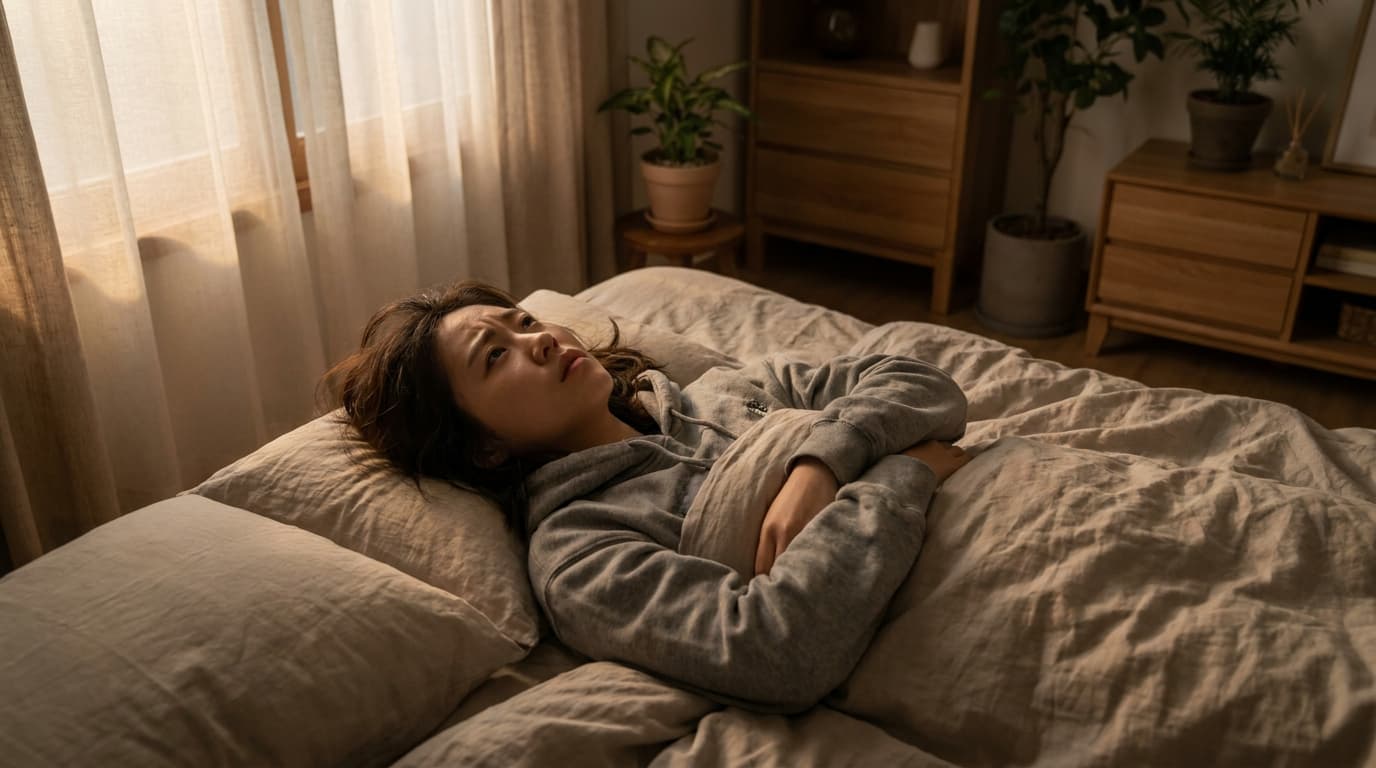
Why Can't I Sleep When I Lie Down? Is It Simple Insomnia or Autonomic Imbalance?
Do you feel like lying in bed every night is like a chore? Many people suffer from sleepless nights, saying, "I can't sleep when I lie down." No matter how hard you try, you can't fall asleep, and the frustration and fatigue the next day interfere with your daily life. Beyond just not sleeping well, if this condition persists, it adversely affects overall physical and mental health. Many people consider sleeping pills, but it is difficult to get a satisfactory night's sleep without resolving the fundamental cause.
💡 Key Answer The 3 most common reasons for "I can't sleep when I lie down": ① Stress and anxiety (Autonomic imbalance) / ② Irregular lifestyle and sleep environment / ③ Excessive arousal state of the brain (Chronic brain overload) Dalimchae Oriental Clinic creates an environment where the brain can rest and recover on its own through autonomic stabilization treatment.
What is the difference between simple insomnia and insomnia caused by autonomic imbalance?
Insomnia refers to a state where the quality and quantity of sleep are unsatisfactory, such as difficulty falling asleep, difficulty maintaining sleep, or waking up too early. Simply not sleeping for a while may be temporary insomnia, but if these symptoms persist for more than 3 times a week for more than 3 months, it can be diagnosed as 'insomnia disorder'. Then, what is the difference between 'simple insomnia' and 'insomnia caused by autonomic imbalance', where in many cases there is no special abnormality on examination? The key difference lies in 'brain stability'.
Simple insomnia often occurs temporarily due to relatively clear external factors such as irregular sleep habits, stress, and excessive caffeine intake. However, insomnia caused by autonomic imbalance occurs because the autonomic nervous system, our body's 'automatic control system', is broken and the brain continuously maintains an excited state. At night, the body wants to rest, but the sympathetic nervous system is excessively activated, so the brain cannot prepare for sleep and stays in a 'hyperarousal state'. This can be accompanied by various physical symptoms such as headaches, dizziness, indigestion, and anxiety, so it is difficult to see it as a simple sleep problem. In particular, many patients seeking Songdo Insomnia Clinic complain of such autonomic imbalance.
Why does autonomic imbalance interfere with sleep?
Our body's autonomic nervous system consists of the sympathetic and parasympathetic nervous systems. The sympathetic nervous system is activated in situations of tension, activity, and stress, and the parasympathetic nervous system is activated during relaxation, rest, and digestion. For healthy sleep, sympathetic activity should decrease and parasympathetic activity should prevail at night.
However, problems occur when the balance of the autonomic nervous system is broken due to excessive stress, irregular life, and chronic fatigue. If the sympathetic nervous system, which should be active during the day, continues to maintain an excessively excited state even at night, the brain cannot rest properly and remains tense. It's like a heated engine that doesn't cool down and continues to run even at night. This hyperarousal state of the brain interferes with the secretion of melatonin, a sleep hormone, and suppresses the activity of brain waves that induce deep sleep, eventually causing insomnia where it is difficult to fall asleep or you wake up frequently even if you fall asleep. Dalimchae Oriental Clinic Songdo Branch identifies these imbalances in the autonomic nervous system in detail and establishes a personalized treatment plan.
How does Oriental medicine treat autonomic imbalance insomnia?
Oriental medicine does not see insomnia as a simple sleep problem, but interprets it as a result of a breakdown in the balance of the five viscera and six bowels and the circulation of Qi and Blood. In particular, it treats the fundamental cause of insomnia through various differential diagnoses such as 'Simdamheogeop (Heart and Gallbladder Deficiency)', 'Eumheonaeyeol (Yin Deficiency Internal Heat)', and 'Sagyeolbulsu (Insomnia due to Overthinking)'. These Oriental medical differential diagnoses are closely related to modern autonomic imbalance. For example, 'Sagyeolbulsu', where the chest feels stuffy and throbbing due to stress and excessive thoughts, shows symptoms similar to sympathetic hyperactivity.
At Dalimchae Oriental Clinic, we focus on restoring the balance of the autonomic nervous system and creating an environment where the brain can rest and recover on its own.
A study published in Frontiers in Pharmacology in 2022 evaluated the efficacy and safety of Jiaotaiwan in a double-blind, randomized controlled clinical trial involving 128 patients with insomnia due to Heart-Kidney Non-interaction (Simsingbulgyo). Heart-Kidney Non-interaction is a symptom caused by the disharmony of the energy of the heart and kidneys in Oriental medicine, which has aspects similar to modern autonomic imbalance. As a result of the study, the Jiaotaiwan treatment group had a significant increase in blood melatonin levels (JTW: 339.09 ± 256.894 vs. Placebo: 219.59 ± 169.045; p = 0.004), and statistically significant differences were also confirmed in specific metabolites in the brain. The researchers concluded that Jiaotaiwan is an effective and well-tolerated drug for the treatment of Heart-Kidney Non-interaction type insomnia. These studies suggest that herbal medicine can have a positive effect on the secretion of sleep-inducing substances and the regulation of brain function.
In addition, a research trend on Oriental medicine insomnia treatment published in Current Research in Complementary and Alternative Medicine in 2023 reported that as a result of administering a specific herbal prescription to chronic insomnia patients for 28 days, the effective rate of the treatment group was 77.5%, which was statistically significantly higher than that of the control group (estazolam group) at 52.5%. In particular, this study shows that treatment based on Oriental medical differential diagnosis such as 'Eumheodamyeol (Yin Deficiency Phlegm-Heat)' was effective, which can be linked to a situation where a lack of Yin fluid in the body and internal heat lead to excessive excitement of the autonomic nervous system and cause insomnia. Based on these data, Dalimchae Oriental Clinic provides treatment to balance the autonomic nervous system and calm the hyperarousal state of the brain through customized herbal prescriptions suitable for each individual's constitution and symptoms.
An Overheated Engine Where the Brain Cannot Rest, Autonomic Stabilization Treatment

Dalimchae Oriental Clinic's autonomic stabilization treatment is a core principle specialized for brain and autonomic nervous system diseases. When the balance of the autonomic nervous system is broken, the brain cannot rest. Just as a car engine is overheated and continues to run, if the sympathetic nervous system is hyper-aroused, the brain maintains a constant state of arousal even at night when it should be asleep. This can go beyond simply not being able to sleep and lead to various symptoms such as anxiety, restlessness, heart palpitations, chronic fatigue, and indigestion. In particular, among those looking for Songdo Autonomic Nervous System Clinic, there are many cases where the daytime condition is ruined because of sleepless nights.
We focus on lowering the excessive heat of the nervous system and creating an environment where the brain can rest comfortably on its own. In Oriental medicine, this is also expressed as 'Suseunghwagang (Ascending Water and Descending Fire)', a treatment that lowers the hot energy of the head and raises the cold energy of the lower abdomen to balance the Qi and Blood circulation and Yin-Yang balance of the entire body. This is achieved through acupuncture, pharmaco-acupuncture, moxibustion, and personalized herbal prescriptions. By calming the excitement of the brain and strengthening the function of the parasympathetic nervous system, it naturally induces deep sleep and helps the harmonious recovery of the entire body. It is especially effective for those who suffer from headaches, dizziness, and digestive symptoms along with insomnia.
Autonomic Imbalance Insomnia, Self-Diagnosis Checklist
Check if any of the following items apply to you.
- Has stress and anxiety become particularly severe recently?
- Do you have many distracting thoughts when you lie down to sleep, making it difficult to fall asleep?
- Do you often take more than 30 minutes to fall asleep?
- Do you wake up frequently during the night, or find it difficult to fall back asleep once you wake up?
- Do you feel heavy and not refreshed even when you wake up in the morning?
- Do you often feel your heart throbbing or feel stuffy in your chest?
- Are your hands and feet cold, or on the contrary, do you have cold sweats?
- Do you have indigestion or frequent nervous stomach symptoms?
- Is your back or shoulder stiff and do you suffer from chronic headaches or dizziness?
- Do you often feel anxious, restless, or tense for no reason?
Diagnosis Result:
- If 3 or more apply: Insomnia due to autonomic imbalance is suspected. Consider Oriental medical treatment to find the fundamental cause of your sleepless nights.
- If 5 or more apply: It is highly likely that the balance of the autonomic nervous system is severely broken. For management of not only sleep quality but overall health, it is recommended to visit Dalimchae Oriental Clinic in Songdo for immediate examination and consultation.
FAQ
Q. How long does insomnia treatment take? A. The treatment period for insomnia varies from person to person depending on the cause and severity of symptoms. Temporary insomnia can improve within a few days, but chronic insomnia due to autonomic imbalance usually requires steady treatment for 1 to 3 months or more. Focusing on solving the fundamental cause and increasing the body's recovery power can lead to a better prognosis.
Q. Can autonomic imbalance insomnia be treated with Oriental medicine? A. Yes, insomnia due to autonomic imbalance responds effectively to Oriental medical treatment. Through herbal medicine, acupuncture, and moxibustion, we calm the excessive excitement of the sympathetic nervous system and activate the parasympathetic nervous system to restore the balance of the autonomic nervous system. This helps the brain rest comfortably on its own and get a deep sleep.
Q. Can insomnia heal naturally? A. Temporary insomnia can improve naturally through lifestyle improvements or the removal of stress factors. However, chronic insomnia due to autonomic imbalance is difficult to heal naturally, and if left unattended, symptoms can worsen or lead to other diseases such as depression and anxiety disorders. It is important to start active treatment with the help of a specialist.
Q. I have both insomnia and anxiety disorder, can they be treated together? A. Yes, insomnia and anxiety disorders are closely related, and autonomic imbalance is often the main cause. Dalimchae Oriental Clinic's autonomic stabilization treatment calms the hyperarousal state of the brain and induces psychological stability, helping to improve not only insomnia but also anxiety disorder symptoms. You can regain the balance of body and mind by treating both symptoms together.
Sleepless nights, lying in bed but unable to sleep, or waking up to an unrefreshed morning after tossing and turning all night, are not problems that can be solved by enduring them. You no longer have to ignore the signals your body has been sending for a long time. If you approach it in the right direction, your body will react faster than you think. Bring your current symptoms as they are. Dalimchae Oriental Clinic will find the cause together.
Where life blooms. Herbal medicine is, after all, Dalimchae Oriental Clinic. Check your similar symptoms through the AI consultation on the Dalimchae Oriental Clinic website first!
This article is health information compiled by the Dalimchae medical staff based on questions actually received in the examination room. Medical Supervision | Brain/Autonomic Nervous System Treatment Standard Dalimchae Oriental Clinic Songdo Branch Oriental Doctor Oh Hyunmin (Insomnia Column)