
Hello. This is Dalimchae Korean Medicine Clinic.
Can't sleep at night? So sleepy during the day? Finding the broken link of sleep.
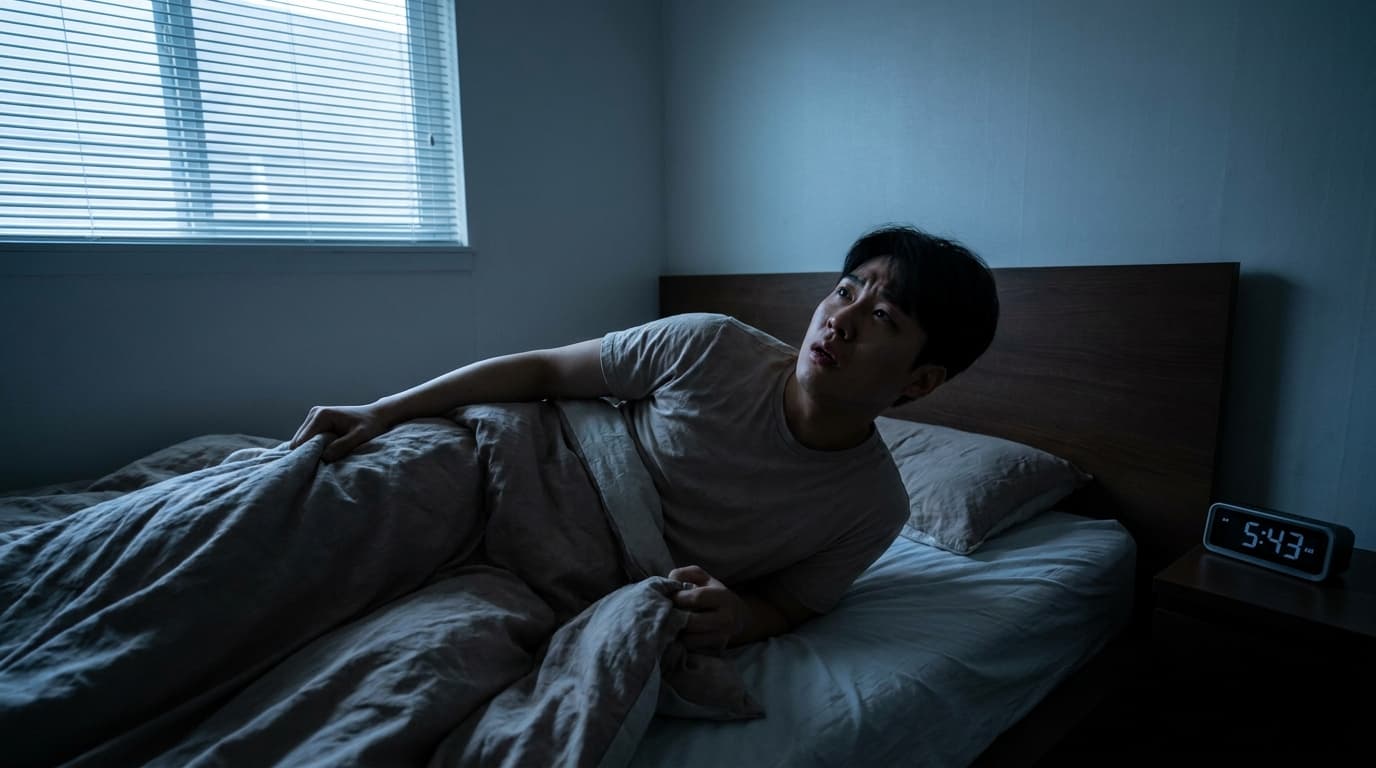
Do you toss and turn every night until dawn, and even after getting out of bed, do you feel heavy instead of refreshed? Many people complain, "I can't sleep at night," and have to fight overwhelming sleepiness during the day. Chronic fatigue, lack of concentration, and even emotional fluctuations. When the quality of deep sleep declines, our daily lives are affected more seriously than we think. While many often dismiss these symptoms as simple fatigue or stress, they can actually be a strong signal that an important balance in our body has been broken.
💡 Key Answer The 3 most common causes of [Can't sleep at night]: ① Autonomic imbalance / ② Emotional stress and anxiety / ③ Poor sleep habits and environment Dalimchae Korean Medicine Clinic creates an environment where the brain and body induce deep sleep on their own through autonomic stabilization treatment.
"I can't sleep at night." Is it simply because I'm tired? The real cause of insomnia.
The symptom of not being able to sleep at night is not simply a matter of physical fatigue. Modern insomnia usually occurs due to complex causes, at the center of which lies an imbalance of the 'autonomic nervous system'. Our body's autonomic nervous system is divided into the sympathetic and parasympathetic nervous systems, responsible for essential life-sustaining functions such as heart rate, digestion, breathing, and temperature regulation. To fall asleep, the body must enter a relaxed rest mode, where the parasympathetic nervous system is dominant. However, if the sympathetic nervous system is hyper-activated due to excessive stress or irregular lifestyle habits, the brain becomes over-aroused, making it difficult to fall asleep. It's like an 'overheated engine' that continues to work without rest even at night. Weakened sleep-wake cycle regulation in the brainstem or stress hormone cortisol levels remaining high late into the night are also major causes of declining sleep quality. Thus, the chaos of the autonomic nervous system prevents the brain from sufficiently relaxing, creating a vicious cycle where no matter how hard we try to sleep, sleep doesn't come. Eventually, this leads to chronic fatigue and sleepiness during the day, interfering with daily life.
What if the 'Sleep Switch' is broken? Insomnia from a Korean medicine perspective.
In Korean medicine, insomnia is expressed as 'Sil-myeon (失眠)' or 'Bul-mae (不寐)', diagnosing states where it's hard to fall asleep, hard to maintain sleep, or waking up early and being unable to fall back asleep. Korean medicine interprets the cause of insomnia not just as a brain problem, but as stemming from general disharmony of Qi and Blood (氣血) and functional abnormalities of the five viscera and six entrails. For example, excessive thinking or stress can lead to 'Sim-dam-heo-geop (心膽虛怯)', weakening the energy of the heart and gallbladder, inducing anxiety and insomnia. Also, when 'Um-heo-nae-yeol (陰虛內熱)' accumulates in the body, it's like a desert filled with heat; the body's fluids become insufficient, and heat rises to the top, making the brain hot and preventing sleep. Korean medicine sees this as a break in the harmony of 'Su-seung-hwa-gang (水昇火降)'. In other words, cool energy should rise and warm energy should descend to achieve balance, but when this balance is broken, the head becomes hot and the hands and feet become cold, leading to a state where sleep doesn't come. At Dalimchae Korean Medicine Clinic Songdo, we identify these complex causes and help the body regulate its own 'sleep switch' through customized herbal treatment suited to the individual's constitution and symptoms.
Can Korean medicine treatment really be effective for insomnia?
The effectiveness of Korean medicine treatment for insomnia is being confirmed through various clinical studies.
A randomized controlled pilot study by a research team at the Korea Institute of Oriental Medicine, published in the journal "Integrative Medicine Research" in 2019, reported results from 40 patients with mild to moderate insomnia (20 in the herbal tea HT002 group, 20 in the waiting group) who consumed HT002 twice a day for 4 weeks. In this study, the HT002 group showed an average decrease of -4.0 ± 0.8 points in the Insomnia Severity Index (ISI) score after 4 weeks of treatment compared to the baseline, showing a statistically significant improvement compared to the -0.4 ± 0.8 point decrease in the waiting group (p < 0.05). In a follow-up observation after 8 weeks, the ISI score decreased by -4.8 ± 0.7 points, showing continuous improvement compared to the waiting group (-0.9 ± 0.7 points) (p < 0.05). Additionally, the Pittsburgh Sleep Quality Index (PSQI) and the physical component score of the 12-item Short Form Health Survey (SF-12) also significantly improved in the HT002 group. The researchers concluded that 4 weeks of herbal tea treatment can help reduce the severity of insomnia symptoms and improve quality of life. These research results suggest that herbal medicine can play a positive role in improving sleep quality for insomnia patients.
Deep sleep without sleeping pills? Autonomic stabilization treatment for you experiencing insomnia.
At Dalimchae Korean Medicine Clinic Songdo, we focus on autonomic stabilization treatment that fosters the body's own power to fall asleep without worrying about dependency on sleeping pills or side effects. By relaxing the excessively hyper-activated sympathetic nervous system and inducing activation of the parasympathetic nervous system, we help the brain and body naturally transition to rest mode.
A multi-center clinical study by Dr. Jun-hwan Lee's research team at the Korea Institute of Oriental Medicine, published in the journal "Nature and Science of Sleep" in 2021, verified the effectiveness of electroacupuncture, a representative Korean medicine treatment, on 150 patients who had suffered from insomnia for more than 3 months. Research participants received a total of 10 electroacupuncture treatments over 4 weeks at 10 acupoints related to insomnia treatment. As a result, the Insomnia Severity Index (ISI) score of the electroacupuncture treatment group significantly improved from an average of 19.02 points before treatment to 10.13 points after treatment. This improvement effect lasted until the follow-up observation points, with 8.60 points after 4 weeks and 8.02 points after 8 weeks, and anxiety and depression scales also improved. The researchers confirmed that electroacupuncture treatment is effective not only for insomnia symptoms but also for improving accompanied anxiety and depression symptoms. Based on this data, Dalimchae Korean Medicine Clinic helps patients regain a healthy sleep rhythm by promoting the secretion of sleep-inducing substances and restoring brain balance through acupuncture, pharmacopuncture, and herbal treatments that regulate imbalanced autonomic nerves and calm excessive brain arousal. Especially as a Songdo insomnia clinic, we strive to solve the fundamental cause through personalized treatment and provide a comfortable night.
What kind of insomnia am I experiencing? Insomnia Self-Diagnosis Checklist.
Check how many of the following items apply to you.
- Difficulty falling asleep within 30 minutes of lying in bed.
- Waking up frequently at night and finding it hard to fall back asleep.
- Waking up too early in the morning and being unable to fall back asleep.
- Feeling like you haven't slept even after sleeping, and being constantly tired and sleepy during the day.
- Insomnia interferes with daily life (work, studies, social life).
- Difficulty sleeping due to being overwhelmed by worry or anxiety before falling asleep.
- Symptoms such as heavy head or dizziness, chest feeling stuffy or palpitations.
- Accompanied by gastrointestinal problems such as poor digestion, constipation, or diarrhea.
- Recently feeling severe stress, becoming sensitive, and increasing irritability.
Judgment Criteria:
- 3 or more applies: Insomnia due to autonomic imbalance is suspected. Consider Dalimchae's autonomic stabilization treatment.
- 5 or more applies: Likely to be moderate or higher insomnia. Immediate diagnosis and treatment by a professional are recommended for improving sleep quality.
FAQ
Q. I can't sleep at night and I'm so sleepy during the day, what should I do? A. The symptom of being overwhelmed by sleepiness during the day because you can't sleep at night is a typical pattern of insomnia. Rather than just enduring sleepiness, it is important to first check your sleep habits and living environment and start stress management. However, if symptoms persist for more than 3 months, it may be due to an imbalance of the autonomic nerves, so it is necessary to seek professional help to identify and treat the fundamental cause.
Q. Is it possible to treat insomnia without sleeping pills? A. Yes, it is fully possible. Sleeping pills can help with temporary symptom relief but do not solve the fundamental cause of insomnia and can cause dependency or side effects with long-term use. At Dalimchae Korean Medicine Clinic, we help restore a healthy sleep rhythm even without sleeping pills through Korean medicine treatments that help the body induce deep sleep on its own by regaining the balance of the autonomic nerves.
Q. I'm looking for an insomnia clinic in Songdo, how long does Korean medicine treatment take? A. The treatment period for insomnia can vary depending on the individual's symptom severity, duration of onset, constitution, and lifestyle habits. Usually, early insomnia can improve in a relatively short period, but in the case of chronic insomnia, time may be needed to restore the balance of the autonomic nerves. At Dalimchae Korean Medicine Clinic Songdo, we establish an optimal treatment plan for the individual through precise diagnosis and support recovery through consistent treatment and lifestyle management.
Q. It is said that autonomic imbalance is the cause of insomnia, what kind of treatment do I receive? A. Insomnia due to autonomic imbalance is approached through various Korean medicine treatments such as acupuncture, moxibustion, herbal medicine, and pharmacopuncture. Especially, by using medicinal herbs that stabilize the excessively hyper-activated sympathetic nervous system and activate the parasympathetic nervous system, we calm brain arousal and help relax the mind and body. Also, we induce natural deep sleep by restoring the body's overall balance with customized herbal prescriptions suited to the individual's constitution and symptoms.
[Can't sleep at night] is not a problem that can be solved by enduring. You no longer have to ignore the signals your body has been sending for a long time. If you approach it in the right direction, your body will react faster than you think. Bring your symptoms as they are. Dalimchae Korean Medicine Clinic will find the cause together.
Where life blooms. For herbal medicine, it's Dalimchae Korean Medicine Clinic. Check your symptoms similar to mine through the AI consultation on the Dalimchae clinic website first!
This article is health information compiled by Dalimchae medical staff based on questions frequently received in the treatment room. Medical Supervision | Dalimchae Korean Medicine Clinic Songdo Branch Korean Medicine Doctor Oh Hyunmin (Insomnia Column) based on Brain/Autonomic Nervous System treatment standards.