
Hello, this is Dalimchae Korean Medicine Clinic.
When I Lie Down to Sleep, My Heart Pounds: Could This Be a Warning Sign of Insomnia?
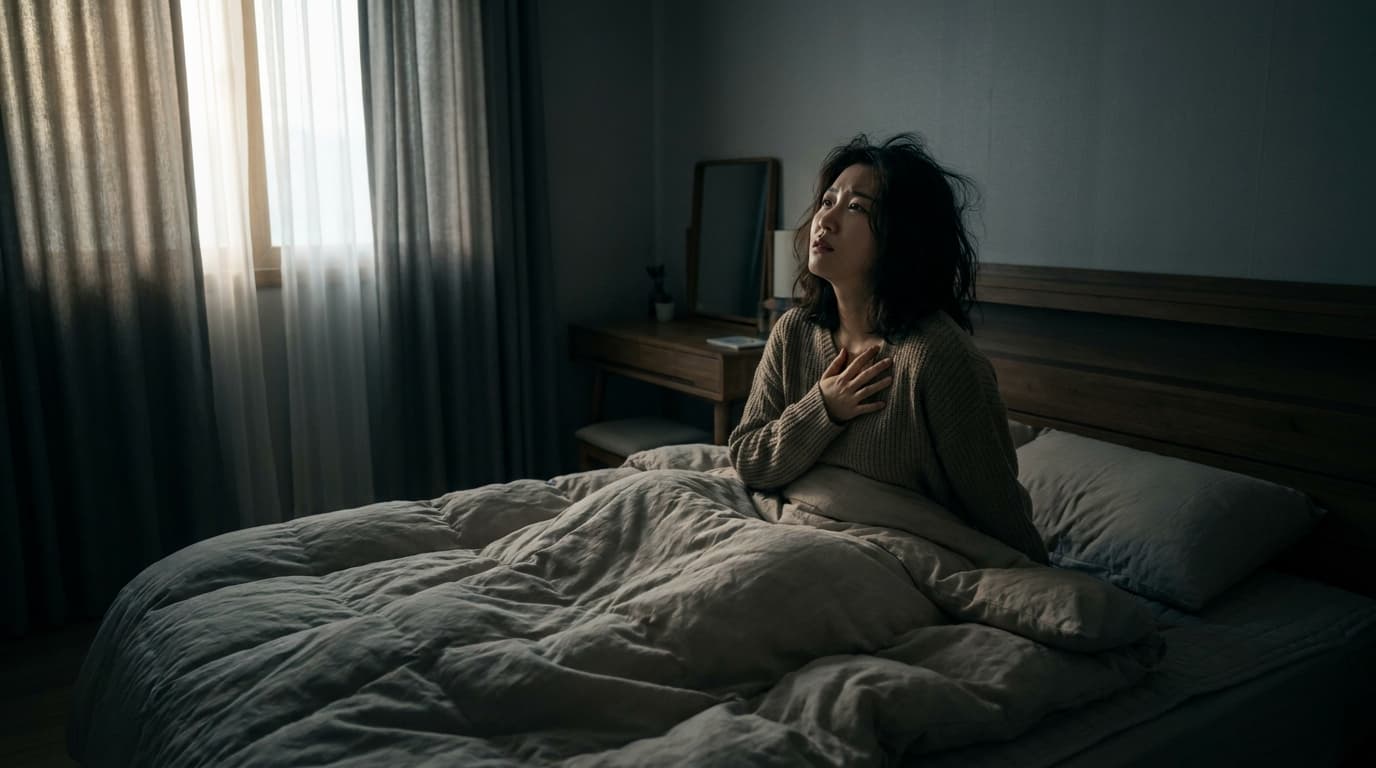
Have you ever experienced your heart suddenly pounding and anxiety washing over you as you comfortably settle into bed after a long day? Many people experience sleepless nights complaining that "my heart pounds when I lie down to sleep," even though they felt fine during the day. Worrying that "there might be something wrong with my heart," even after visiting a hospital and getting "normal" test results, can leave you feeling even more frustrated. These symptoms are not simply a sign of being overly sensitive; they are likely a warning signal sent by your autonomic nervous system, a crucial regulatory system in our body.
💡 [Key Answer] The 3 most common causes of "my heart pounds when I lie down to sleep": ① Autonomic imbalance (Sympathetic hyperactivity) / ② Stress and anxiety / ③ Failure of sleep entry mode transition Dalimchae Korean Medicine Clinic resolves the root cause through autonomic stability treatment, allowing the brain to rest sufficiently and the body to relax.
Why does my heart pound harder when I lie down to sleep?
During the day, sympathetic nerves act dominantly to support active movement and regulate heart rate. However, at night when we go to bed, our body should transition to a parasympathetic-dominant state (rest mode), where heart rate naturally decreases and relaxation occurs. When an imbalance occurs in the autonomic nervous system, this mode transition does not occur smoothly. Consequently, when external stimuli decrease while lying down, internal bodily sensations are amplified, making heartbeat sensations feel much more vivid.
At this point, the anxiety of "why is my heart beating like this?" further hyperactivates the sympathetic nervous system, starting a vicious cycle that increases heart rate even more. Even if there are no structural problems on cardiology tests, the discomfort and distress felt by the patient are real, resulting from an overactive autonomic system regulating the heart. Various factors such as stress, anxiety, caffeine intake, and irregular sleep habits can exacerbate this autonomic instability. In particular, many patients visiting our Incheon Insomnia Korean Medicine Clinic experience heart palpitations at night.
How does Korean medicine view autonomic imbalance and heart palpitations?
In Korean medicine, heart palpitations are referred to as 'simgye' (心悸) or 'jeongchung' (怔忡), viewing them as closely related to systemic imbalances such as psychological instability, deficiency of qi and blood, and stress, beyond just heart problems. In particular, the complaint of "my heart pounds when I lie down to sleep" often appears together with insomnia, heavily related to a state of excessive arousal in the brain and autonomic nervous system.
According to a clinical trend study on the efficacy and safety of Cheonwangbosimdan (Heavenly King's Heart Elixir) for insomnia published in Yaksa Gongron in 2026, Cheonwangbosimdan is a representative herbal formula used for heart yin deficiency and heart-kidney disharmony, known to alleviate insomnia, anxiety, and palpitation. Through a systematic review and meta-analysis of 14 randomized controlled trials (total 1,256 patients) targeting insomnia patients, the study explained that Cheonwangbosimdan generally showed favorable trends in improving clinical response rate and sleep quality (PSQI). Researchers concluded that Cheonwangbosimdan helps improve insomnia symptoms accompanied by heart palpitations through complex actions such as regulating nervous system hyper-excitation, stabilizing the central nervous system, stabilizing autonomic nerves, and reinforcing qi and blood.
Furthermore, a randomized controlled pilot study published in Integrative Medicine Research in 2019 by the Korea Institute of Oriental Medicine and other researchers compared an experimental group (n=20) taking herbal tea (HT002) for 4 weeks with a waiting group (n=20) in 40 patients with mild-to-moderate insomnia. As a result, the HT002 group showed a significant decrease in Insomnia Severity Index (ISI) scores by an average of 4.0 points at 4 weeks (p<0.05) and 4.8 points at 8 weeks (p<0.05) compared to pre-treatment, showing marked improvement over the waiting group (-0.4 points, -0.9 points). Significant improvements in sleep quality (PSQI) and quality of life (SF-12) scores were also confirmed. These results suggest that Korean medicine approaches can contribute to alleviating insomnia symptoms associated with heart palpitations and improving overall sleep and quality of life.
Warning light of an overheated brain: Relieve sleepless nights with 'Autonomic Stability'.
Symptoms such as "my heart pounds when I lie down to sleep" mean that autonomic imbalance has deepened, leaving the brain in a continuous state of arousal like an overheated engine that cannot rest. This phenomenon occurs when stress and tension accumulated during the day are not resolved at night and excessively activate the sympathetic nervous system. If this state persists, it can lead to various physical symptoms including chronic fatigue, headaches, dizziness, and indigestion alongside insomnia.
Dalimchae Korean Medicine Clinic in Incheon finds the root cause of these symptoms in autonomic stability. When the balance of autonomic nerves collapses, the brain cannot rest and sends abnormal signals like a car with a warning light on. We focus not simply on suppressing symptoms, but on lowering the heat in the nervous system and creating an environment where the brain can rest sufficiently—referred to in Korean medicine as Suseunghwagang (water rises, fire descends). Through this, we calm excessively hyperactive sympathetic nerves, activate parasympathetic functions, and help body and mind reach a true state of relaxation.
Through personalized herbal medicine prescriptions tailored to individual constitutions and symptoms, as well as various Korean medical therapies such as acupuncture, pharmacopuncture, moxibustion, and cupping, we help restore autonomic balance. Especially at Dalimchae Korean Medicine Clinic, widely sought after as an Incheon Autonomic Nervous System Korean Medicine Clinic, we identify objective states of the autonomic nervous system through heart rate variability (HRV) exams and establish customized treatment plans to help the body restore its self-healing power.
Could I also have insomnia due to autonomic imbalance? (Symptom Checklist)
Check how many of the following apply to you:
- When lying in bed, I feel my heart beating fast or pounding.
- It is difficult to fall asleep at night, or I wake up frequently, resulting in poor sleep quality.
- Anxiety or restlessness increases when lying quietly even if I felt fine during the day.
- I frequently feel tightness in my chest or difficulty breathing without a specific reason.
- I frequently feel excessive stress or tension and find it difficult to relieve.
- I always feel tired and lethargic, and notice poor concentration.
- Physical symptoms such as headaches, dizziness, and indigestion appear together.
Criteria:
- 3 or more apply: You may suspect autonomic imbalance-type insomnia. Consider complex Korean medicine treatment.
- 5 or more apply: Immediate expert diagnosis and treatment are required. We recommend visiting Dalimchae Korean Medicine Clinic Incheon Branch for an accurate consultation.
Frequently Asked Questions (FAQ)
Q. Can heart pounding when lying down to sleep heal naturally? A. If symptoms are due to temporary stress or fatigue, they may naturally improve through rest. However, if symptoms repeat or worsen, autonomic imbalance has likely become chronic, making expert help important.
Q. My heart keeps pounding even though heart tests show nothing abnormal. What should I do? A. Even if cardiac structures are fine, the autonomic nervous system regulating the heart may be reacting overly sensitively. At this time, treatment to restore autonomic balance is necessary. Our Incheon Autonomic Nervous System Korean Medicine Clinic deeply identifies root causes through autonomic function tests and provides custom treatments.
Q. How long does insomnia with heart pounding when lying down take to treat? A. Treatment duration varies depending on symptom severity, cause, and lifestyle habits. Typically, gradual symptom relief and improved sleep quality can be achieved through consistent treatment over several months. Active early treatment brings faster recovery.
Q. I have headaches and dizziness along with insomnia. Can they be treated together? A. Yes, absolutely. Insomnia accompanied by heart palpitations is closely related to autonomic imbalance, and headaches or dizziness also frequently stem from autonomic issues. Dalimchae Korean Medicine Clinic aims to simultaneously improve multiple symptoms through integrated Korean medicine treatments for autonomic stability.
Experiencing sleepless nights with "my heart pounds when I lie down to sleep" is not something to endure and resolve. You no longer need to ignore the bodily signals sent for so long. Approached in the right direction, the body responds faster than expected. Bring the symptoms you are experiencing as they are. Dalimchae Korean Medicine Clinic will find the cause together.
Where life blooms. Herbal medicine is Dalimchae Korean Medicine Clinic. Check symptoms similar to yours first through AI consultation on the Dalimchae Korean Medicine Clinic website!
Medical Supervision | Department of Neurology & Autonomic System, Incheon Branch of Dalimchae Korean Medicine Clinic, Korean Medicine Doctor Min Ji-hong (Insomnia Column)