
Hello. This is Dalimchae Korean Medicine Clinic.
Thought It Was Hives But It Is Purpura Confusing Skin Rashes Require Solving Root Causes
Have you ever been worried when red spots suddenly appeared on your skin and you thought they were hives, but they didn't disappear over time and instead turned dark red? Many people visit Dalimchae Korean Medicine Clinic saying, "I thought it was hives, but it's purpura." Hives and purpura may look similar on the surface, but they show significant differences in their causes, symptom patterns, and treatment approaches. Since it can be an important signal notifying an abnormality in our body's immune system rather than a simple skin problem, accurate understanding and fundamental treatment are important.
💡 Key Answer Top 3 most common causes of the question "I thought it was hives, but it's purpura": ① Vascular inflammation due to immune system imbalance ② Worsened gut health and toxin influx ③ Susceptibility to chronic inflammation due to constitutional factors Dalimchae Korean Medicine Clinic fundamentally regulates skin inflammatory responses by restoring body immune balance through constitutional improvement.
How do hives and purpura differ?
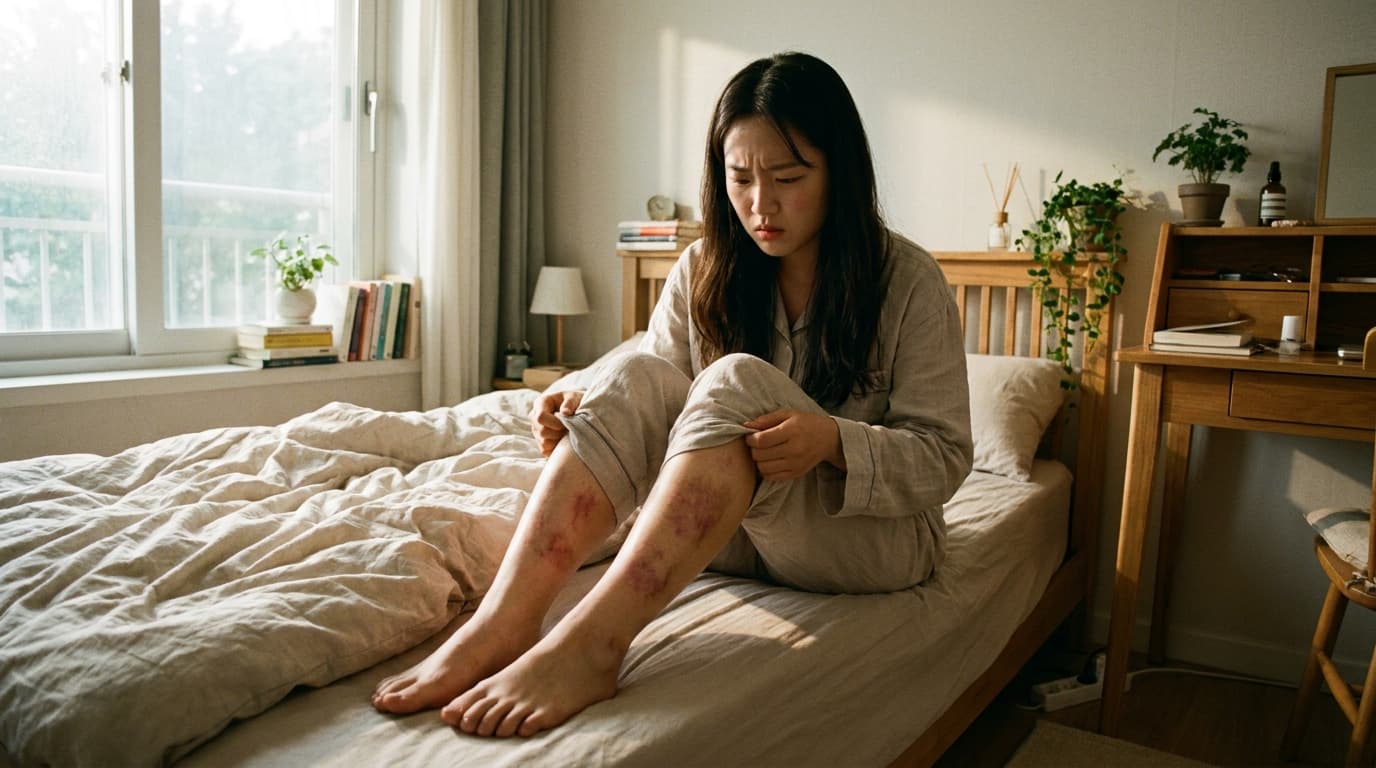
When red or dark red spots appear on the skin, many people first think of hives. However, hives and purpura are distinctly different conditions. Hives accompany wheals where the skin swells along with severe itching, and typically show mobility disappearing within hours and reappearing on other parts. On the other hand, purpura appears in the form of red or purple spots on the skin due to blood leaking from capillaries, and these spots do not disappear even when pressing the skin. In particular, they tend to turn brown or yellowish-brown over time.
Purpura can be largely divided into purpura due to platelet abnormalities and purpura due to blood vessel abnormalities, and allergic purpura (Henoch-Schönlein Purpura, HSP) mainly dealt with in Korean medicine belongs to the latter kind of vasculitis. This is often caused by abnormalities in systemic immune responses rather than simple skin problems. Therefore, while it may be accompanied by itching like hives, it often accompanies other organ symptoms such as joint pain, abdominal pain, vomiting, and hematuria, and has complication risks, making accurate diagnosis and treatment essential.
Why does purpura occur? Is it not a simple skin problem?
Although purpura looks like a symptom appearing simply on the skin surface, its root cause lies deep within our body's immune system and vascular health. In Korean medicine, purpura is viewed as 'blood heat (血熱)' or 'stasis blood (瘀血)', and is understood to occur when blood vessels are damaged due to abnormal internal blood circulation or excessive heat. From a modern medical perspective, purpura is also classified as a type of autoimmune disease where inflammation occurs on blood vessel walls mainly due to immune system disturbance.
When the immune system weakens or is disturbed, our body mistakenly attacks its own blood vessels as foreign substances even though they are not external invaders. Such autoimmune reactions induce inflammation in capillaries, and eventually blood leaks out of blood vessels and appears in the form of purpura. Major factors that induce or worsen purpura include the following:
- Upper respiratory infections such as colds: Especially in pediatric allergic purpura, it often develops after suffering from a cold, and antibiotics or fever reducers used at this time can affect immune system disturbance.
- Worsened gut health: Excessive increase in intestinal mucosal permeability allows external toxins to flow into the blood, which can induce overreaction of immune cells. This is pointed out as a common cause of various immune and digestive diseases such as atopic dermatitis and reflux esophagitis.
- Stress and overwork: Can contribute to the occurrence of purpura by causing decreased immunity and autonomic nervous system imbalance.
- Dietary habits: Research results show that recurrence rates are high when frequent meat or instant food intake occurs.
As such, purpura is not just a skin trouble, but an important warning signal sent by our body's immune system.
How does Korean medicine view and treat purpura?
Dalimchae Korean Medicine Clinic Incheon Branch focuses on fundamentally rebuilding the body's immune system and improving constitution beyond merely suppressing skin symptoms for purpura. While Western medicine quickly suppresses symptoms with steroids and antihistamines, this does not solve the root cause, leaving the possibility of recurrence. On the other hand, Korean medicine treatment may take some time, but aims to suppress recurrence and build the body's self-healing power.
A study by Dr. Han Dong-ha published in the Journal of Internal Korean Medicine in 2007 analyzed the effects of Korean medicine treatment on 106 allergic purpura patients. According to this study, 91.8% of patients under 18 years old who received herbal medicine treatment completely recovered, and the recurrence rate was only 4.5%. In the case of adult patients aged 19 and older, 69.7% also completely recovered. In particular, considering side effects appearing in steroid-treated patients (moon face, weight gain, increased appetite, acne, etc.) and high recurrence rates (recurrence rates are high with steroid use), it suggested that Korean medicine treatment can lower steroid dependency and significantly lower recurrence rates through immune stabilization effects (p<0.05).
In addition, 5 case reports by Dongkyung Korean Medicine Clinic research team published in the Journal of Korean Medicine in 2014 reported that administering only herbal medicine called 'Jarotang' to 5 Henoch-Schönlein purpura patients showing Yin deficiency symptoms improved symptoms in all patients. In particular, lower limb purpura and abdominal pain that were not controlled by steroids disappeared, and improved states were maintained without recurrence during the 6--month follow-up period, with no side effects observed. These researchers concluded that Jarotang can be effective in treating Yin deficiency-type purpura despite the limited number of cases. These data show that Korean medicine treatment can contribute not only to symptom improvement of purpura but also to recurrence prevention and immune system reinforcement. Based on these research results, Dalimchae Korean Medicine Clinic Incheon Branch aims to remove unnecessary body heat and enhance immunity through herbal medicine prescriptions tailored to each patient's constitution and symptoms.
What makes Dalimchae Korean Medicine Clinic Incheon Branch's purpura constitutional improvement treatment different?
At Dalimchae Korean Medicine Clinic Incheon Branch, purpura is approached as a problem caused by body immune system imbalance, not just a skin disease. We help the body generate healthy immune responses on its own through the treatment principle of constitutional improvement rather than turning off symptoms. The goal is to correct the malfunction of the immune system that overreacts to external stimuli or attacks itself, creating a body where skin inflammatory reactions do not turn back on.
To this end, we thoroughly analyze each patient's constitution and strengthen immunity and fortify blood vessel walls through customized herbal medicine prescriptions suited to their current body condition. Beyond simply calming inflammation, we resolve internal 'heat toxins' causing purpura and remove 'stasis blood' to improve blood circulation. In addition, we parallel pharmacopuncture and acupuncture treatments to alleviate pain and swelling of inflamed areas, restore overall bodily functions, and strengthen the body's defense barrier. In particular, Dalimchae Korean Medicine Clinic Incheon Branch steadily helps chronic purpura patients prevent recurrence and maintain healthy lifestyle habits. Just as multiple oriental medicine clinics in Busan and other regions emphasize immunity strengthening, our Incheon purpura clinic also focuses on immunity recovery for the fundamental resolution of purpura.
Could I also have purpura? Self-Checklist
If 3 or more of the following symptoms apply to you, suspect purpura and consult with Dalimchae Korean Medicine Clinic Incheon Branch.
- Red or purple spots appeared on the skin and do not disappear even when pressed.
- Spots mainly appear on lower parts like legs, feet, and buttocks, or spread throughout the body.
- Spots are initially red but change to brown or yellowish-brown over time.
- Joint pain (knees, ankles, etc.) appears along with spots.
- Digestive symptoms such as unexplained abdominal pain, vomiting, and diarrhea are accompanied.
- Spots started appearing after a cold or upper respiratory infection.
- Skin feels itchy or dry.
- Purpura keeps recurring even after steroid treatment.
When 3 or more apply: It is likely purpura, so we recommend consulting professional medical staff for an accurate diagnosis. When 5 or more apply: It is important to start treatment through immediate visitation.
FAQ: Frequently Asked Questions about Purpura
Q. Can purpura heal naturally? A. Some mild purpuras improve naturally, but most can recur frequently and become chronic if left untreated without care. Since there is a risk of complications such as joint pain, abdominal pain, and kidney involvement, receiving appropriate treatment early is important.
Q. Why does purpura recur frequently? A. If immune imbalance, the root cause of purpura, is not resolved, recurrence is easy. In particular, upper respiratory infections, stress, and wrong dietary habits can weaken immunity again and induce recurrence. Dalimchae Korean Medicine Clinic focuses on constitutional improvement treatment to prevent recurrence.
Q. How long does herbal medicine treatment take? A. Purpura treatment duration varies depending on the patient's symptom severity, duration of illness, and constitution. Generally, early purpura improves within 3 months, but chronic cases may require longer treatment periods. Steady treatment and lifestyle management are important.
Q. What tests are performed at Dalimchae Korean Medicine Clinic Incheon Branch? A. At Dalimchae Korean Medicine Clinic Incheon Branch, we analyze the patient's overall health condition and causes of purpura from multiple angles through autonomic balance tests, body composition tests, as well as Korean medicine diagnoses such as inquiry, pulse diagnosis, and abdominal diagnosis, to establish a customized treatment plan.
Purpura is not a problem that can be solved by enduring. You no longer have to ignore the body's signals sent for a long time. If you approach in the right direction, the body responds faster than you think. Bring the symptoms you are experiencing as they are. We will find the cause together at Dalimchae Korean Medicine Clinic.
Where life blooms. For herbal medicine, it's Dalimchae Korean Medicine Clinic. Check symptoms similar to yours through AI consultation on the Dalimchae Korean Medicine Clinic website first!
This article is health information compiled by Dalimchae medical staff based on questions frequently received in the treatment room. Medical Supervision | Skin Treatment Standards Dalimchae Korean Medicine Clinic Incheon Branch Korean Medicine Doctor Min Jihong (Purpura Column)