
Hello. This is Dalimchae Oriental Medical Clinic.
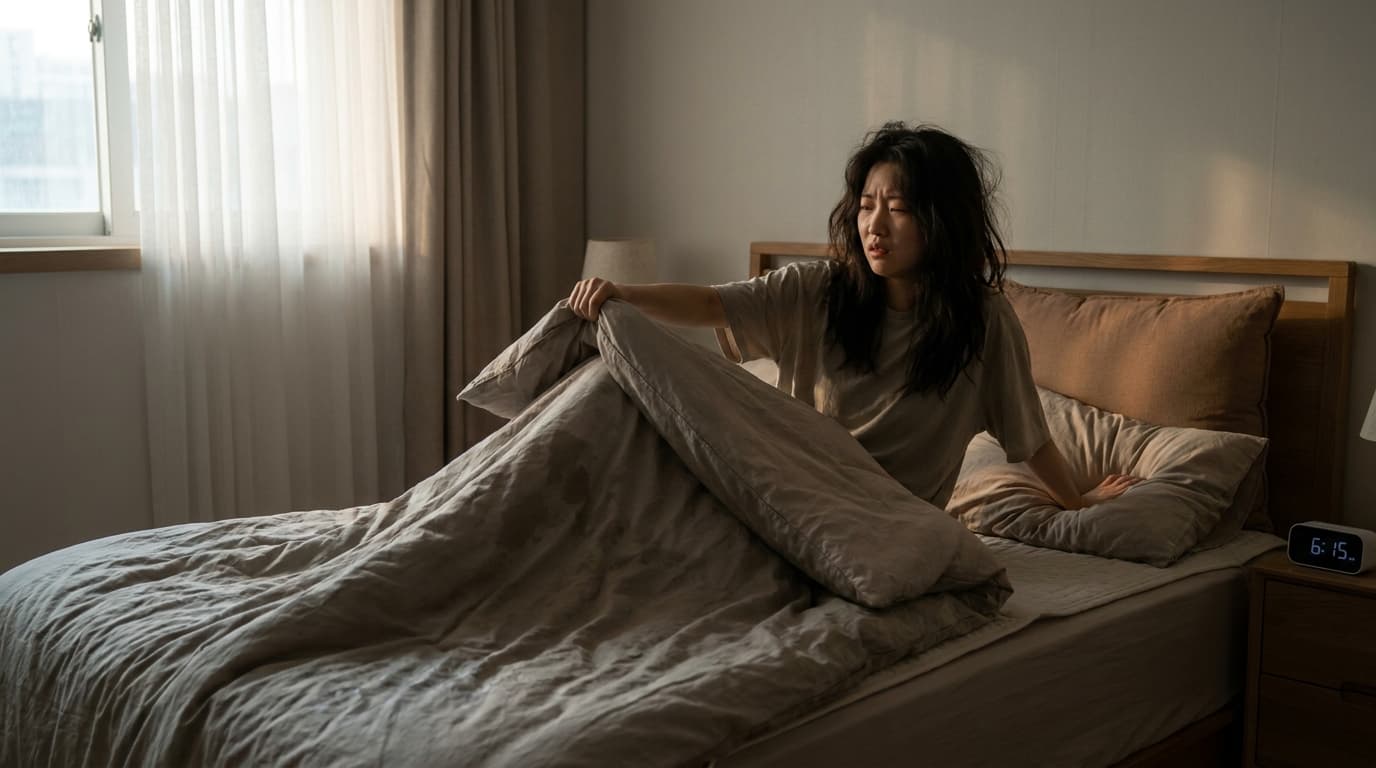
Sweat-soaked blankets after sleep: Is it a danger signal from your body?
If you wake up to find your blanket damp with sweat, it's easy to assume your sleeping environment is just too hot. However, if the night sweats persist even with the window open or the air conditioner on, it could be an important signal from your body. These night sweats reduce sleep quality, cause chronic fatigue, and significantly disrupt daily life. Neglecting it as a simple symptom can lead to bigger health issues, so it's important to understand the cause and try to solve it. Often, night sweats are caused by complex imbalances in the body rather than simple temperature.
💡 [Key Answer] The 3 most common reasons for "waking up with sweat-soaked blankets": ① Autonomic nervous system imbalance / ② Excessive internal body heat / ③ Stress and chronic fatigue Dalimchae Clinic helps restore the body's balance through autonomic nerve stabilization, regulating excessive sweating and helping you regain a healthy sleep environment.
Why do we sweat so much at night? Is it just the heat?
Night sweats, or nocturnal hyperhidrosis, can be caused by various factors. While external factors like a warm sleeping environment or thick blankets do have an effect, in many cases, it originates from internal imbalances. Especially when stress and chronic fatigue accumulate, the body's regulatory functions can become disrupted, leading to night sweats. If night sweats are severe, don't just see it as a matter of being a person who easily feels heat; listen to your body's internal signals.
Can autonomic imbalance cause night sweats?
Yes, that's correct. Our body's autonomic nervous system is responsible for essential life-sustaining functions such as temperature regulation, heart rate, digestion, and sleep, operating through a balance between the sympathetic and parasympathetic nerves. When this balance is disrupted by stress, irregular lifestyle habits, or overwork, the function of regulating sweat secretion can also be affected. In particular, if the sympathetic nervous system is excessively activated, the body remains in a state of tension even at night, which can lead to excessive sweating.
A study published in the journal 「Complementary Therapies in Medicine」 in 2011 evaluated the effect of Saam acupuncture on heart rate variability (HRV) in night-shift nurses. This study showed that Saam acupuncture significantly decreased sympathetic activity and increased parasympathetic activity. Specifically, after Saam acupuncture treatment, LF (Low Frequency), an indicator of sympathetic activity, decreased by an average of -17.4 in normalized units, and the LF/HF ratio, an indicator of sympathetic/parasympathetic balance, decreased by -1.691. Conversely, HF (High Frequency), an indicator of parasympathetic activity, increased by an average of 17.41 (including 95% confidence intervals). The researchers concluded that these results suggest Saam acupuncture can alleviate autonomic nervous system imbalances caused by night shift work. In this way, Dalimchae Clinic helps the body restore autonomic balance so it can regulate temperature and sweat secretion on its own.
In addition, another Korean study published in the journal 「Phytotherapy Research」 in 2004 investigated the effect of herbal medicine (Ondamtang-gamibang) on exam stress in medical students. In this randomized, placebo-controlled trial of 40 volunteers, the herbal medicine group showed significant decreases in systolic blood pressure and levels of norepinephrine and cortisol. The researchers stated that these results suggest herbal medicine can improve stress-related physiological variables by stabilizing the sympathetic nervous system. This shows that oriental medical treatment doesn't just stop at relieving symptoms but contributes to increasing the body's resilience through fundamental regulation of the autonomic nervous system. Based on this data, Dalimchae Clinic in Incheon approaches and treats autonomic imbalance symptoms like night sweats from various angles.
How does oriental medicine view sweating during sleep?
In oriental medicine, sweating at night is called 'Dohan' (stolen sweat), and it is seen as occurring when the body's Yin fluid (陰液) becomes deficient, causing the Yang energy (陽氣) to become relatively hyperactive. This can be interpreted similarly to the modern concept of autonomic imbalance. Yin fluid plays a role in calming and soothing the body, and when it's lacking, the body generates excessive heat, much like an engine overheating, and is unable to rest even at night, leading to the discharge of sweat.
Dalimchae Clinic focuses on cooling the body's overheated engine and stabilizing our body's autonomic nerves. When the balance of autonomic nerves is broken, the brain remains in a state of tension and cannot rest. In oriental medicine, this is sometimes explained as an imbalance of 'Suseunghwagang' (Water Rises, Fire Descends). A healthy state is when the head is cool and the lower abdomen is warm, but due to excessive stress and fatigue, heat rises and the lower part becomes cold. We correct these imbalances to create an environment where the brain can fully rest and induce harmonious circulation of Qi and blood throughout the body to normalize sweat gland regulation. In this process, many people seeking an Incheon night sweat clinic experience improvement in sleep quality along with overall health recovery.
Night sweats, check your condition like this!
If you're experiencing discomfort due to excessive sweating at night, check your condition through the checklist below and consider consulting with Dalimchae Clinic.
[Autonomic Night Sweats Checklist]
- It's hard to fall asleep, and I wake up often at night.
- I feel severe fatigue and lethargy during the day.
- I'm usually under a lot of stress and sensitive.
- I feel heart palpitations or anxiety even at small things.
- My hands and feet often feel cold or numb.
- I often suffer from headaches, dizziness, or indigestion.
- My mood swings are severe and I get irritated easily.
- I often feel dry mouth or thirst.
Judgment Criteria:
- 3 or more: Autonomic imbalance suspected -> Consultation with an expert and review of complex oriental medical treatment is recommended.
- 5 or more: Possibility of severe autonomic imbalance -> Immediate visit for precise diagnosis and treatment is strongly recommended. Dalimchae Clinic, an autonomic nerve clinic in Songdo, integrally diagnoses and treats these symptoms to restore the body's balance.
FAQ Section
Q. I sweat too much after waking up, is it a disease? A. Night sweats are not a specific disease themselves, but rather a symptom that can appear when there is an autonomic imbalance, stress, chronic fatigue, or when excessive heat has accumulated in the body. It is best to consult an expert to identify the exact cause.
Q. Can night sweats heal naturally? A. Temporary environmental changes or light stress can improve naturally, but if it occurs chronically or is accompanied by other symptoms (insomnia, fatigue, dizziness, etc.), it could be a sign that the body's balance is broken. In this case, it is important to actively seek treatment to resolve the root cause rather than neglecting it.
Q. Can Dalimchae Clinic Incheon also treat night sweats? A. Yes, Dalimchae Clinic Incheon diagnoses and treats night sweats from an oriental medical perspective, such as autonomic imbalance, internal body heat, and stress. We help improve symptoms and recover health through customized oriental treatments like herbal medicine, acupuncture, moxibustion, and pharmacopuncture according to individual constitution and symptoms.
Waking up with sweat-soaked blankets is not a problem that can be solved by just enduring it. You no longer have to ignore the signals your body has been sending for a long time. When approached in the right direction, the body responds faster than you think. Bring the symptoms you are experiencing as they are. Dalimchae Clinic will find the cause together.
Where life blossoms. For herbal medicine, it's Dalimchae Clinic. Check for symptoms similar to yours through the AI consultation on the Dalimchae Clinic homepage!
This health information was compiled by the Dalimchae medical staff based on questions frequently asked in the examination room. Medical Supervision | Dalimchae Clinic Incheon, Min Ji-hong, Oriental Medical Doctor (Hyperhidrosis Column)
#NightSweats #ColdSweat #AutonomicNerves #IncheonHyperhidrosisClinic #SongdoClinic #SweatDuringSleep #OrientalMedicineTreatment