
Hello. This is Dalimchae Korean Medicine Clinic.
Severe Menstrual Cramps, If Painkillers Don't Help, Listen to Your Body's Signals
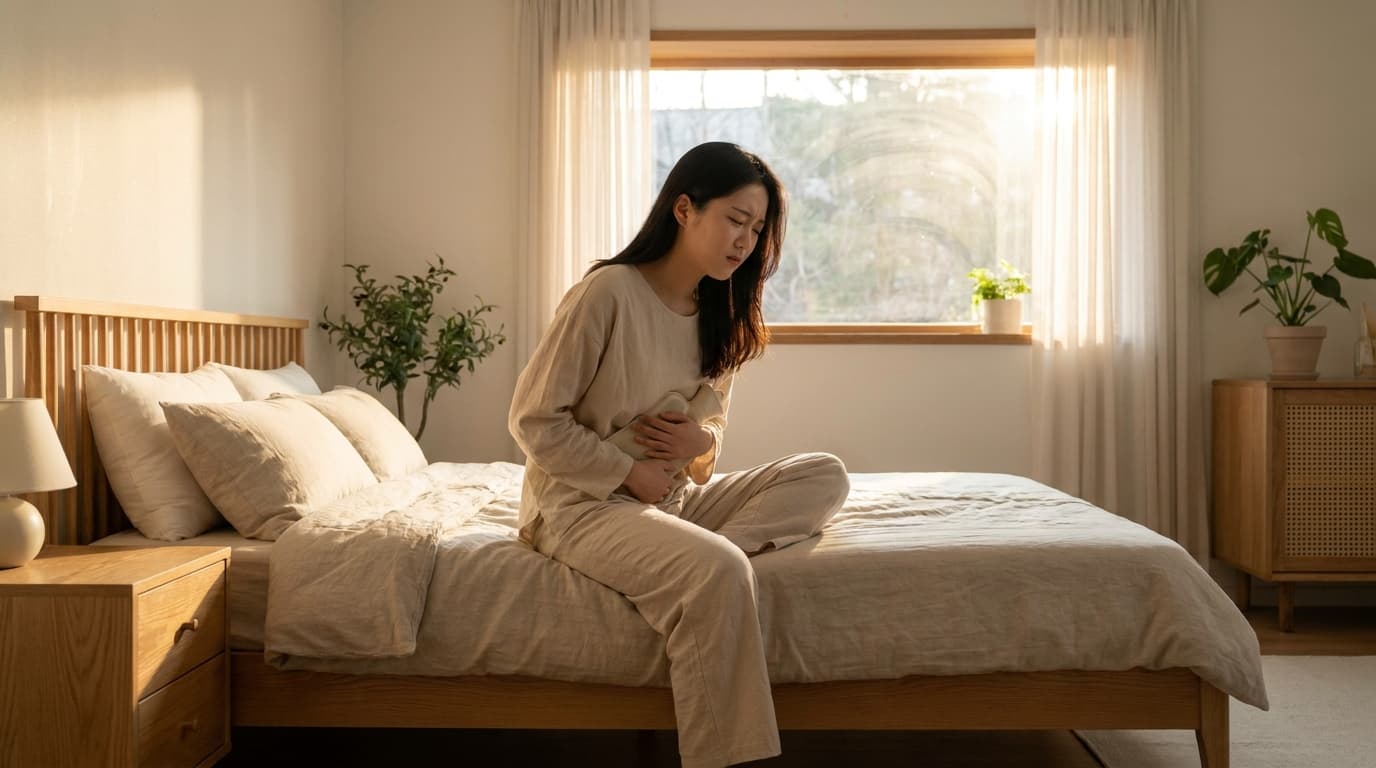
Every month without fail, many women find themselves clutching their abdomen and reaching for painkillers. Severe pain that makes "My menstrual cramps hurt so much" escape your lips disrupts daily life, and sometimes leaves you feeling helpless when painkillers don't work. Menstrual cramps, which can be more than simple discomfort and serve as a strong warning sign from your body—how long will you just endure them? Dalimchae Korean Medicine Clinic Songdo branch aims to help you regain comfortable, pain-free days by finding and resolving the root cause of menstrual cramps.
💡 Key Answer Top 3 most common causes of "My menstrual cramps hurt so much": ① Stagnation of uterine qi and blood (blood stasis) / ② Autonomic imbalance and stress / ③ Underlying conditions such as adenomyosis and endometriosis Dalimchae Korean Medicine Clinic restores a healthy uterine environment without recurrence by treating the root of symptoms through constitutional improvement.
Menstrual Cramps May Be a Red Flag, Not Just Simple Pain
Many women take menstrual cramps for granted or think taking a few painkillers is all they can do. However, complaining that "menstrual cramps hurt so much" that even painkillers don't work can be a warning sign that there is a serious problem with uterine health beyond simple pain. Primary dysmenorrhea is predominant among teenagers and women in their twenties, and a significant number rely on painkillers or endure the pain. Menstrual cramps can also be caused by conditions such as endometriosis, where endometrial tissue exists outside the uterus, or adenomyosis, where it penetrates the uterine muscle layer. These conditions can lead not only to severe menstrual cramps but also excessive menstrual bleeding, anemia, and even infertility, requiring special attention and active treatment.
How Does Korean Medicine View and Treat Menstrual Cramps?
In Korean medicine, menstrual cramps are not viewed merely as a uterine problem. They are interpreted as a combination of stagnant qi and blood circulation around the uterus (blood stasis), cold energy, and autonomic imbalance caused by stress. In other words, emphasis is placed on making the "root"—the uterus—and the entire "soil" surrounding it healthy.
A systematic review and meta-analysis published in 2020 in Explore: The Journal of Science and Healing compared the effects of herbal medicine (Modified Dahuang Shaoyao Decoction variant, MTST) and nonsteroidal anti-inflammatory drugs (NSAIDs) in 486 patients with primary dysmenorrhea. The results showed that the MTST group demonstrated significantly superior therapeutic efficacy compared to the NSAIDs group (risk ratio 1.53, 95% confidence interval 1.37-1.72), and particularly regarding recurrence rate reduction, the herbal medicine treatment group had a markedly lower recurrence rate than the NSAIDs group (risk ratio 0.31, 95% confidence interval 0.15-0.63, p=0.001). The researchers concluded that herbal medicine treatment may have a positive effect not only on relieving pain from menstrual cramps but also on preventing recurrence.
Furthermore, another systematic review and meta-analysis published in 2019 in Medicine (Baltimore) explored the effects of herbal medicine (Xuefu Zhuyu Decoction) treatment. This study analyzed data from 1048 patients across 8 randomized controlled trials. While NSAIDs caused a 20-25% failure rate and side effects, Xuefu Zhuyu Decoction monotherapy showed a better response rate than NSAIDs monotherapy (relative risk 1.26, 95% confidence interval [1.06, 1.49], p < 0.01). Herbal medicine treatment is gaining attention as an alternative to supplement the limitations of existing treatments for menstrual cramps.
Based on these data, the Songdo branch of Dalimchae Korean Medicine Clinic conducts constitutional improvement treatment that goes beyond simply calming pain to correct the imbalance between the uterine environment and systemic health causing menstrual cramps. The goal is not just turning off symptoms, but building a body where they don't turn back on. We reinforce the functions of the uterus and ovaries, remove waste products such as blood stasis and phlegm, and smooth blood circulation around the uterus.
If Painkillers Don't Help Menstrual Cramps, What State Is Your Body In?
If your menstrual cramps are severe, unresponsive to painkillers, or debilitating to daily life, you may suspect the following conditions. The Incheon Songdo women's Korean medicine clinic provides tailored treatment through meticulous diagnosis for these symptoms.
- Uterine Blood Stasis: In Korean medicine, blood stasis means blood circulation is stagnant and waste has accumulated. Accumulation of blood stasis in the uterus hinders menstrual blood discharge, causes pain, and can develop into conditions like endometriosis or adenomyosis.
- Autonomic Imbalance: Excessive stress and irregular lifestyle habits disrupt autonomic balance, affecting hormone regulation and causing excessive uterine muscle contraction, further worsening menstrual cramps.
- Body Coldness: Women with cold lower abdomens or hands and feet tend to experience worse menstrual cramps due to poor blood circulation around the uterus.
'Menstrual Cramps Self-Checklist' Provided by Songdo Menstrual Cramps Korean Medicine Clinic
If 3 or more of the following items apply to you, the "menstrual cramps hurt so much" you are experiencing may be a signal requiring active treatment beyond simple dysmenorrhea.
- Pain starts again within 2 hours even after taking painkillers.
- Daily life (school, work) is disrupted due to menstrual cramps.
- Diarrhea, vomiting, headaches, or dizziness frequently accompany menstrual cramps.
- Menstrual bleeding suddenly becomes heavy or blood clots frequently appear.
- Lower abdomen is always cold and hands and feet are chilly.
- Pain or discomfort is felt in the lower abdomen even when not menstruating.
- Usually experience high stress or sensitivity.
- Menstrual cramps newly developed or worsened after childbirth.
Criteria:
- If 3-4 apply: Suspect 'secondary dysmenorrhea' or 'constitutional imbalance' -> Review complex Korean medicine treatment through Songdo Korean medicine clinic consultation.
- If 5 or more apply: Immediate Korean medical diagnosis and active treatment planning recommended.
Dalimchae Korean Medicine Clinic Songdo Branch's 'Constitutional Improvement' Menstrual Cramps Treatment
Dalimchae Korean Medicine Clinic solves the root cause of menstrual cramps through constitutional improvement, creating a healthy body that doesn't hurt again. This goes beyond simply suppressing symptoms; it is a treatment that nurtures the uterus's self-healing power.
- Individualized Herbal Prescription: Prescribes herbal medicine to clear blood stasis and improve blood circulation, strengthen uterine and ovarian functions, remove body coldness, and restore autonomic balance. Carefully selects herbs according to each patient's constitution and symptoms.
- Acupuncture and Moxibustion Treatment: Stimulates acupoints around the uterus to promote qi and blood circulation and relieve pain. Moxibustion especially warms the lower abdomen, improving coldness and activating uterine function.
- Pharmacopuncture Treatment: Injecting pure herbal extracts directly into acupoints to induce rapid and effective anti-inflammatory and pain-reducing responses.
These integrated Korean medical treatments can be safely applied even when experiencing severe menstrual cramps due to endometriosis or adenomyosis where surgery or drug treatment is difficult.
FAQ Section: Answering Your Questions About Menstrual Cramps
Q. Even when taking painkillers, it hurts. Are there other solutions? A. Menstrual cramps unresponsive to painkillers may have root causes such as uterine blood stasis, endometriosis, or adenomyosis. Korean medical treatment helps reduce pain and restore health by improving these root causes.
Q. Can adenomyosis or endometriosis be treated with Korean medicine? A. Yes, it is possible. Korean medicine views adenomyosis and endometriosis as caused by 'blood stasis' and uses blood stasis removal herbal medicine, acupuncture, and moxibustion to reduce lesion size, alleviate symptoms, and prevent recurrence. It is an effective alternative especially when preparing for pregnancy or when surgery/drug treatment is difficult.
Q. How long does menstrual treatment take? A. Treatment duration varies depending on individual constitution, the cause of menstrual cramps, and severity. Generally, mild cramps require 3 months, and severe cramps or underlying conditions may require 3 to 6 months of steady treatment.
Q. I am worried about pregnancy because my menstrual cramps are so severe. Does Korean medicine treatment help? A. Severe menstrual cramps can be linked to infertility. Korean medicine treatment can help improve the uterine environment and reinforce ovarian function to increase pregnancy potential. Many visiting Songdo infertility Korean medicine clinics improve overall women's health through menstrual cramp treatment.
Menstrual cramps are not problems solved by endurance. You no longer need to ignore the body signals sent for a long time. Approaching in the right direction makes the body react faster than expected. Bring the symptoms you are experiencing as they are. Dalimchae Korean Medicine Clinic will find the cause together.
Where life blooms. Herbal medicine is Dalimchae Korean Medicine Clinic. Check symptoms similar to yours first through the AI consultation on the Dalimchae Korean Medicine Clinic website!
Medical Supervision | Women & Pregnancy Treatment Standards, Songdo Branch of Dalimchae Korean Medicine Clinic, Korean Medicine Doctor Oh Hyun-min