
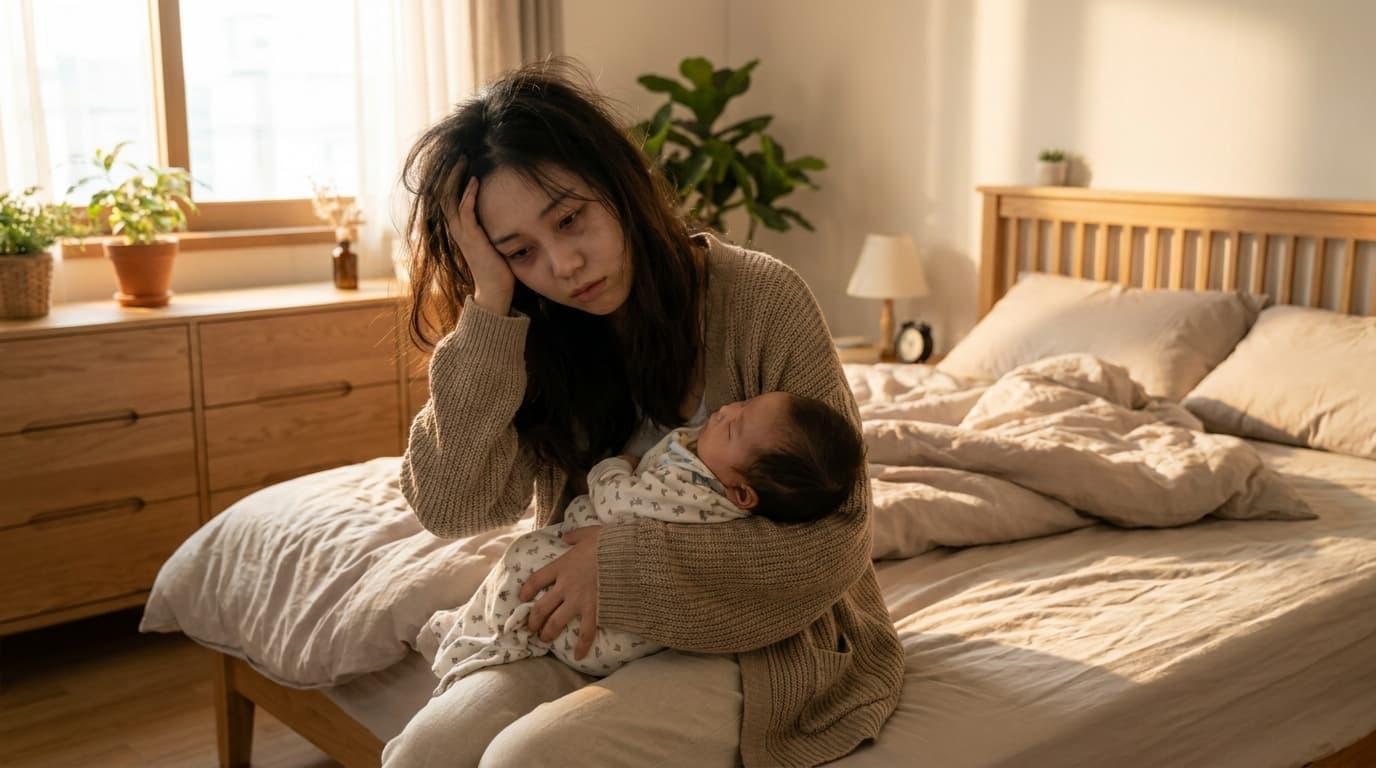
Postpartum recovery is too slow, is it because of advanced maternal age?
The joy of welcoming a new life is brief, as deep fatigue and physical pain after childbirth make many mothers suffer. Especially when the worry of 'advanced maternal age' is added, it's easy to feel psychological pressure along with self-blame like "Is my recovery slow because I'm old?" If your body still aches despite sufficient rest, your energy is depleted, and your mind keeps sinking, you should suspect causes beyond simple fatigue. Your body is clearly sending signals of recovery, but Dalimchae Korean Medicine Clinic will look together to see if you are missing those sounds.
💡 [Key Answer] 3 most common causes of "postpartum recovery is too slow": ① Serious depletion of Qi and blood (氣血) due to childbirth / ② Stagnation of blood stasis (瘀血) in the uterus / ③ Decreased organ function and immunity weakened by advanced maternal age Dalimchae Clinic resolves symptoms fundamentally with constitutional improvement treatment and helps regain a healthy body.
My recovery after childbirth is particularly slow, is it because of advanced maternal age?
Childbirth is a process that has a profound impact on a woman's body, and in particular, as you get older, it may take more time and effort to recover. In Korean medicine, childbirth is explained as a 'process where Qi and blood are greatly consumed,' and if sufficient recovery is not achieved at this time, various postpartum symptoms can appear. Especially in the case of advanced maternal age, postpartum recovery can be slow due to the following reasons compared to younger mothers.
First, Qi and blood are excessively consumed during the childbirth process. Bleeding during delivery and the process of pouring physical strength for a long time make the mother's body extremely weak. If supplementation is not properly achieved at this time, it is easy to lead to general fatigue, lethargy, and decreased immunity. Second, blood stasis (瘀血) in the uterus can stagnate and hinder circulation. After childbirth, the uterus contracts and discharges lochia to return to its original state, but if this process is not smooth, it causes lower abdominal pain, swelling, or coldness, making recovery slow. Third, advanced maternal age can be accompanied by overall weakening of organ functions and decreased immunity. In the case of mothers aged 35 or older, i.e., advanced age mothers, physical functions are often already decreased compared to younger mothers, so it can take more time to recover from the impact of childbirth. This increases the possibility of leading to various problems such as postpartum wind (San-hu-pung) or postpartum depression.
Why is Korean medicine management important for postpartum recovery?
Postpartum recovery is more than just returning to the body before childbirth; it is an important turning point for a healthy life ahead. Korean medicine focuses on reinforcing the mother's body and preventing and treating various symptoms that can occur after childbirth. Even if there are no special abnormalities in modern medical tests, if the body continues to ache or it is psychologically difficult, it is necessary to find and resolve the cause from a Korean medicine perspective. Korean medicine focuses on pulling up the mother's own recovery power by restoring the body's balance through improvement of Qi and blood circulation, removal of blood stasis, and strengthening of weakened organ functions.
In a study by Oh Seong-yun's research team published in the 「Journal of Pharmacopuncture」 in 2023, a survey was conducted on satisfaction and perception of effectiveness of taking postpartum herbal medicine. In this study conducted on a total of 68 mothers, 76.47% of respondents were satisfied with taking herbal medicine, and in particular, more than 50% of mothers reported perceiving improvement effects in symptoms such as postpartum wind, weight gain, and delayed lochia discharge. This shows that mothers are greatly feeling subjective symptom improvement through Korean medicine treatment. In addition, in a qualitative study by Dr. Seo Ju-hee's research team published in the 「International Journal of Environmental Research and Public Health」 in 2022, mothers' experiences that Korean medicine treatment helps in managing postpartum wind symptoms and providing psychological stability were confirmed. These research results suggest that many mothers looking for Incheon postpartum clinics can receive practical help in physical and mental recovery through Korean medicine treatment.
What happens if postpartum wind is left alone?
Postpartum wind (San-hu-pung) is a Korean medicine concept that collectively refers to various symptoms such as pain, coldness, fatigue, numbness, and tingling that appear after childbirth. It doesn't just pass by like a body ache; if not treated in time, it can become fixed as chronic pain or develop into other related diseases such as dizziness, insomnia, and postpartum depression. For example, continuous joint pain can go beyond the discomfort of daily life and interfere greatly with childcare, and chronic fatigue can cause loss of vitality and deepen depression. Especially for advanced age mothers, recovery power is slow, so symptoms can become more severe and last longer, so active response from the beginning is important.
In the 2010 study "Development and Application of Korean Medicine Standard Clinical Pathway for Postpartum Wind" by Hwang Su-in's research team, as a result of applying Korean medicine treatment for 4 weeks to 30 postpartum wind patients, statistically significant symptom improvement was shown in local muscle pain (neck), local joint pain (fingers, wrist, shoulder, waist, pelvis, knee, ankle), general coldness, local coldness (knee), fatigue, sweating, and dizziness compared to the initial diagnosis (p<0.05). In addition, significant improvement was also confirmed in the Edinburgh Postpartum Depression Scale (EPDS) score and the anxiety/depression domain score of the quality of life index (EQ-5D-3L). As such, postpartum wind affects not only physical symptoms but also emotional parts, so professional treatment is absolutely necessary for the mother's quality of life. Dalimchae Clinic Incheon Branch identifies these various symptoms of postpartum wind and helps improve symptoms through customized treatment suitable for the mother's body condition.
How does Dalimchae Clinic's constitutional improvement help postpartum recovery?
Dalimchae Clinic applies the principle of 'constitutional improvement' treatment to fundamentally recover the body weakened after childbirth. Constitutional improvement is not simply about temporarily relieving the symptoms in front of you, but aims to create a body where symptoms do not turn on again, rather than just turning off the symptoms. This is a process of strengthening immunity and self-healing power by closely diagnosing the mother's natural constitution and current body condition and providing optimized treatment for the individual.
Specifically, Dalimchae Clinic's constitutional improvement treatment proceeds in the following directions.
-
Qi and Blood Supplementation and Removal of Blood Stasis: Supplement energy and blood consumed during childbirth, and discharge remaining blood stasis in the uterus to smooth blood circulation. This helps the mother's fatigue recovery and promotes normal recovery of the uterus. In a study by Kim Seong-ha's research team published in 「PMC」 in 2025, the safety of taking herbal medicine was evaluated for 186 mothers, and although mothers aged 35 or older accounted for 54.8%, the incidence of serious side effects due to taking herbal medicine was very low (2.2% minor gastrointestinal symptoms), showing that herbal medicine can be used safely for postpartum recovery.
-
Strengthening Organ Function and Increasing Immunity: Recover weakened functions of the five organs and six viscera, and pull up overall immunity to create a body that can resist external cold energy or stress. This is even more important for advanced age mothers, and contributes to preventing postpartum wind and improving chronic fatigue.
-
Autonomic Nervous System Stabilization: Stress from childbirth and childcare can cause autonomic nervous system imbalance, leading to insomnia, anxiety, and depression. Constitutional improvement treatment restores the balance of the autonomic nervous system to find psychological stability, get deep sleep, and help emotional recovery.
This constitutional improvement approach is Dalimchae Clinic's core treatment philosophy that helps the mother's body return to a healthy and vibrant state from the pain of childbirth. If you are worried about postpartum recovery in Incheon, you can regain your life as a healthy mother through fundamental constitutional improvement with Dalimchae Clinic Incheon Branch.
Mothers who are losing themselves while focusing on their children, could I also have postpartum wind?
Look at the following items and if 3 or more apply, suspect postpartum wind and consider professional treatment at Dalimchae Clinic.
[Postpartum Wind Self-Diagnosis Checklist]
- Q. After childbirth, every joint such as wrists, knees, and waist aches or feels sore.
- Q. The body feels more chilly and painful when exposed to cold water or cold wind.
- Q. The whole body feels heavy and I have no energy, so I'm tired all day.
- Q. Even if I sleep, it's not refreshing and I suffer from insomnia.
- Q. I keep crying and feel depressed for no particular reason.
- Q. Digestion is not good and I have no appetite, or conversely, I binge eat.
- Q. My head aches or I feel dizzy and hear a ringing sound in my ears.
- Q. Night sweats occur frequently, or the body swells and skin troubles occur.
[Judgment Criteria]
- 3 or more items apply: Suspected postpartum wind → Review integrated Korean medicine treatment
- 5 or more items apply: Immediate professional treatment is recommended → Visit Dalimchae Clinic Incheon Branch for precise diagnosis
Q. How long does postpartum recovery for advanced maternal age take? A. Individual differences are large, but for advanced age, Qi and blood consumption is greater and organ function is weaker, so the recovery period can be longer. Generally, steady management for at least 3 months to 1 year or more is required, and Dalimchae Clinic increases the recovery speed with customized treatment suitable for the constitution.
Q. Can postpartum wind also be treated with Korean medicine? A. Yes, postpartum wind is a representative disease that has been researched and treated for a long time in Korean medicine. Through complex treatments such as Qi and blood supplementation, removal of blood stasis, immunity enhancement, and autonomic nervous system stabilization, various postpartum wind symptoms such as joint pain, coldness, fatigue, and depression can be effectively improved.
Q. When should I start postpartum care after childbirth? A. It is recommended to start postpartum care from about 2-3 weeks after childbirth, considering the mother's recovery state. Especially in the beginning, treatment that helps uterine recovery and blood stasis discharge is important, and then leads to general energy reinforcement and constitutional improvement treatment. We recommend that you receive a consultation at Dalimchae Clinic as soon as possible.
Q. I'm not losing weight after childbirth, is this also part of postpartum care? A. Weight gain after childbirth is a common phenomenon and should be managed through appropriate postpartum care. In Korean medicine, we help healthy weight loss through improvement of Qi and blood circulation and regulation of organ functions, and restore overall body functions so that weight management occurs naturally.
Postpartum recovery is not a problem solved by just enduring. You no longer have to ignore the signals your body has been sending for a long time. If you approach in the right direction, the body responds faster than you think. Bring your symptoms exactly as they are. At Dalimchae Clinic, we will find the cause together.
Where life blooms. For herbal medicine, it's Dalimchae Korean Medicine Clinic. Check your symptoms similar to mine through the AI consultation on the Dalimchae Clinic website first!
This article is health information compiled by Dalimchae medical staff based on questions frequently received in the treatment room. Medical Supervision | Women and Pregnancy Treatment Standards Dalimchae Clinic Incheon Branch Korean Medicine Doctor Yang Yuchan (Postpartum Care Column)