
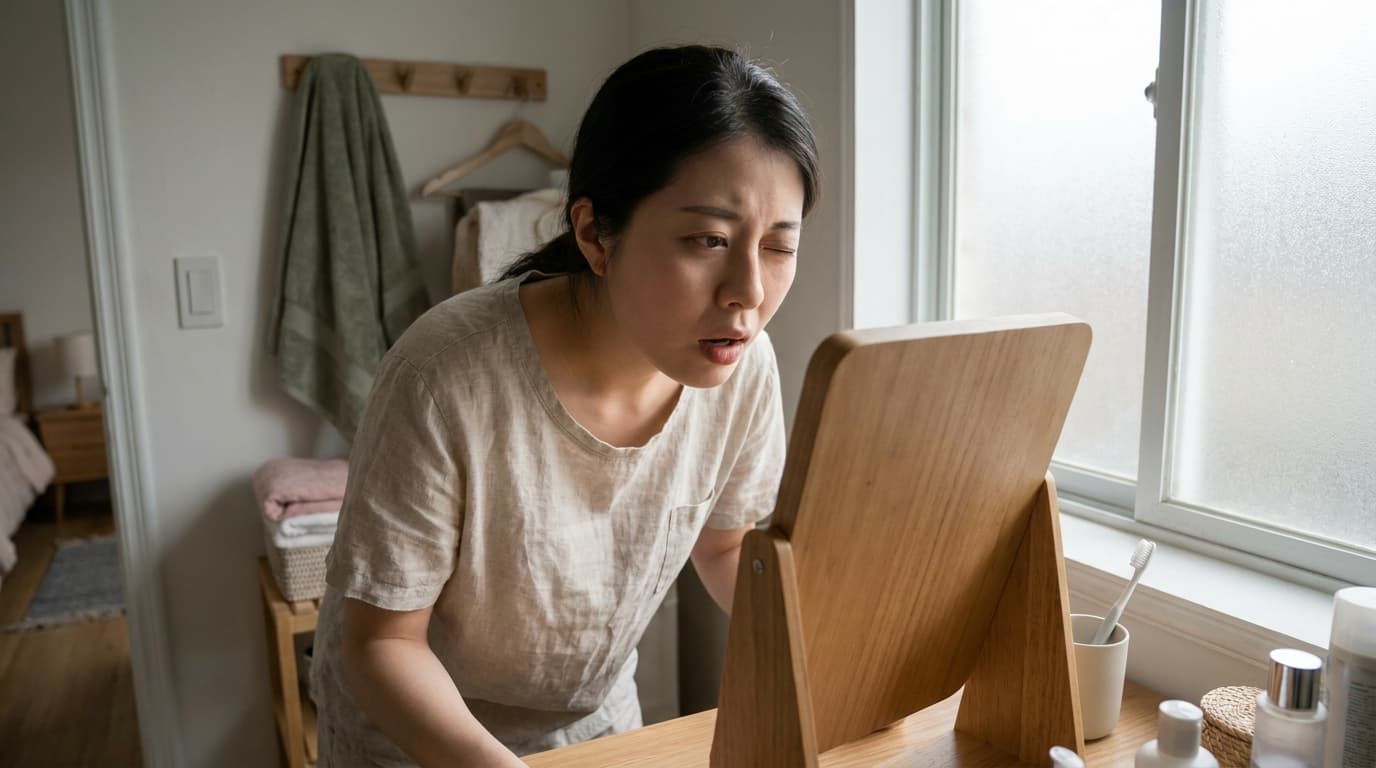
Hello. This is Dalimchae Oriental Medical Clinic.
One eye won't close? Facial paralysis came suddenly, early response is important.
Have you ever experienced a situation where one eye doesn't close completely while trying to wash your face in the morning, or water keeps leaking out while eating, and your face becomes crooked whenever you laugh? The symptom of one eye not closing that comes on suddenly may not be a simple temporary phenomenon due to fatigue. It is highly likely to be an early signal of facial nerve paralysis, commonly known as 'Guanwasa' or 'Bell's palsy'. Many people are at a loss after visiting a hospital and hearing words like "the cause is unknown" or "it's because of stress." However, for facial paralysis, taking appropriate action in the early stages of onset has a decisive impact on recovering without aftereffects.
💡 [Key Answer] 3 most common causes of the symptom of one eye not closing (facial paralysis): ① Decreased immunity due to extreme stress and overwork ② Viral infection (herpes zoster virus, etc.) ③ Decreased facial nerve function due to autonomic nervous system imbalance Dalimchae Clinic calms the inflammation of the facial nerve and promotes the recovery of damaged nerves through autonomic stabilization treatment.
Why does one eye suddenly not close? Causes and mechanisms of facial paralysis
Q. Why does facial paralysis come on suddenly, and by what principle does one eye not close?
A. Facial paralysis occurs when a problem arises in the 7th cranial nerve, the facial nerve, which moves the facial muscles. The facial nerve comes out of the brain and is involved in facial expression muscles, tear glands, salivary glands, and the sense of taste. When inflammation or damage occurs in this nerve, the movement of one side of the face controlled by that nerve becomes paralyzed. In particular, the reason one eye doesn't close is that the facial nerve is connected to the muscles that move the eyelids.
One of the most common causes of such facial nerve damage is viral infection. In particular, herpes simplex virus or herpes zoster virus takes advantage of a weakened immune system, stays latent in the facial ganglia, and then becomes activated, causing inflammation in the nerve. In addition, when the balance of the autonomic nervous system is disrupted due to extreme stress, overwork, or lack of sleep, our body's immunity decreases and blood circulation is not smooth, making the nerve recovery power drop, which can easily lead to facial paralysis. This autonomic nervous system imbalance can decrease blood flow to the facial nerve and exacerbate the inflammatory response, further deteriorating nerve function.
Facial paralysis, why early treatment is important and the effect of Oriental medicine treatment
Q. Can facial paralysis heal naturally over time? Why is early treatment so important?
A. In the case of facial paralysis, especially Bell's palsy, it is known that about 70% recover naturally. However, the remaining 30% may recover incompletely or leave severe aftereffects. The reason early treatment is important is that the degree of damage to the facial nerve and the possibility of recovery tend to be determined within 72 hours after onset. If this period is missed, serious aftereffects such as facial asymmetry, eyelid drooping, crooked mouth corners, and even synkinesis (e.g., mouth corners moving together when closing the eyes) can remain. Therefore, seeking an Incheon facial paralysis clinic to start early diagnosis and appropriate treatment is the best way to minimize aftereffects and help complete recovery.
In Oriental medicine, facial paralysis is viewed as a 'Qi and blood circulation disorder' caused by decreased immunity and confusion in the autonomic nervous system. Treatment is conducted focusing on improving Qi and blood circulation around the facial nerve and regenerating damaged nerves. This can create even more synergy when combined with Western medical treatment.
A study by Lin et al. published in the 『Journal of Traditional Chinese Medicine』 in 2021 confirmed the effect of Oriental medicine treatment on 120 patients with Bell's palsy. The research team divided the patients into two groups, one group received electroacupuncture treatment and herbal medicine prescriptions, and the other group received only Western medical treatment. After 4 weeks of treatment, the group that combined electroacupuncture and herbal medicine prescriptions showed a significantly higher facial nerve function recovery rate compared to the group that received only Western medical treatment (Effective rate of treatment group 93.3% vs. effective rate of control group 76.7%, p < 0.01). The researchers concluded that these results indicate that Oriental medicine treatment helps recovery by reducing inflammation of the facial nerve and promoting regeneration.
Also, according to a systematic literature review and meta-analysis study by Lu et al. published in 『Medicine (Baltimore)』 in 2018, acupuncture treatment for facial nerve paralysis showed a significantly higher effective rate especially when combined with existing Western medical treatment, and concluded that it was also effective in lowering the incidence of aftereffects. This suggests that acupuncture treatment can help improve blood circulation around the facial nerve and alleviate inflammation of the nerve.
Based on these research data, Dalimchae Clinic Incheon Branch performs acupuncture and pharmacopuncture treatments effective for inflammation relief and nerve regeneration during facial paralysis treatment, and helps the rapid recovery of the facial nerve by strengthening systemic immunity and promoting autonomic stabilization through individual customized herbal medicine prescriptions.
Autonomic stabilization: The key to facial paralysis treatment
Q. How does the balance of autonomic nerves affect facial paralysis recovery?
A. Facial paralysis is not just a muscle problem, it is closely related to overall nervous system problems. In particular, the autonomic nervous system regulates all involuntary functions of our body and is deeply involved in immunity and stress response. When the balance of the autonomic nervous system is broken, our body maintains a state of tension like an overheated engine without being able to rest. In such a state, blood circulation is hindered, and even if inflammation occurs around the facial nerve, recovery proceeds slowly. Excessive tension in the nervous system interferes with the environment in which the facial nerve can recover itself and increases the risk of aftereffects.
At Dalimchae Clinic, the core of facial paralysis treatment is autonomic stabilization. This is not simply suppressing symptoms, but a treatment that corrects the imbalance of the nervous system and creates an optimal environment for the facial nerve to recover itself. In Oriental medicine, creating an environment where the heat of the nervous system is lowered and the brain can rest is expressed as 'Suseunghwagang (水昇火降)'. In other words, making the head cool and the lower abdomen warm to smooth the overall Qi and blood circulation, and through this, stabilizing the autonomic nervous system tensed by stress to strengthen immunity and promote regeneration of the facial nerve.
This approach also helps to improve other autonomic-related symptoms such as headache, dizziness, and sleep disorders that may accompany facial paralysis. As an Incheon autonomic nerve clinic, Dalimchae Clinic proceeds with treatment with the goal of overall health recovery of patients.
What type of facial paralysis do I have? Symptom checklist
Are you experiencing any of the following symptoms? Check your current status through the items below.
[Facial Paralysis Self-Diagnosis Checklist]
- When I wake up in the morning, my face feels swollen or stiff.
- When I look in the mirror, one corner of my mouth goes down, or my eye doesn't close properly.
- When drinking water or brushing my teeth, water leaks out from one side.
- There is discomfort when chewing food, or the sense of tasting has become dull.
- Even when I try to wrinkle my forehead, only one side doesn't move.
- Pain is felt around the back of the ear or the temporomandibular joint.
- My ears react hypersensitively to even small sounds as if they are ringing.
- Tears do not come out, or conversely, tears keep flowing from one eye.
- I have suffered from extreme stress or overwork more than usual.
- I have body aches like a cold, or herpes blisters have appeared.
[Diagnosis Result]
- If 3 or more apply: You can suspect early symptoms of facial nerve paralysis. Check for정밀 diagnosis and Oriental medicine combined treatment at an Incheon facial nerve paralysis clinic.
- If 5 or more apply: It is important to visit a medical institution immediately and start professional diagnosis and treatment.
FAQ
Q. How long does it take to recover when facial paralysis comes?
A. The recovery period for facial paralysis varies greatly depending on the severity of the individual's symptoms, whether early action was taken, and immune status. Usually, a recovery period of 3 weeks to 6 months is expected, but if you start treatment within the first 1-2 weeks, you are more likely to recover faster.
Q. Can facial paralysis also be treated with Oriental medicine?
A. Yes, Oriental medical treatment is very effective for recovery from facial paralysis. Acupuncture, pharmacopuncture, and herbal medicine reduce inflammation of the damaged facial nerve, promote regeneration, and help prevent recurrence by restoring systemic immunity and autonomic balance.
Q. What are the aftereffects of facial paralysis?
A. Facial paralysis aftereffects include facial asymmetry, eyelid drooping, crooked mouth corners, synkinesis (e.g., mouth corners moving together when closing eyes), and contracture (hardening of facial muscles). If early treatment is insufficient, the risk of such aftereffects increases.
Q. I have facial paralysis and a headache together, can they be treated together?
A. Yes, facial paralysis and headaches are deeply related to autonomic nervous system imbalance and stress. Dalimchae Clinic can help improve both facial paralysis and headache simultaneously through treatment that stabilizes autonomic nerves and strengthens systemic immunity.
The symptom of facial paralysis, such as one eye not closing, is not a problem that can be solved by enduring. You no longer have to ignore the body's signals that have been sent for a long time. If you approach in the right direction, your body reacts faster than you think. Bring your symptoms exactly as they are. Dalimchae Clinic will find the cause together.
Where life blooms. For herbal medicine, it's Dalimchae Clinic.
Check your symptoms similar to mine through the AI consultation on the Dalimchae Clinic website first!
This article is health information compiled by Dalimchae medical staff based on questions actually received in the treatment room.
Medical Supervision | Brain and Autonomic Nerve Treatment Standards Dalimchae Clinic Incheon Branch Korean Medicine Doctor Yang Yuchan (Facial Paralysis Column)