
Hello. This is Dalimchae Korean Medicine Clinic.
Missing Periods for Months: Is it a Sign of 'Premature Menopause'?
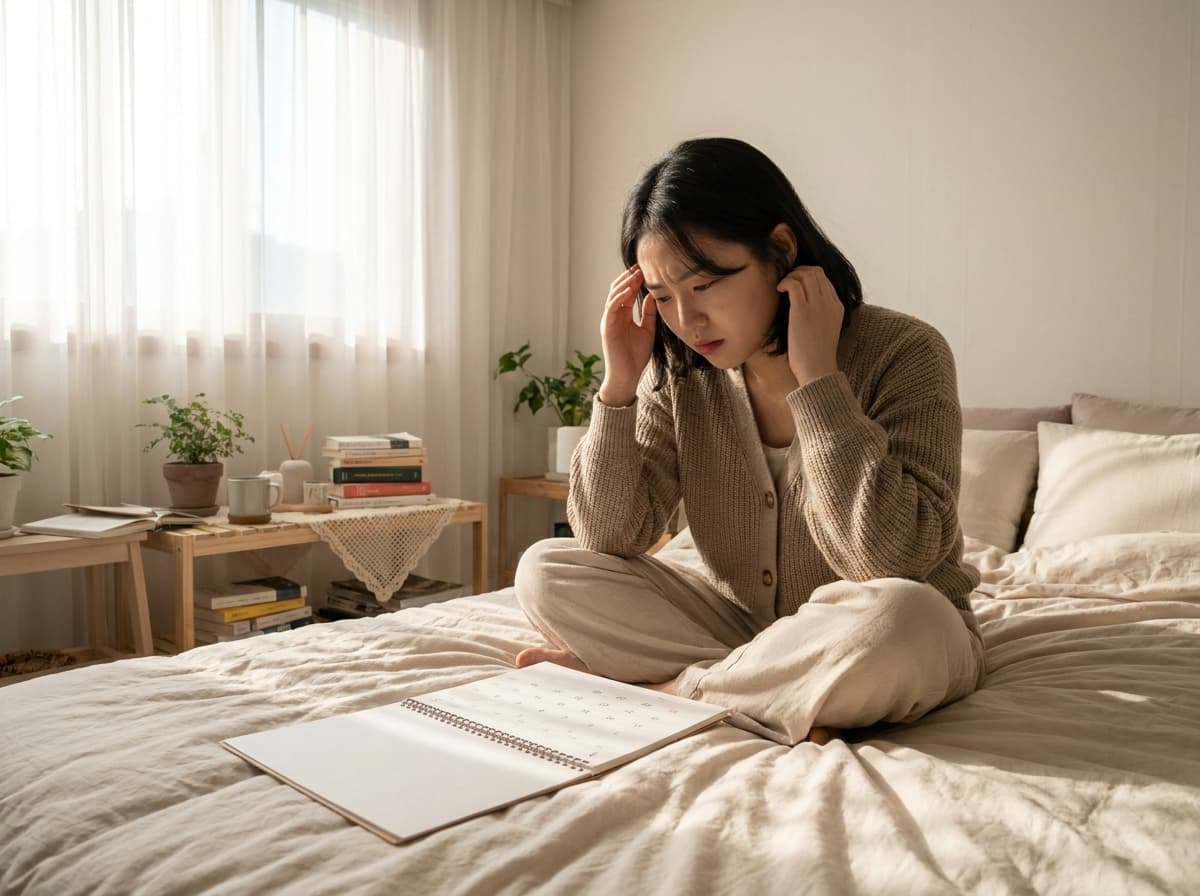
There are moments when you look at the calendar and feel a sudden shock. It's when you realize you haven't had a period this month, nor the month before. Along with the hope of a possible pregnancy, you feel the anxiety of "Why haven't I had my period for months?" Even if you try to brush it off as fatigue or stress, it's natural to feel uneasy as time passes. In particular, a state of amenorrhea lasting more than 6 months before the age of 40 can be a sign of 'premature menopause' beyond mere physical condition issues, requiring close attention.
💡 [Key Answer] Top 3 common causes of not having periods for months: ① Hormonal imbalance (stress, diet, overwork, etc.) / ② Decreased ovarian function (precursor to premature menopause) / ③ Polycystic Ovary Syndrome (PCOS). Dalimchae Korean Medicine Clinic helps you regain a healthy menstrual cycle by restoring ovarian function and the uterine environment through constitutional improvement.
Why Does Menstruation Suddenly Stop? 3 Causes of Amenorrhea
Amenorrhea, the sudden cessation of periods, is divided into primary and secondary amenorrhea. Secondary amenorrhea is defined as a lack of periods for 6 months or more in an adult who has already had their first period. This can be an important warning signal from the body, as menstruation is closely linked to hormonal balance, a key indicator of women's health.
First, hormonal imbalance is one of the most common causes. Extreme stress, excessive dieting, over-exercise, and irregular lifestyle habits can disrupt the pituitary and hypothalamic functions, directly affecting female hormone secretion. This prevents the ovaries from functioning properly, leading to a lack of ovulation and the cessation of periods.
Second, decreased ovarian function is a significant cause to suspect 'premature menopause', especially in women under 40. When ovarian function weakens, follicles cannot grow properly and ovulation fails, leading to amenorrhea. Early detection and treatment are crucial as it can increase the risk of osteoporosis and cardiovascular disease.
Third, Polycystic Ovary Syndrome (PCOS) is also a major cause of irregular periods and amenorrhea. Multiple small follicles develop in the ovaries but fail to mature and ovulate, often accompanied by hormonal imbalance and insulin resistance. Other causes include thyroid disease, pituitary tumors, and uterine adhesions, making an accurate diagnosis essential.
How Does Korean Medicine View Amenorrhea and Premature Menopause?
In Korean medicine, amenorrhea is called 'Gyeongpye (經閉)', and it is viewed as a result of poor circulation of Qi and Blood (氣血) or weakened Kidney (腎臟) function, leading to decreased reproductive capacity. Stress or overwork can disrupt the balance of the autonomic nervous system, which in turn affects the hormonal system and accelerates the decline in ovarian function. When ovaries lose function like an overheated engine, hormone secretion becomes unstable, and blood flow to the uterus weakens, making normal menstruation difficult.
At Dalimchae Songdo Branch, we focus on building the body's own power to regulate menstruation, rather than just restarting it. We aim to correct deep-rooted imbalances so that the ovaries and uterus can regain healthy function.
Clinical Research Results on Korean Medicine Treatment for Amenorrhea and Ovarian Function Recovery
Recent clinical studies show that Korean medicine treatment can have a positive impact on patients with amenorrhea and premature menopause (premature ovarian failure).
A study published in 『Explore: The Journal of Science and Healing』 in 2023 reported three cases of patients diagnosed with Premature Ovarian Failure (POF). These patients regained their menstruation after 3 months of combined treatment including herbal medicine, electro-acupuncture, moxibustion, and placenta pharmacopuncture. One patient even succeeded in natural pregnancy. The researchers concluded that Korean medicine can be effective for menstrual recovery in POF patients and emphasized the need for further research.
Furthermore, a systematic review and network meta-analysis published in 『F1000Research』 in 2023 analyzed 37 randomized controlled trials involving 2,597 patients with premature ovarian insufficiency (POI). The study confirmed that combined herbal medicine and catgut embedding therapy were most effective in increasing the total effective rate and improving Anti-Müllerian Hormone (AMH) levels, an indicator of ovarian function. Specifically, the combination of Hormone Replacement Therapy (HRT) with herbal medicine and acupuncture was presented as the most effective model for improving FSH, E2, and LH levels. These data suggest that Korean medicine plays a vital role in restoring the menstrual cycle by improving ovarian function and hormonal balance.
At Dalimchae Songdo Branch, based on scientific and traditional knowledge, we analyze each patient's condition deeply and provide customized constitutional improvement treatments to help the ovaries and uterus recover fundamentally.
Turning Back Your Body's Clock with Dalimchae's 'Constitutional Improvement'
The concern of "I haven't had my period for months" cannot be fully resolved by addressing only the external symptoms. At Dalimchae, we focus on constitutional improvement with the goal of creating a body where issues don't recur. We help the body regulate hormonal balance and regain a healthy menstrual cycle by boosting its natural healing power.
Specifically, we focus on strengthening the 'Kidney' energy, which is closely related to reproductive function, and removing stagnant blood (Eohyeol) to improve blood circulation to the uterus and ovaries. Stagnant blood can block microvessels in the uterus, causing decreased ovarian function and menstrual irregularity. Dalimchae's constitutional improvement treatment uses customized herbal prescriptions to support weakened organs and improve circulation for proper follicle growth and ovulation. We also use acupuncture, moxibustion, and pharmacopuncture to warm the lower abdomen and activate uterine and ovarian functions.
This constitutional improvement treatment at Songdo Amenorrhea Clinic goes beyond restoring the menstrual cycle, helping to improve overall health and lower the risk of complications such as osteoporosis and cardiovascular disease caused by premature menopause. For those planning a pregnancy, it helps create a healthy uterine environment and strengthens ovarian function to increase the possibility of natural pregnancy.
Self-Check: Symptoms of Amenorrhea and Premature Menopause
If you meet 3 or more of the following, your body may be sending a warning signal. Consider proactive management and consultation.
- Menstruation has stopped completely for more than 3 months.
- The menstrual cycle has become irregular and longer than 40 days.
- Menstrual flow has significantly decreased or blood clots are frequent.
- Sudden facial flushing or night sweats have become severe.
- Emotional swings are more severe, with easy irritation or depression.
- Skin feels dry and less elastic.
- Decreased libido and vaginal dryness appear.
- Severe fatigue and rapid drop in stamina without a specific reason.
- Menstrual abnormalities appeared before the age of 40.
If 3 or more apply: Suspect decreased ovarian function and autonomic imbalance → Recommended to visit Dalimchae Songdo for a detailed consultation. If 5 or more apply: High possibility of premature menopause or serious hormonal imbalance → Immediate visit and check-up recommended.
FAQ: Frequently Asked Questions about Amenorrhea and Premature Menopause
Q. How long without a period is considered amenorrhea? A. For women who previously had regular periods, missing them for 6 months or more, or for a duration 3 times longer than their usual cycle, is diagnosed as amenorrhea. In women under 40, the possibility of premature menopause must be considered.
Q. Can amenorrhea heal naturally? A. Mild menstrual irregularity due to temporary stress may recover with lifestyle changes. However, if it lasts for more than 3 months or has other symptoms, it's best to see an expert.
Q. Can premature menopause be treated with Korean medicine? A. Yes, premature menopause is often viewed as a state of decreased function rather than complete cessation. Korean medicine restores function and regulates hormonal balance to induce ovulation and restore menstruation.
Q. Can irregular periods and infertility be treated together? A. Yes, they are closely linked. Dalimchae normalizes the cycle and strengthens ovarian function to improve infertility through healthy ovulation and uterine environment.
"I haven't had my period for months" – this is not an issue that can be solved by just waiting. Do not ignore the signals your body has been sending. With the right approach, the body reacts faster than you think. Bring your symptoms as they are. We will find the cause together at Dalimchae Songdo Branch.
Where life blooms. Herbal medicine is, after all, Dalimchae. Check similar symptoms first via AI consultation on the Dalimchae website!
This health information was compiled by Dalimchae medical staff based on frequently asked questions in the clinic. Medical Supervision | Women's & Pregnancy Specialist, Dalimchae Songdo, Dr. Oh Hyunmin (Premature Menopause Column)