
Hello. This is Dalimchae Korean Medicine Clinic.
Is my hair falling out too much? Normal vs. Hair Loss
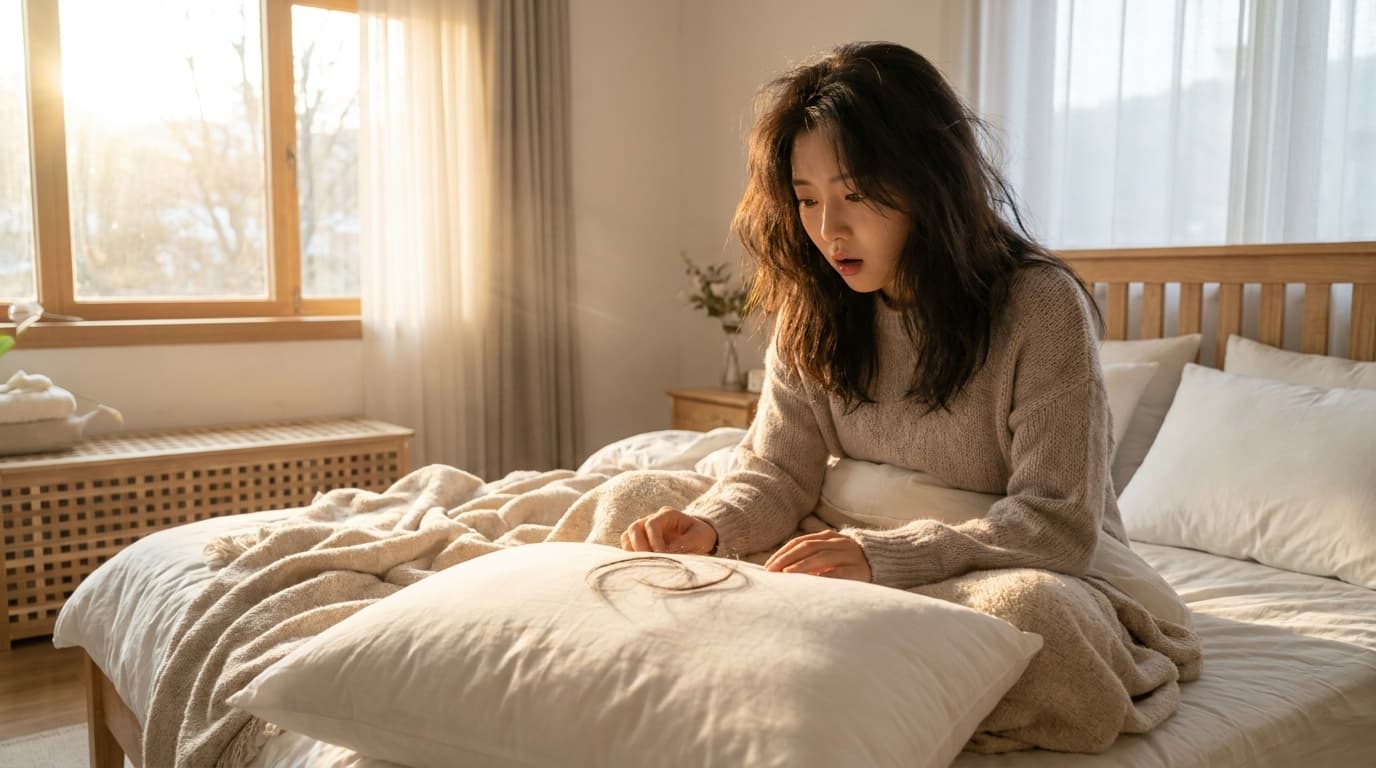
Have you ever been surprised by a pile of hair on your pillow or in the drain after a shower? You might have searched for "my hair is falling out too much" out of anxiety. While losing hair is natural, if the amount feels excessive or your hair density is noticeably decreasing, it could be a signal from your body that shouldn't be ignored as a simple seasonal change.
💡 [Key Answer] The 3 most common causes of "my hair is falling out too much": ① Natural changes in the hair cycle (loss of telogen hair) ② Deterioration of the body's internal environment due to stress, nutritional imbalance, etc. ③ Weakening of hair follicles due to genetic predisposition and hormonal imbalance Dalimchae Korean Medicine Clinic creates a fundamental body environment where hair can grow healthily through constitutional improvement.
100 strands a day? The line between normal hair loss and alopecia?
Our hair repeats a unique growth cycle of 'Anagen-Catagen-Telogen-Exogen'. After an anagen phase of about 2-6 years, the hair goes through a catagen phase of 2-3 weeks and a telogen phase of 2-4 months before falling out naturally. Since new hair grows back in the place where it fell out, you don't usually feel a major change in overall hair volume.
Generally, losing about 50 to 100 strands of hair a day is considered normal for a healthy person. In particular, it may feel like a lot is falling out when washing or brushing your hair, or when you wake up, which is because telogen hairs that have already reached the end of their lifespan fall out all at once due to friction or stimulation.
However, if you consistently lose more than 100 strands a day, especially more than 150 strands, or if the amount of loss feels much higher than before, you should suspect alopecia rather than simple hair loss.
Alopecia is a 'warning light' for your body, not just a hair problem
Hair is an important indicator reflecting the health status of our body. Beyond simple hair problems, body-wide imbalances often manifest as alopecia. In particular, stress, overwork, and irregular lifestyle habits cause autonomic nervous system imbalance, which can cause problems with blood and nutrient supply essential for hair growth, leading to alopecia.
A 2021 study, 「Literature Review on Korean Medicine Treatment for Alopecia」, which comprehensively analyzed international and domestic academic databases such as PubMed, OASIS, and RISS, analyzed a total of 1,464 alopecia patients who participated in 22 domestic Korean medicine clinical studies. According to this study, various Korean medicine treatments such as herbal medicine, acupuncture, pharmacopuncture, and external preparations were found to have a positive effect on improving symptoms in alopecia patients. The researchers emphasized that while these results show the potential of Korean medicine treatment, large-scale long-term studies are needed to establish standardized guidelines and objective evaluation criteria for alopecia treatment.
This systemic perspective aligns with the treatment philosophy of Dalimchae Korean Medicine Clinic. Some studies focus on internal body problems, especially the link between gut health and hair health, beyond simply applying medicine or injecting into the scalp. A 2019 domestic clinical study reported the results of giving kimchi and cheonggukjang probiotic products to 46 alopecia patients for 4 months. The results showed that after 1 month, the average hair count significantly increased from 85.98±20.54/cm² to 90.28±16.13/cm², and to 91.54±16.29/cm² after 4 months (p<0.001 for female patients, p=0.002 for hair thickness in all patients), and hair thickness also improved. The researchers concluded that probiotic intake promoted the anagen phase of hair follicles, having a positive effect on hair growth and alopecia improvement. This suggests that the balance of the Gut-Brain-Scalp Axis has a significant impact on hair health, and constitutional improvement treatment that improves the fundamental environment of the body can be an effective approach to alopecia.
Is my hair loss alopecia? Self-diagnosis Checklist
Check if any of the following questions apply to you. If 3 or more apply, you should suspect alopecia, and if 5 or more apply, it is recommended to visit an Incheon alopecia clinic for an accurate diagnosis.
Alopecia Self-diagnosis Checklist
- There are many days when more than 100 strands, especially more than 150 strands, of hair fall out a day.
- Judgment: Suspicious sign of alopecia. If the amount of hair loss has significantly increased compared to usual, you should observe carefully.
- The thickness of the falling hair is thinner than before and lacks strength.
- Judgment: Possibility of alopecia progressing. Alopecia starts with the thinning of hair before it falls out.
- The scalp on the crown or parting area looks wider or more visible than before.
- Judgment: Early symptoms of female/male pattern alopecia. A typical symptom of decreased hair density.
- The forehead hairline feels like it's gradually receding or widening in an M-shape.
- Judgment: Suspected male pattern alopecia. A characteristic pattern of frontal hair loss.
- The scalp is often itchy or red, and feels hot.
- Judgment: Deterioration of the scalp environment. Inflammation or scalp heat adversely affects hair follicle health.
- When lightly pulling the hair, more than 5 strands fall out easily.
- Judgment: Abnormal hair loss.
- There is someone in the family suffering from alopecia.
- Judgment: Consideration of genetic factors. Alopecia has strong genetic predisposition.
- Have recently been under extreme stress or have irregular eating habits.
- Judgment: Telogen effluvium or systemic imbalance. Stress is a major trigger for alopecia.
3 or more items apply → Alopecia suspicion stage, so consider professional diagnosis along with lifestyle improvements. 5 or more items apply → Immediate visit recommended. Accurate cause identification and customized treatment are needed at Dalimchae Korean Medicine Clinic Incheon branch.
Why Dalimchae Korean Medicine Clinic Incheon Branch for Alopecia? - Constitutional Treatment
At Dalimchae Korean Medicine Clinic Incheon Branch, alopecia is not seen as just a scalp or hair problem. We believe alopecia occurs when nutrients and oxygen are not properly supplied to the scalp due to decreased organ function or problems with blood and energy circulation. Especially when the body's balance is broken and immunity is lowered due to excessive stress or poor eating habits, heat rises to the scalp or inflammatory reactions occur easily, making hair fall out more weakly.
Dalimchae Korean Medicine Clinic Incheon Branch focuses on constitutional treatment to solve these fundamental causes. We aim not to temporarily turn off symptoms, but to create a body that doesn't turn back on. By meticulously diagnosing each patient's constitution and health status, we resolve toxins and imbalances in the body that hinder hair growth and create an optimal environment for hair to grow healthily. Through this, we help healthy and strong hair grow back by improving scalp blood circulation and strengthening hair follicle regeneration, beyond simply reducing falling hair. At Dalimchae Korean Medicine Clinic, we increase the body's natural healing power through constitutional improvement to prevent the recurrence of alopecia and contribute to overall health promotion.
Questions about Alopecia, FAQ
Q. How long does alopecia treatment take? A. The treatment period varies depending on the type of alopecia, degree of progression, and body condition, but considering the hair growth cycle, consistent treatment for at least 3 to 6 months or more is necessary. Since hair grows slowly, it is important to be patient with the treatment.
Q. Can female pattern alopecia also be treated with oriental medicine? A. Yes, female pattern alopecia occurs due to various reasons such as hormonal imbalance, stress, and postpartum sequelae, and oriental medicine constitutional treatment provides effective treatment by comprehensively considering these female-specific causes. Since the recovery speed is faster than that of men, early treatment is important.
Q. I'm worried about side effects when taking alopecia medicine. A. Some conventional alopecia medicines can cause side effects such as decreased sexual function, which many people worry about. Dalimchae's oriental medicine treatment focuses on balancing the body and promoting hair growth without the burden of drug side effects.
Q. Can stress-induced alopecia heal naturally? A. Mild stress-induced alopecia (telogen effluvium) may recover naturally once the stress factor is resolved, but chronic stress can worsen alopecia and induce recurrence. It is important to resolve body imbalance caused by stress and regain a healthy hair cycle through active oriental medicine treatment.
Alopecia is not a problem that can be solved by enduring. You don't have to ignore the signals your body has been sending for a long time anymore. If approached in the right direction, the body responds faster than expected. Bring the symptoms you are experiencing as they are. Dalimchae Korean Medicine Clinic will find the cause together.
Where life blooms. For herbal medicine, it's Dalimchae Korean Medicine Clinic. Check symptoms similar to yours first through the AI consultation on the Dalimchae Korean Medicine Clinic website!
This health information was compiled by Dalimchae medical staff based on questions frequently received in the consultation room. Medical Supervision | Min Jihong, Doctor of Korean Medicine, Dalimchae Korean Medicine Clinic Incheon Branch, Skin Disease Treatment Criteria (Alopecia Column)
#Alopecia #HairLoss #HairLossIdentification #IncheonAlopeciaClinic #ScalpHealth #OrientalAlopeciaTreatment #ConstitutionalImprovement #KoreanMedicineDoctorMinJihong