
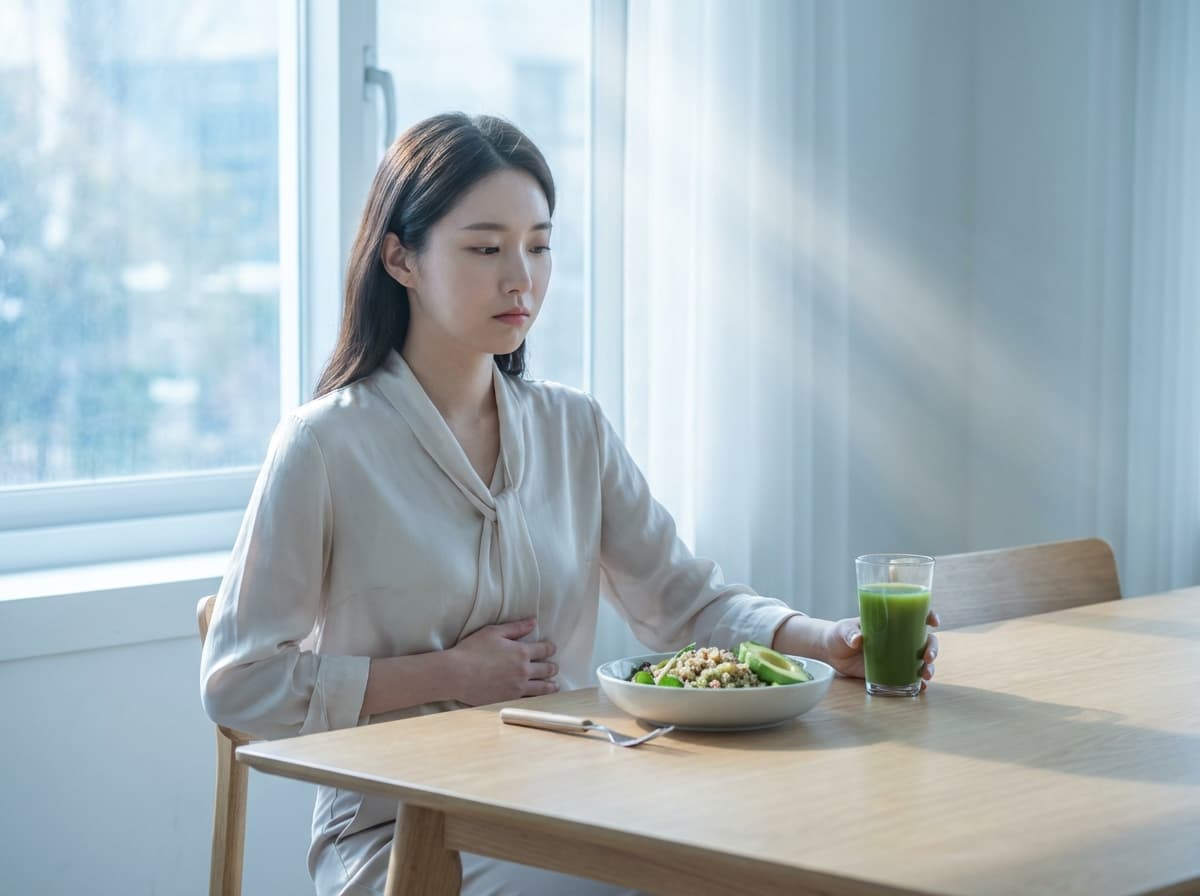
Functional Dyspepsia: Why It Is Not Visible on Endoscopy (Based on Research)
Hello, this is Dalimchae Oriental Medicine Clinic. "Even after eating just a little, my epigastrium feels tightly blocked and bloated with gas." "I went to an internal medicine clinic and had a stomach endoscopy and abdominal ultrasound because I couldn't digest, but they said everything is perfectly 'normal' except for mild gastritis. Then why am I in so much pain every day?" This is a very common concern shared by patients visiting our clinic with gastrointestinal issues. While hospitals say you should be relieved since there are no major diseases like ulcers or cancer, the patient experiences daily discomfort, nausea, and even headaches, which significantly drops their quality of life. Rather than vaguely relying on acid suppressants or digestive aids, it is time to fundamentally revive the function of the stopped stomach based on objective scientific data and research results. Today, Dalimchae explains the real cause of functional dyspepsia missed by machines and provides solutions proven by latest academic papers.

🚨 Why machines miss it: It's a 'functional' failure, not 'structural' Stomach endoscopy is a 'structural' test to check for organic diseases like ulcers, inflammation, or tumors. However, 'functional' problems where the stomach muscle has hardened and stopped peristalsis or where the digestive juice secretion system has failed do not appear on the endoscopy camera. Then why did the stomach suddenly stop moving? The secret lies in the 'Gut-Brain Axis' and 'autonomic nervous system' connecting the brain and stomach. When we are under extreme stress or overwork, the brain recognizes it as a crisis and over-activates the 'sympathetic nervous system' (alarm bell). At this time, the switch of the 'parasympathetic nervous system'—responsible for digestion and rest—turns off, completely stopping the autonomous movement of the gastrointestinal tract. Since the pilot has collapsed, no matter how much digestive enzyme you pour in, the stomach won't budge, and food rots inside, emitting toxins (damjeok).
📘 Integrated Treatment Data Proven by Research Let's check through latest academic data how powerful the Korean medicine approach is in making the stomach move on its own by stabilizing the autonomic nerves, rather than just forcibly squeezing the stomach. 📊 [Research Data: Effect of Complex Korean Medicine Treatment on Gastrointestinal Function in Functional Dyspepsia Patients] According to a 2022 clinical research paper in the 『Journal of Korean Internal Medicine』, patients who received 4 weeks of complex treatment showed a significant 45% decrease in their Nepean Dyspepsia Index (NDI-K). Specifically, the sympathetic over-excitation index that was inhibiting stomach movement stabilized significantly (p<0.05), proving that beyond temporary digestion promotion, the stomach's original motor function recovers on its own.
🌿 Dalimchae's 3-Step Dimensional Treatment Process Dalimchae does not just cover up symptoms. We restore the root imbalance of the autonomic nervous system.
- Step 1: Precision Diagnosis (Autonomic/Brainwave Test & Pulse/Abdominal/Tongue Diagnosis) We accurately identify the degree of sympathetic over-excitation and the location/hardness of damjeok (toxins) through both objective data and traditional diagnosis.
- Step 2: 'Cranial Nerve Pharmacopuncture & Lymph High-Frequency' (Sogan-haeul & Cheongyeol-ansim) Immediately releases neck/head pressure to clear blocked nerves and discharges accumulated abdominal toxins through integrated therapies.
- Step 3: '1:1 Customized Herbal Medicine' to Restore Gut-Brain Axis (Geonbi-hwayui & Sodo) Revives the stomach's peristaltic movement and cleanses the intestinal wall of toxins, creating a sturdy stomach that can digest on its own without relying on drugs.
💬 Functional Dyspepsia FAQ Q1. Why did the internal medicine clinic prescribe antidepressants for indigestion? Since the brain and gut are closely connected (Gut-Brain Axis), hospitals sometimes prescribe antidepressants to stabilize the nerves. However, Dalimchae uses natural therapies like pharmacopuncture and herbal medicine to naturally stabilize the autonomic nervous system without drug dependency. Q2. What foods should I avoid? Avoid high-fat foods, spicy foods that irritate the lining, and caffeine or carbonated drinks that over-stimulate nerves. Soft foods made of rice are better for absorption than dairy or flour. Q3. Is it okay to take herbal medicine if my stomach is weak? We prescribe starting from light, easily absorbed medicinal herbs that gently empty (Sodo) and soothe the stomach wall first, so it's actually very comfortable for weak stomachs.
"The stopped stomach is a distress signal from your brain asking to please turn off the emergency switch because it's under too much stress." regain yourLost comfortable and light daily life with Dalimchae's dimensional diagnosis and customized treatment.
Where life blooms. For herbal medicine, trust Dalimchae. Medical Review | Digestive & Autonomic Specialist, Dalimchae Incheon Branch, Dr. Min Ji-hong
Check your similar symptoms first with Dalimchae's website AI consultation!