
Hello. This is Dalimchae Korean Medicine Clinic.
First step is hard and feet feel stuck to the ground: Parkinson's disease, don't be afraid anymore.
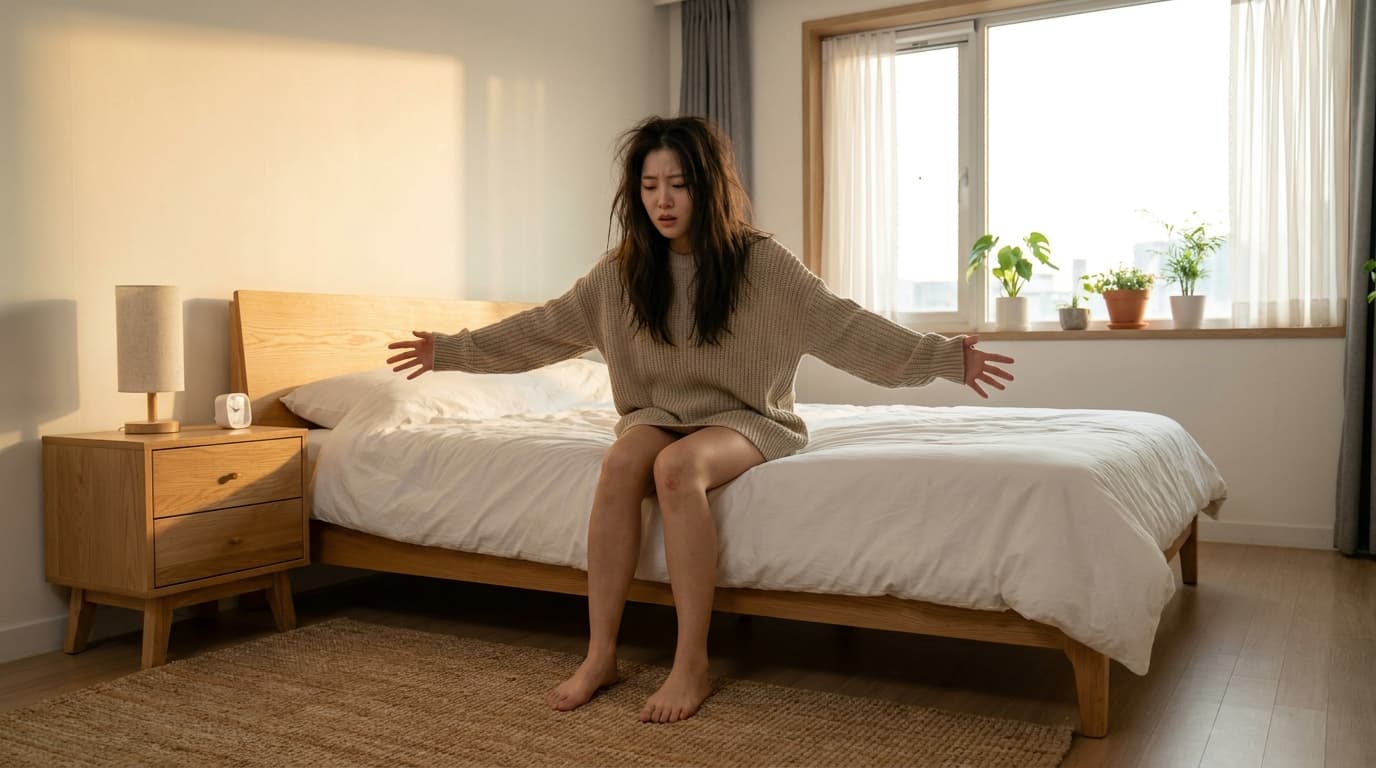
"The first step is difficult, and my feet feel stuck to the ground." These symptoms of slowed movement and heavy steps are more than just signs of aging; they can be important warning signals from our bodies. In particular, the feeling that your feet won't move when you wake up and take your first steps in the morning or when you change direction in a confined space, or a shuffling gait where your steps become narrower and your body leans forward, are representative walking disorder symptoms of Parkinson's disease. These symptoms cause great inconvenience in daily life and can significantly reduce the quality of life.
💡 Key Answer The 3 most common causes of the symptom "The first step is difficult and my feet feel stuck to the ground": ① Impaired motor function due to damage to dopamine neurons in the brain / ② Postural instability and muscle rigidity due to autonomic nervous system imbalance / ③ Loss of walking control ability due to brain circuit problems. Dalimchae Korean Medicine Clinic helps to recover brain function and regain body balance through autonomic stabilization to help improve symptoms.
Why do I keep feeling like my feet are stuck to the ground and my movements are slow?
Walking disorders and slowed movement, such as the feeling of feet being stuck to the ground, are major motor symptoms of Parkinson's disease, occurring as dopamine secretion decreases due to damage to dopamine neurons in a specific part of the brain, especially the substantia nigra. Dopamine is an essential neurotransmitter for smooth regulation of our body's movements. In addition, an imbalance in the autonomic nervous system can lead to muscle rigidity, postural instability, and loss of balance, further worsening walking disorders. These problems manifest as 'abnormal gait' or 'Freezing of Gait (FoG)', where the feet do not move when starting to walk, changing direction, or passing through a narrow space, making it difficult for patients.
Is it possible to improve walking ability with Korean medicine treatment for Parkinson's disease?
Recent studies show that Korean medicine treatment for Parkinson's disease can have a positive impact on improving motor and non-motor symptoms. In particular, acupuncture treatment has been reported to be effective in improving motor functions related to walking disorders.
In a clinical study by Lee Jeong-hoon's research team published in the Journal of Clinical Neurology in 2020, 26 patients with walking disorders due to Parkinson's disease underwent acupuncture treatment twice a week for 4 weeks in combination with general treatment. As a result, the group that received acupuncture treatment showed a significant decrease in walking speed (cadence) and UPDRS (Unified Parkinson's Disease Rating Scale) 'walking and balance' item scores (p = .004, p = .020, respectively). In particular, stride, swing, and single support times significantly increased (p = .006, p = .001, p = .001, respectively), confirming that walking ability was improved. The researchers concluded that these results were because acupuncture treatment was associated with blood flow changes in the prefrontal cortex and supplementary motor area of the brain, contributing to the improvement of walking function.
Furthermore, according to a systematic review and meta-analysis by a research team at Wuhan University of Chinese Medicine to be published in Therapeutic Advances in Neurological Disorders in 2025, acupuncture treatment showed significantly better effects than Western medicine treatment in all areas of the UPDRS in 50 randomized controlled trials (total 3,248 people), with the strongest improvement effect appearing in treatment-related motor complications (SMD: -2.16; 95% CI: -3.10 to -1.22). The study showed positive effects on improving non-motor symptoms such as quality of life, pain, sleep, depression, and anxiety, and electroacupuncture specifically showed the highest overall efficacy. The researchers suggested that acupuncture treatment performed under optimized conditions could be a clinically valuable adjunctive therapy to standard Parkinson's disease treatment.
Based on these data, Dalimchae Korean Medicine Clinic in Incheon approaches walking disorders caused by Parkinson's disease not as a simple muscle problem, but as a complex functional abnormality of the brain and autonomic nervous system. If the brain cannot rest and overheats, the balance of the nervous system is disrupted, which can deepen not only motor symptoms such as tremors, rigidity, and walking disorders but also non-motor symptoms such as sleep disorders, depression, and anxiety.
Dalimchae Korean Medicine Clinic's treatment to restore autonomic balance and let the brain rest
Dalimchae Korean Medicine Clinic does not view walking disorders like "The first step is difficult and my feet feel stuck to the ground" simply as a lack of dopamine. Rather, we interpret that an imbalance in the autonomic nervous system overloads brain function and worsens symptoms. If the balance of the autonomic nervous system is disrupted, the brain cannot rest and becomes excessively excited, leading to a decrease in the ability to control our body's minute movements. This leads to the major symptoms of Parkinson's disease, such as walking disorders, rigidity, and tremors.
Dalimchae Korean Medicine Clinic in Incheon applies 'autonomic stabilization' treatment to solve the root of these problems. This treatment stabilizes the excessively hyperactive sympathetic nervous system and activates the function of the parasympathetic nervous system to create an environment where the brain can sufficiently rest. Lowering the heat of the nervous system and creating an environment where the brain can rest—in Korean medicine, this is called Suseunghwagang (水昇火降)—helps to activate brain function and improve the circulation of Qi and blood throughout the body to assist in the recovery of motor function. Through this, patients can experience improvement in not only the discomfort during walking but also the accompanied non-motor symptoms such as sleep disorders, anxiety, and depression.
Could I also have early symptoms of Parkinson's disease? Walking disorder self-diagnosis checklist
If 3 or more of the following items apply, it is recommended to have a detailed consultation at Dalimchae Korean Medicine Clinic in Incheon.
- Hands or feet tremble when at rest.
- It is especially difficult to take the first step when starting to walk, and it feels like the feet are stuck to the ground.
- As you walk, the stride becomes narrower and you walk with a shuffling gait as if your body is leaning forward.
- Body movements have generally become dull and slow.
- Facial expressions have stiffened and become expressionless as if wearing a mask.
- There is a tendency for handwriting to become increasingly smaller.
- Sleep quality has worsened, such as difficulty falling asleep at night or waking up frequently.
- Feeling severely depressed or anxious for no particular reason.
If 3 or more apply → Suspected autonomic imbalance type Parkinson's disease → Review complex Korean medicine treatment If 5 or more apply → Immediate visit and in-depth diagnosis recommended.
FAQ – We will solve your questions about Parkinson's walking disorders.
Q. Is the symptom of having a hard time taking the first step and feet feeling stuck to the ground Parkinson's disease? A. Having difficulty taking the first step or feeling like your feet are stuck to the ground can be Freezing of Gait (FoG), one of the characteristic walking disorders of Parkinson's disease. This occurs due to dopamine deficiency and abnormalities in neural circuits in the brain, and consultation with a specialized medical institution is necessary for an accurate diagnosis.
Q. Can Korean medicine treatment for Parkinson's disease be taken along with Western medicine? A. Yes, Korean medicine treatment for Parkinson's disease can create synergy when combined with Western medicine. Acupuncture and herbal treatment reduce the side effects of Western medicine and increase treatment efficacy, especially helping to improve non-motor symptoms. Dalimchae Korean Medicine Clinic, an Incheon autonomic nerve Korean medicine clinic, establishes a safe and effective Korean medicine treatment plan considering the patient's currently prescribed medications.
Q. Can walking disorders due to Parkinson's disease improve naturally? A. Parkinson's disease is a degenerative brain disease, and it is difficult for symptoms to improve naturally. Rather, symptoms tend to worsen over time, so active treatment and management from the early stages are important. It is important to receive customized treatment at a specialized medical institution like Dalimchae Korean Medicine Clinic, a Songdo Parkinson's Korean medicine clinic.
Q. Can I feel like my feet are stuck to the ground due to causes other than Parkinson's disease? A. Yes, in addition to Parkinson's disease, various neurological and musculoskeletal diseases such as stroke, spinal cord injury, degenerative arthritis, spinal stenosis, and sarcopenia can cause walking disorders. In addition, side effects of certain drugs or a decrease in sense of balance can also be causes. It is important to identify the root cause through an accurate diagnosis.
"The first step is difficult and my feet feel stuck to the ground" is not a problem that can be solved by enduring it. Do not ignore the signals your body has been sending for a long time. If you approach it in the right direction, your body will respond faster than you think. Bring the symptoms you are experiencing as they are. Dalimchae Korean Medicine Clinic in Incheon will find the cause together.
Where life blossoms. For herbal medicine, it's Dalimchae. Check your symptoms with the AI consultation on the Dalimchae Korean Medicine Clinic website first!
This post is health information compiled by the Dalimchae medical team based on questions frequently asked in the consultation room. Medical Supervision | Yang Yuchan, Korean Medicine Doctor at Dalimchae Korean Medicine Clinic Incheon (Parkinson's Disease Column)