
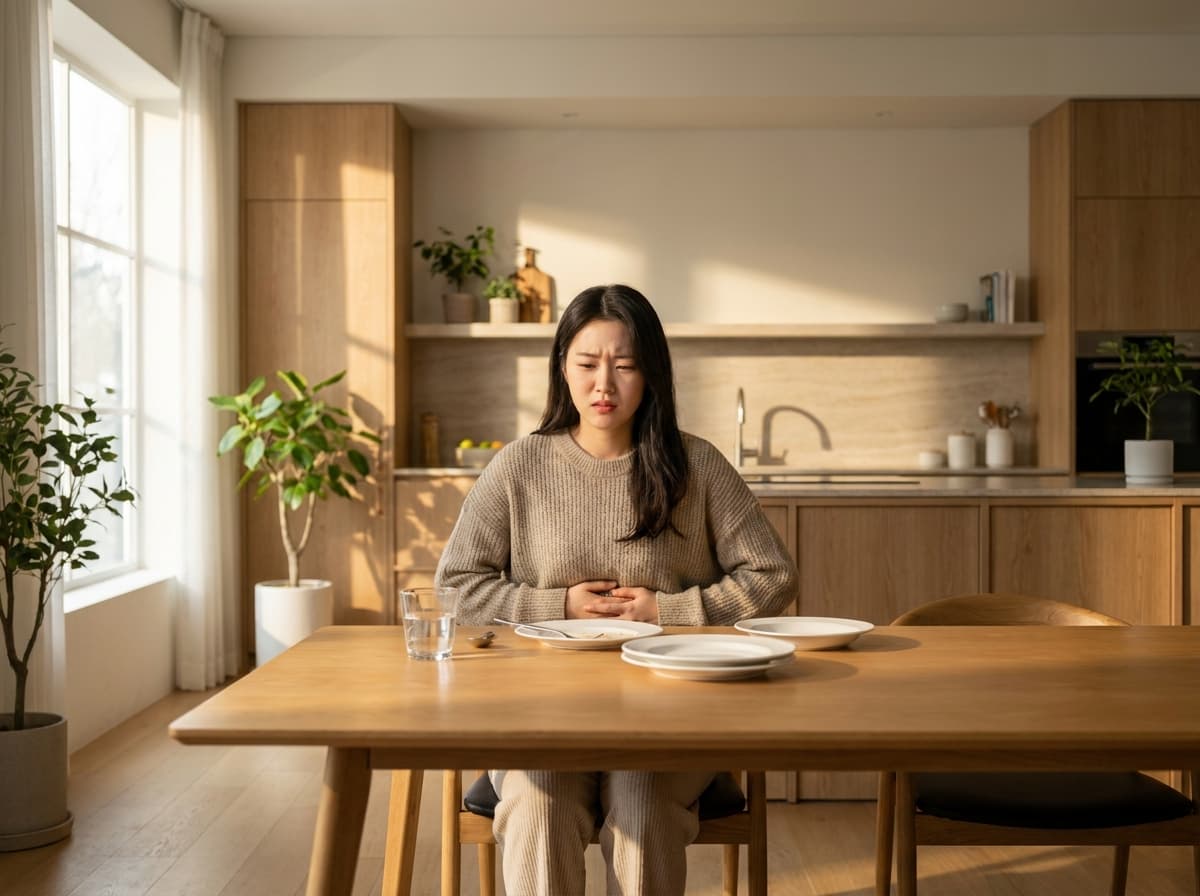
Feeling heavy and stuffed after a meal. Have you ever suffered from an unpleasant feeling as if undigested food is staying in your stomach? Even after a check-up, you might be told there's no specific problem, but the daily 'stomach blockage' suffocates your daily life. It's more than simple indigestion; many people suffer from chronic discomfort. These symptoms can be an important 'warning light' for decreased gastrointestinal function, and in Oriental medicine, this is closely linked to 'Phlegm Accumulation (Damjeok).'
💡 Key Answer The 3 most common reasons why your stomach feels blocked after eating: ① Waste products accumulated on the outer wall of the stomach (Phlegm Accumulation) / ② Decreased gastrointestinal motility due to autonomic nervous system imbalance / ③ Gut-Brain Axis dysfunction Dalimchae Oriental Clinic removes toxins from the outer wall of the stomach through Gut Detox, restores autonomic balance, and fundamentally improves digestive function.
Is the reason your stomach feels blocked after eating really 'Phlegm Accumulation'?
The feeling of stuffiness and blockage after a meal is often diagnosed as functional dyspepsia. This refers to cases where symptoms such as upper abdominal discomfort, early satiety, and epigastric pain appear, but no specific organic abnormalities are found in examinations such as endoscopy. In Oriental medicine, one of the root causes of these symptoms is 'Phlegm Accumulation (痰積).' Phlegm Accumulation refers to a pathological state in which waste products and toxins pass through the gastric mucosa and accumulate on the outer wall of the stomach, causing the stomach tissue to harden. When the outer wall of the stomach hardens, the peristaltic movement of the stomach decreases, and digestive enzymes are not secreted smoothly, so food is not digested properly and stays in the stomach for a long time.
This Phlegm Accumulation can be caused by various factors such as irregular eating habits, excessive stress, and congenitally weak gastrointestinal function. In particular, stress affects the autonomic nervous system, further deepening the decline in digestive function.
Why do I still feel uncomfortable when the test results are 'normal'?
Many patients complain of frustration after receiving a word from the hospital that "there is nothing wrong" or "it's psychological" even after a detailed examination such as gastroscopy. This is because modern medical examinations mainly focus on diagnosing structural problems such as inflammation or ulcers of the gastric mucosa itself. However, functional dyspepsia or Phlegm Accumulation often stems from functional abnormalities of the outer stomach wall tissue or imbalance of the autonomic nervous system rather than the gastric mucosa itself.
In fact, about 2/3 of patients with functional dyspepsia show gastric rhythm disorders, which suggests gastric motility disorders. In addition, functional dyspepsia is known to be closely related to Gut-Brain Axis dysfunction. The brain and the gut are closely connected, so psychological factors such as stress or anxiety can directly affect gut function.
How does Oriental medicine treat the symptom of 'blocked stomach'?
Dalimchae Oriental Clinic Songdo Branch does not view functional dyspepsia symptoms such as 'my stomach feels blocked after eating' as a simple digestive problem, but focuses on correcting the autonomic nervous system imbalance and the collapse of the Gut-Brain Axis, which are the roots of the symptoms. In particular, Gut Detox treatment, which removes 'Phlegm Accumulation,' the toxins accumulated on the outer wall of the stomach, and restores intestinal function, is the core.
Our body's intestines are involved in various biological activities such as immunity and neurotransmitter production, as well as the digestion and absorption of food. Toxins accumulated on the intestinal wall can travel through the blood and cause systemic inflammation, or disrupt Gut-Brain Axis function, leading to various systemic symptoms such as chronic fatigue, headache, and anxiety, as well as indigestion. Dalimchae Oriental Clinic goes beyond simply alleviating symptoms and helps the body regain its health by detoxifying intestinal toxins and fundamentally strengthening gastrointestinal function. This is like cooling down an overheated engine and removing residue to restore its original performance.
Recent clinical studies report that Oriental medicine treatment has a significant effect on improving functional dyspepsia. In 2020, a research team from the Department of Clinical Oriental Medicine at Kyung Hee University College of Oriental Medicine administered Naesohwajung-tang granules for 4 weeks to 116 patients with functional dyspepsia, and found that the total dyspepsia symptom score significantly decreased compared to the placebo group (p < 0.05). Individual symptoms such as postprandial satiety, early satiety, and upper abdominal burning, and quality of life (FD-QoL) were also significantly improved. The researchers concluded that Naesohwajung-tang is an effective treatment for symptom relief in patients with functional dyspepsia. These data suggest that herbal medicine treatment can help improve various symptoms of functional dyspepsia.
Also, according to a study published in the journal Frontiers by a research team from Wonkwang University College of Oriental Medicine in 2025, after applying Eight-Constitutional acupuncture and diet to patients with functional dyspepsia, acupuncture treatment is effective in regulating gastrointestinal inflammation, suppressing gastric acid secretion, and regulating Gut-Brain Axis function. In particular, citing the results of a systematic review that acupuncture treatment leads to better symptom relief than conventional treatments by regulating gastrointestinal function through nerve stimulation, it emphasizes that Gut-Brain Axis dysfunction is one of the causes of functional dyspepsia. These research results are in line with the treatment philosophy of Dalimchae Oriental Clinic, which is fundamental treatment through Gut Detox, that is, improving the body's internal environment and restoring the balance of the autonomic nervous system. Dalimchae Songdo Phlegm Accumulation Clinic provides customized Oriental medicine treatments tailored to the symptoms and constitution of each patient based on these scientific grounds.
Shall I self-diagnose my 'stomach blockage' symptoms?
Through the checklist below, check if the symptoms you are currently experiencing are related to functional dyspepsia, especially 'Phlegm Accumulation.'
[Stomach Blockage Self-Diagnosis Checklist]
- I often feel blocked or stuffed in my stomach after eating.
- I feel full easily even after eating a little, and it's hard to finish the meal.
- There is a burning or stinging pain in the pit of the stomach.
- Burping or gas occurs frequently, and abdominal bloating is severe.
- Bowel movements are irregular, such as alternating diarrhea and constipation.
- Even if I take digestive medicine, it's only temporary, and the symptoms recur or do not heal well.
- It is often accompanied by headache, dizziness, and chronic fatigue.
- When I'm stressed, digestive symptoms get worse.
Judgment Criteria:
- 3 or more items: Decreased gastrointestinal function and autonomic nervous system imbalance are suspected. Consider accurate diagnosis and Oriental medicine complex treatment at Songdo Indigestion Clinic.
- 5 or more items: There is a high possibility of a chronic gastrointestinal problem. It is recommended to visit and receive professional examination and treatment immediately.
Where should I start consulting for 'stomach blockage' symptoms in Songdo?
Dalimchae Oriental Clinic Songdo Branch does not just listen to the symptoms and treat them, but establishes an optimized treatment plan for the individual by comprehensively considering the patient's lifestyle, stress factors, and overall physical condition. Along with traditional diagnostics such as pulse diagnosis, abdominal diagnosis, and tongue diagnosis, we find the hidden causes of decreased gastrointestinal function through precise autonomic nervous system tests.
Q. How long does Phlegm Accumulation treatment take? A. The duration of treatment for Phlegm Accumulation can vary depending on the severity of the individual's symptoms, the degree of chronicity, constitution, and lifestyle. Usually, if you combine steady treatment with lifestyle improvement, you can expect symptom improvement within weeks to months.
Q. Can the symptoms of stuffiness and blockage in the stomach heal naturally? A. Temporary indigestion can improve naturally, but chronic and recurring 'stomach blockage' can have fundamental causes such as decreased gastrointestinal function or Phlegm Accumulation. In this case, if left untreated, symptoms may worsen or lead to other diseases, so professional medical care is necessary.
Q. Is feeling extremely sleepy after eating also related to Phlegm Accumulation? A. Severe postprandial sleepiness can occur when excessive energy is consumed in the digestion process or when energy is low because nutrients are not absorbed smoothly due to indigestion. This can be related to decreased gastrointestinal function such as Phlegm Accumulation.
Q. I have both functional dyspepsia and reflux esophagitis, can they be treated together? A. Functional dyspepsia and reflux esophagitis often have common causes such as decreased gastrointestinal function and autonomic imbalance, so they can be treated together. At Dalimchae Oriental Clinic, we provide customized treatments that simultaneously improve the root causes of both diseases.
‘My stomach feels blocked after eating’ is not a problem that can be solved by enduring it. You no longer have to ignore the signals your body has been sending for a long time. When approached in the right direction, the body responds faster than you think. Bring the symptoms you are experiencing as they are. Dalimchae Oriental Clinic will find the cause together.
Where life blooms. Herbal medicine is, after all, Dalimchae Oriental Clinic. Check your symptoms with the AI consultation on the Dalimchae Oriental Clinic website first!
This is health information compiled by the Dalimchae medical team based on questions frequently received in the clinic. Medical Supervision | Oh Hyun-min, Oriental Medical Doctor at Dalimchae Oriental Clinic Songdo Branch (Indigestion Column), based on intestinal and digestive medical treatment standards. #PhlegmAccumulation #Indigestion #BlockedStomachAfterEating #GutDetox #AutonomicNervousSystem #SongdoOrientalClinic #SongdoIndigestionClinic #DecreasedGastrointestinalFunction