
Hello. This is Dalimchae Korean Medicine Clinic.
Does Your Scalp Itch and Develop Dandruff Only During Exam Periods? Frequent Stress as a Health Warning Sign!
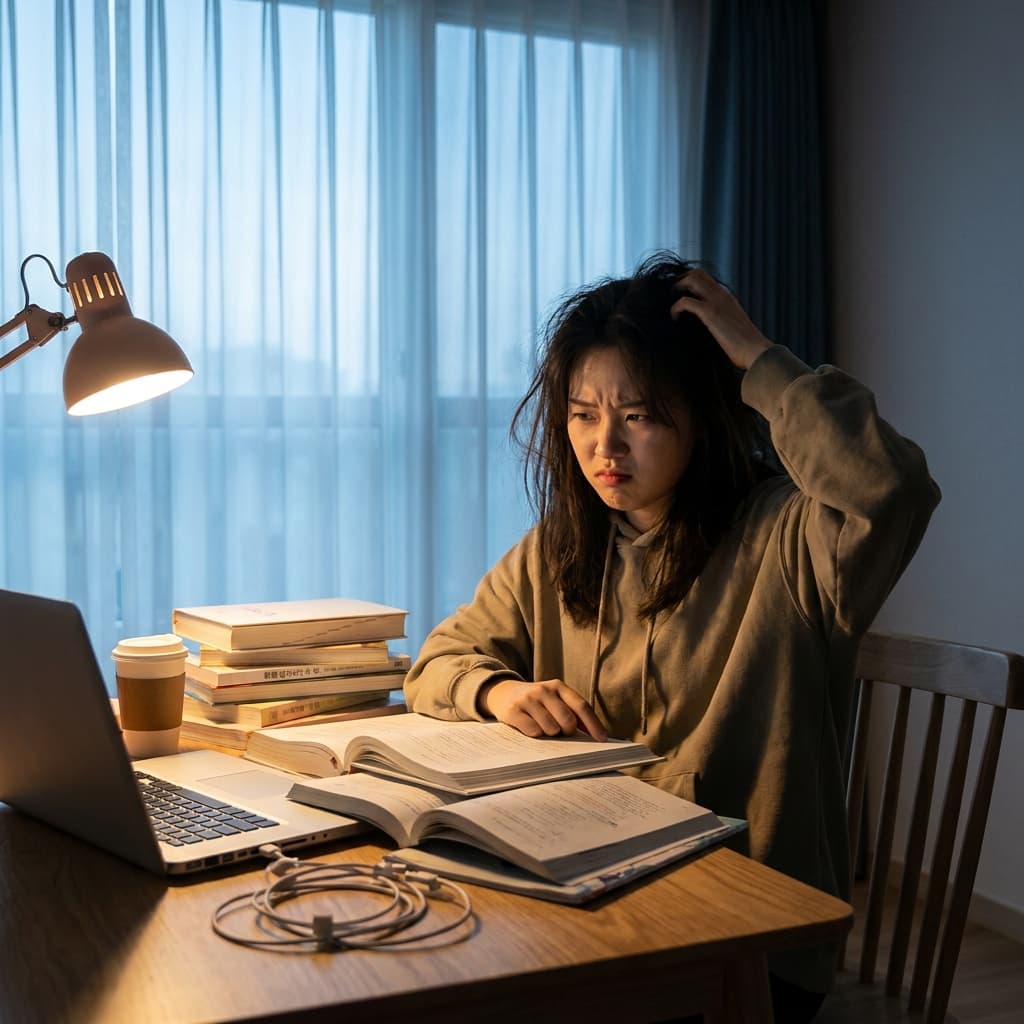
Many people worry as their scalp starts itching and developing dandruff whenever exam periods arrive with late-night desk sessions or important presentations. If scalp itching and dandruff worsen exclusively during periods of severe stress when you are otherwise fine, this may not be a simple skin problem. Such symptoms can be important warning signals sent by your body.
💡 Key Answer Top 3 most common causes of "Does your scalp itch and develop dandruff only during exam periods?": ① Excessive stress and autonomic imbalance / ② Inflammatory response due to worsened gut health / ③ Decreased skin immunity and sebaceous gland hyperactivation Dalimchae Korean Medicine Clinic helps restore skin health on its own by resolving the root causes inside the body affecting the scalp through gut detoxification treatment approaches.
Why does your scalp itch and develop dandruff exclusively during exam periods and stress?
Although scalp itching and dandruff occur due to various causes, their worsening particularly during times of extreme stress like exam periods suggests a close connection between our body's autonomic nervous system and the gut-brain axis. Stress disrupts the balance of the autonomic nervous system, excessively activating the sympathetic nervous system, which in turn stimulates skin sebaceous glands and increases sebum secretion. Excessive sebum promotes the proliferation of Malassezia yeast resident on the scalp, triggering an inflammatory response and worsening itching and dandruff. Furthermore, stress can weaken intestinal barrier function, increasing intestinal harmful bacteria and toxin production. These intestinal toxins travel through the blood throughout the body and become a primary culprit in worsening inflammation across the scalp and general skin.
Korean medicine does not view scalp itching and dandruff simply as superficial skin problems. When stress increases, 'heat (熱)' accumulates inside the body, and this heat rises upward to induce inflammation in the scalp. Additionally, decreased gut function produces 'damp-heat (濕熱)', acting as a factor worsening skin problems. Therefore, Dalimchae Korean Medicine Clinic provides treatments focusing on internal body imbalances, particularly autonomic stabilization and gut detoxification, alongside skin symptoms, to treat scalp itching and dandruff. The core of Korean medicine treatment is helping the body recover its fundamental balance so the skin can regain regenerative capacity on its own.
Korean medicine treatment has proven significant efficacy against stress-related inflammatory skin diseases through various studies.
In July 2020, a systematic review titled "Herbal Medicine for Atopic Dermatitis: An Overview of Systematic Reviews" led by Prof. Chan-Young Kwon's research team published in Allergy, Asthma & Immunology Research demonstrated that herbal medicine (HM) treatment is effective in improving symptoms in atopic dermatitis patients. Including 9 systematic reviews and re-analyzing 58 randomized controlled trials (RCTs), the herbal medicine treatment group showed a significantly reduced SCORAD (SCORing Atopic Dermatitis) score compared to placebo or control groups, along with a higher Total Effective Rate (TER). Notably, it confirmed positive effects on pruritus, sleep symptoms, and quality of life improvement. The researchers concluded that herbal medicine possesses multi-component, multi-target, and multi-pathway characteristics, making it suitable for diseases with complex pathomechanisms such as atopic dermatitis. These results suggest that herbal medicine can also contribute to modulating stress-related inflammatory responses and alleviating skin symptoms in other inflammatory skin conditions such as seborrheic dermatitis.
Furthermore, in February 2025, a case report titled "A Case Report of Seborrheic Dermatitis Improved by Korean Medicine Treatment" published in the Journal of Korean Medicine Ophthalmology & Otolaryngology & Dermatology confirmed that administering Yanggyeoksanhwa-tang, Hwangnyeonhaedok-tang wet dressings, and acupuncture in a 23-year-old seborrheic dermatitis patient resulted in significant symptom improvement within 2 weeks. The patient presented with facial erythema, scaling, and pruritus; 2 weeks post-treatment, skin symptoms almost disappeared, and pruritus (itching) decreased markedly from NRS (Numeric Rating Scale) 5 to 1. This report noted that seborrheic dermatitis involves multiple complex causes including Malassezia yeast along with stress and hormonal influences, demonstrating that Korean medicine treatments can approach these complex causes multi-dimensionally and show efficacy.
Based on these data, Dalimchae Korean Medicine Clinic focuses on gut detoxification treatment to correct internal body balance rather than searching for causes solely on the skin surface for scalp itching and dandruff. By reinforcing intestinal barrier functions weakened by stress and fostering a beneficial gut flora environment to reduce inflammatory responses while improving systemic immune systems, we help the scalp recover and become healthy on its own.
If you experience scalp itching and dandruff alongside exam period stress, this can be a strong signal that your body's gut-brain axis has lit a warning light. Stress directly worsens gut health and increases inflammatory substances, triggering systemic skin problems including the scalp. Therefore, efforts are needed not only to alleviate symptoms but to resolve root causes.
Dalimchae Korean Medicine Clinic approaches these issues through gut detoxification. Gut detoxification is a treatment that eliminates harmful substances in the gut, promotes beneficial bacteria growth, and reinforces intestinal barrier function. Once gut health recovers, inflammatory responses decrease and immunity improves, naturally regulating excessive scalp sebum secretion and Malassezia yeast proliferation. This can have positive effects not only on scalp issues but also on other digestive problems that can worsen with stress, such as gastrointestinal reflux disease or irritable bowel syndrome, as well as skin problems like itching and allergies. For those seeking Songdo scalp Korean medicine clinics who experience chronic scalp issues alongside digestive problems, this can be an even more effective treatment.
Stress-Related Scalp Itching & Dandruff Self-Diagnosis Checklist
If 3 or more of the following apply to you, there is a high probability of scalp problems caused by stress and gut health imbalance.
- ☐ Your scalp is particularly itchy when important tasks arise or under stress.
- ☐ Scalp dandruff increases noticeably, with visible flaking.
- ☐ Your scalp becomes red or frequently develops inflammation and pimples.
- ☐ Scalp itching worsens when lying down to sleep, making it hard to fall asleep.
- ☐ You frequently experience poor digestion, gas bloating, or repeating constipation and diarrhea.
- ☐ You tend to be tense or sensitive, finding stress relief difficult.
- ☐ Your hair quickly becomes greasy and develops an odor even after washing.
- ☐ Hair loss symptoms are also appearing alongside.
Diagnosis Results and Recommended Actions:
- 3 or More Apply: Suspected scalp inflammation due to stress and gut imbalance. Dalimchae Korean Medicine Clinic recommends considering combined Korean medicine treatment.
- 5 or More Apply: Immediate professional consultation and treatment are required. Resolving the root cause through Songdo seborrheic dermatitis Korean medicine clinic care is essential.
Dalimchae Korean Medicine Clinic Songdo Branch provides diverse Korean medicine treatments to fundamentally resolve scalp problems exacerbated by stress, such as scalp itching and dandruff during exam periods. We establish tailored treatment plans to alleviate scalp inflammation, restore gut health, and strengthen overall immunity through 1-on-1 customized diagnosis matching each patient's constitution and symptoms.
The treatment process begins with personal consultations to understand current symptoms and lifestyle habits, closely diagnosing body balance states via pulse wave and autonomic nervous system examinations. Subsequently, herbal prescriptions eliminate internal body inflammation, improve gut function, and regulate autonomic balance. In addition, acupuncture, pharmacopuncture, and external treatments are combined to promote scalp blood circulation and calm direct inflammatory responses. Through these comprehensive treatments, Songdo Korean Medicine Clinic aims beyond simple symptom alleviation to build a healthy body where symptoms do not recur.
Q. How long does stress-related scalp dermatitis take to heal? A. Treatment duration for stress-related scalp dermatitis can vary depending on individual symptom severity, chronic status, and lifestyle improvement efforts. Generally, concentrated treatment for 2 to 3 months can be expected to improve symptoms, followed by a maintenance period for recurrence prevention.
Q. How do general dandruff treatments differ from Korean medicine clinic treatments? A. General dandruff treatments focus mainly on maintaining scalp cleanliness and using antifungal agents. In contrast, Korean medicine treatments find the root causes of dandruff in internal bodily imbalances (stress, gut health, immunity, etc.) and focus on improving them.
Q. Can seborrheic dermatitis heal naturally? A. Mild symptoms caused by temporary stress or condition drops can improve solely through lifestyle improvements. However, chronic or frequently recurring cases are difficult to heal naturally, and leaving them unattended can lead to serious problems like hair loss, requiring professional help.
Q. Scalp itching and hair loss occur together; can they be treated together? A. Yes, scalp itching and hair loss are frequently closely linked. In particular, persistent inflammation from seborrheic dermatitis can damage hair follicles and lead to hair loss. Dalimchae Korean Medicine Clinic provides comprehensive treatments resolving the root causes of both conditions together.
Scalp itching and dandruff appearing whenever exam periods arrive are not problems to be endured. You no longer need to ignore the body's signals sent for a long time. Approach in the right direction, and your body responds faster than you think. Bring your current symptoms as they are. Dalimchae Korean Medicine Clinic will find the causes together with you.
Where life blooms. For herbal medicine, it's Dalimchae Korean Medicine Clinic. Check your symptoms through AI consultation on the Dalimchae website first!
Medical Supervision | Skin Disease Treatment Standards Dalimchae Korean Medicine Clinic Songdo Branch Korean Medicine Doctor Oh Hyun-min (Inflammatory Skin Disease Column)