
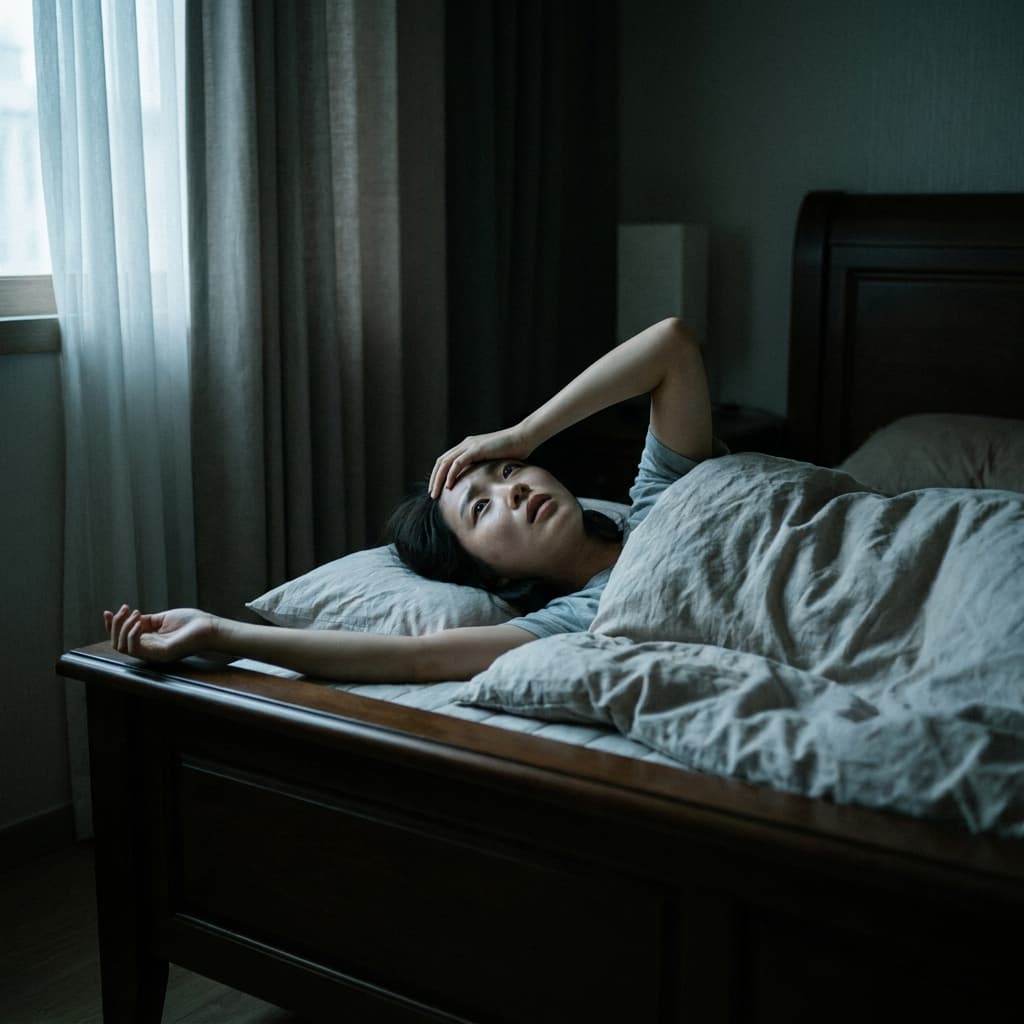
Why You Cant Sleep at Night: Why Its More Than Just Fatigue for Mid-40s
Hello. This is Dalimchae Korean Medicine Clinic. # Why You Can't Sleep at Night: Mid-40s, Why It's More Than Just Fatigue Are you finding yourself saying "I can't sleep at night" habitually lately, now that you're in your mid-40s? Even those who used to fall asleep as soon as their head hit the pillow often find themselves tossing and turning all night or waking up at dawn and unable to fall back asleep during this period. It's too much to dismiss as simple fatigue when daytime lethargy, irritability, and lack of concentration significantly interfere with daily life. When these sleepless nights repeat, you feel not just physically exhausted but mentally drained as well. 💡 **[Key Answer]** 3 most common causes of **"I can't sleep at night"**: ① Hormonal changes due to menopause / ② Autonomic nervous system imbalance / ③ Stress and psychological anxiety Dalimchae Clinic turns off the body's 'warning lights' that interfere with sleep through **autonomic stabilization** and helps the body regain balance on its own. ## Why do I suddenly start having trouble sleeping in my mid-40s? There are several complex reasons why many people complain of being unable to sleep at night as they enter their mid-40s. The most representative is 'menopause'. For women, as estrogen levels decrease, various menopausal symptoms such as hot flashes, night sweats, anxiety, and depression appear, and these symptoms directly interfere with sleep. Feelings of heat or cold sweats that come up before falling asleep disturb deep sleep, and emotional fluctuations and anxiety due to hormonal changes keep the brain from resting. In addition, imbalance in the autonomic nervous system is also a major cause. The autonomic nervous system, which regulates our body's sleep and wakefulness, consists of the sympathetic and parasympathetic nervous systems. When the sympathetic nervous system is excessively activated due to stress or hormonal changes, the brain stays in an excited state even at night, making it difficult to fall asleep. During this period, various social and psychological stress factors such as children's independence, support for parents, and occupational changes often overlap, making stabilization of the autonomic nervous system even more difficult. These factors act in combination to deepen sleep disorders, namely insomnia, in women in their mid-40s. ## How effective is Korean medicine treatment for menopausal insomnia? Since menopausal insomnia can lead to concerns about tolerance or side effects when depending on Western medical treatments such as sleeping pills, Korean medicine treatment is attracting attention as an effective alternative from a long-term perspective. In fact, the effectiveness and safety of Korean medicine treatment are being proven through various studies. A systematic literature review and meta-analysis study published in 'Frontiers in Pharmacology' in 2024 evaluated the effects and safety of East Asian Herbal Medicine (EAHM) on menopausal insomnia. Analysis of data from 6,035 patients participating in a total of 70 randomized controlled trials (RCTs) showed that the herbal medicine treatment group showed significant improvement in the Pittsburgh Sleep Quality Index (PSQI), which measures sleep quality, compared to the sedative-hypnotic control group (mean difference -2.18, 95% confidence interval -2.56 to -1.80). In addition, menopausal symptoms evaluated by the Kupperman Index also significantly decreased (-4.92, 95% confidence interval -6.03 to -3.80), and the incidence of side effects was significantly lower than that of sedative-hypnotics (risk ratio 0.15, 95% confidence interval 0.07-0.34). Based on these results, researchers concluded that herbal medicine can be effectively and safely utilized for the management of menopausal insomnia and overall menopausal symptoms. In another study, a systematic literature review and Bayesian network meta-analysis on non-pharmacological therapies published in 'Maturitas' in 2025 confirmed that various non-pharmacological therapies are effective in improving menopause-related insomnia. As a result of analyzing 44 final studies out of 1,925 studies, relaxation therapy, cognitive behavioral therapy, mindfulness, aromatherapy, acupuncture treatment, massage, yoga, and exercise were all found to significantly improve sleep quality. In particular, it emphasized that acupuncture treatment also has a positive effect on improving sleep quality. Based on this data, Dalimchae Clinic Incheon Branch focuses on resolving the imbalance of the autonomic nervous system, the fundamental cause of menopausal insomnia, and improving the sleep environment. Through complex treatments such as herbal medicine, acupuncture, moxibustion, and pharmacopuncture tailored to each patient's constitution and symptoms, we help increase the body's recovery power and regain healthy sleep patterns. ## Sleepless nights, comfort regained through autonomic stabilization If you can't sleep at night due to insomnia, this is an important warning signal sent by your body. In particular, insomnia in women in their mid-40s is not just a problem of sleep, but may mean that the 'autonomic nervous system', the control tower of our body, has overheated and lost its balance. When the balance of the autonomic nervous is broken, the brain cannot rest and continues to maintain a state of tension. At Dalimchae Clinic, we focus on **autonomic stabilization** treatment to correct this autonomic nervous system imbalance. Our body's autonomic nervous system consists of the sympathetic nervous system (excitation) and parasympathetic nervous system (relaxation), much like a car's accelerator and brake. When the sympathetic nervous system is excessively activated due to stress, menopausal hormonal changes, or overwork, the heart rate increases even at night, heat rises, and anxiety grows, making it difficult to fall into a deep sleep. In Korean medicine, this is seen as a state where the harmony of 'Suseunghwagang (水升火降)' is broken. In other words, it is healthy when the head is cool and the lower abdomen is warm, but due to imbalance, 'upper body heat' where heat rises to the head and the chest feels stuffy appears, interfering with sleep. Dalimchae Clinic focuses on lowering the excessive heat of the nervous system and creating an environment where the brain can rest comfortably. This is not simple symptom suppression, but a fundamental treatment that helps the body find its optimal balance and restore healthy sleep patterns on its own. This treatment helps improve not only insomnia but also various related diseases caused by autonomic nervous system imbalance such as headaches, dizziness, anxiety, and indigestion. Many people looking for an Incheon insomnia clinic are satisfied with this fundamental approach. ## Am I having menopausal insomnia? Symptom Checklist If 3 or more of the following items apply to you, you may suspect menopausal insomnia and autonomic nervous system imbalance. Consult with the medical staff at Dalimchae Clinic Incheon Branch to set an accurate diagnosis and treatment direction. * It takes more than 30 minutes to fall asleep. * I wake up more than 2 times a night and find it difficult to fall back asleep. * I wake up too early in the dawn and cannot fall back asleep. * The total sleep time is less than 6 hours for more than 3 days a week. * I feel fatigue, drowsiness, and lethargy during the day due to lack of sleep. * I feel that my concentration or memory has decreased. * I feel anxious or restless when I try to sleep. * I often wake up from sleep at night due to night sweats or hot flashes. * Emotional fluctuations become severe, and I get irritated easily even by small things. * I often feel my heart pounding or feel stuffy. **[Judgment Criteria]** * **3 or more apply:** Menopausal insomnia and autonomic imbalance suspected → Review Korean medicine complex treatment * **5 or more apply:** Immediate visit and professional medical consultation recommended ## FAQ: Frequently asked questions about menopausal insomnia **Q. How long does insomnia in my 40s last?** A. Insomnia in your 40s is often primarily caused by menopausal hormonal changes and autonomic nervous system imbalance, so it varies by individual but can last from several months to several years. If left without proper treatment, it can become chronic or lead to other problems such as depression and anxiety disorders, so early diagnosis is important. **Q. If I treat menopausal insomnia with Korean medicine, can I sleep without sleeping pills?** A. Yes, in many cases, you can regain healthy sleep without sleeping pills. Dalimchae Clinic Incheon Branch helps restore the body's ability to fall asleep on its own by regaining the balance of the autonomic nervous system, the fundamental cause. If you normalize body functions through herbal medicine, acupuncture, moxibustion, etc., you can experience comfortable sleep without drug dependency. **Q. Are there any foods or lifestyle habits good for when I can't sleep?** A. Foods that help with sleep include warm milk, lettuce, and cherries, and regular sleep habits, refraining from using smartphones before sleep, and light stretching can help. However, despite these efforts, if you continuously cannot sleep at night, it is important to seek professional help. **Q. I have headaches or dizziness along with insomnia, can they be treated together?** A. Yes, insomnia, headaches, and dizziness are all often closely related to the imbalance of the autonomic nervous system. Because Dalimchae Clinic's autonomic stabilization treatment deals with the fundamental cause of these complex symptoms together, accompanying symptoms such as headaches and dizziness can be improved along with insomnia. Can't sleep at night? Menopausal insomnia is not a problem that can be solved by enduring. You no longer have to ignore the signals your body has been sending for a long time. If you approach in the right direction, the body responds faster than you think. Bring your symptoms exactly as they are. At Dalimchae Clinic, we will find the cause together. Where life blooms. For herbal medicine, it's Dalimchae Korean Medicine Clinic. Check your symptoms similar to mine through the AI consultation on the Dalimchae Clinic website first! This article is health information compiled by Dalimchae medical staff based on questions frequently received in the treatment room. Medical Supervision | Brain/Autonomic Diagnosis Standards Dalimchae Clinic Incheon Branch Korean Medicine Doctor Min Jihong (Menopausal Column)