
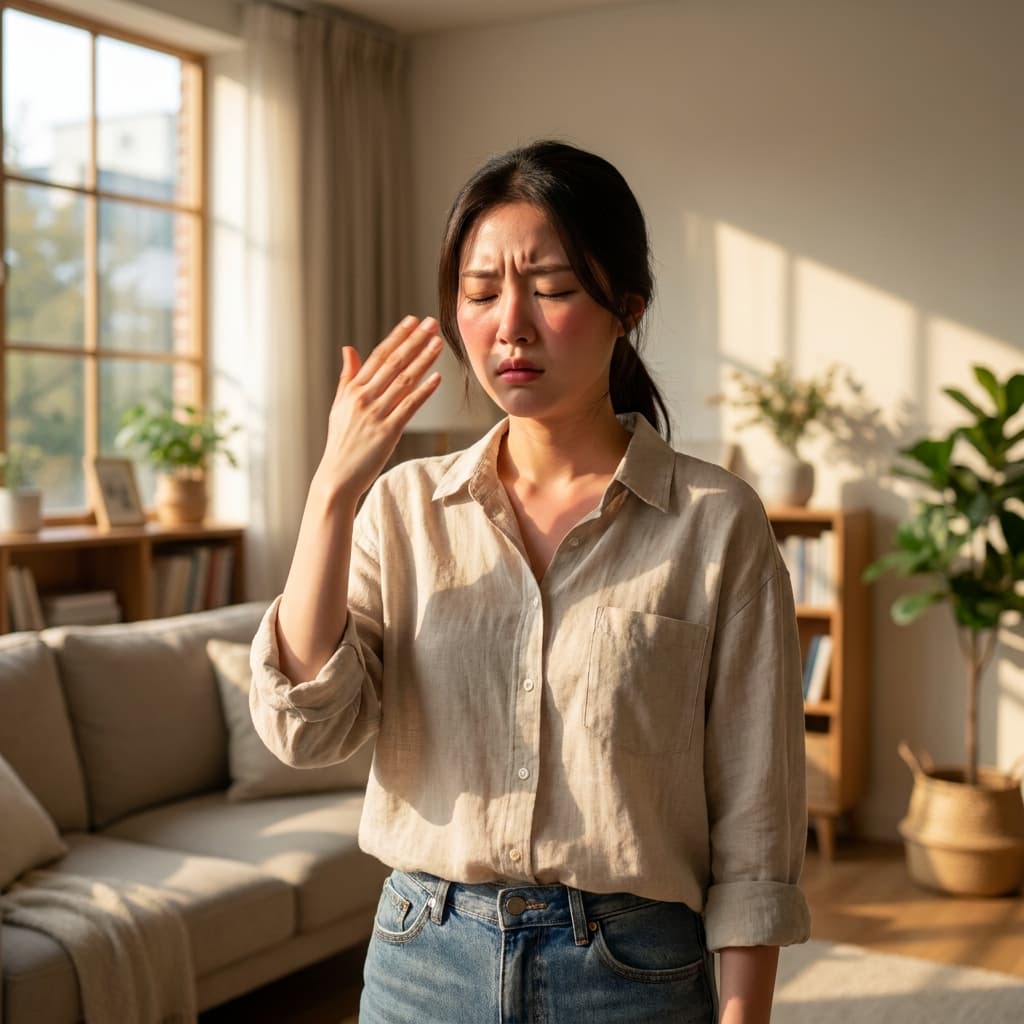
Why is my face suddenly flushing? Menopausal flushing vs General flushing
Hello. This is Dalimchae Korean Medicine Clinic. # Is Your Face Suddenly Flushing? Menopausal Hot Flashes: The Real Cause Different from General Flushing "My face suddenly feels hot." Are you experiencing a face that turns red every time you look in the mirror, and a burning heat sensation that makes even daily life difficult with a sudden burst of sweat? Especially for women entering menopause, these hot flashes and facial flushing can be a pain that significantly lowers the quality of life beyond simple heat. If you're just putting up with it, thinking it's a natural phenomenon everyone goes through, you might be missing an important signal your body is sending. 💡 **[Key Answer]** **3 most common causes of "sudden facial flushing" (menopausal hot flashes):** ① **Hormonal Imbalance**: Malfunction of the temperature control center due to decreased estrogen. ② **Autonomic Nervous System Overactivity**: Heat sensation occurring as blood vessels expand due to sympathetic nerve activation. ③ **Brain Heat (腦熱) and Upper Body Heat**: A Korean medicine perspective where heat is concentrated in the upper body due to brain overload. Dalimchae Clinic restores internal heat balance and resolves fundamental upper body heat through autonomic stabilization treatment. ## Why Do Menopausal Hot Flashes Feel Unusually Intense? Menopausal hot flashes are fundamentally different from general flushing where the face turns red simply because it's hot. During menopause, levels of the female hormone estrogen decrease sharply. This estrogen is a key substance that helps the temperature control center located in the hypothalamus of the brain function normally. When the hormone decreases, the hypothalamus mistakenly perceives the body as being 'excessively hot' even though the actual body temperature is normal. It's like a main sensor of a central heating boiler malfunctioning, turning on boiling heat for the upper floors while closing the valves for the lower floors. This brain malfunction immediately sends a signal to dissipate body heat, and in this process, the sympathetic nervous system among our body's autonomic nervous systems becomes excessively activated. As a result, capillaries in the upper body and facial area expand rapidly, and as blood rushes in, abnormal heat sensation, facial flushing, and night sweats are induced. According to research, menopausal hot flashes are associated with an acute decrease in cardiac vagal control (parasympathetic activity), suggesting that the autonomic nervous system plays an important role in the pathophysiology of hot flashes. Also, there are research results showing that objectively measured hot flashes are related to increased sympathetic activity. Therefore, menopausal hot flashes are not simple heat sensations but a complex symptom resulting from hormonal changes and autonomic nervous system disturbance. ## General Facial Flushing vs. Menopausal Hot Flashes: What's the Difference? General facial flushing mainly occurs due to skin irritation, emotional changes (tension, embarrassment), excessive drinking, or consumption of certain foods, and often subsides in a relatively short time. It's a phenomenon where blood vessels on the skin surface expand. However, menopausal hot flashes originate from fundamental changes within the body—hormonal imbalance and the resulting autonomic nervous system disturbance—rather than these external factors. Menopausal hot flashes often involve heat suddenly surging up to the face, neck, and chest area accompanied by sweat, and can last from a few seconds to several minutes or more. These symptoms can repeat several times a day and often appear at night, interfering with sleep and increasing fatigue. Also, menopausal hot flashes tend to be strongly accompanied by other menopausal symptoms such as headaches, insomnia, dizziness, heart palpitations, and anxiety. It's not a simple skin problem, but a signal informing of systemic health changes. ## Menopausal Hot Flashes: 'Overheating of the Autonomic Nervous System' is the Real Cause. Dalimchae Clinic does not view menopausal hot flashes simply as a lack of hormones. We diagnose it as a state where the autonomic nervous system imbalance triggered by hormonal changes, i.e., our body's 'heat regulation system,' is overheated. Stress and hormonal changes overheat the heart and interfere with the 'Suseunghwagang (水升火降)'—the body's natural energy circulation where the cold energy of the kidneys rises and the hot energy of the heart descends. Just as water in a pot boils over quickly with even a small spark when there's little water, 'Heoyeol (虛熱)'—where the face suddenly flushes and sweat occurs with even minor stimuli—occurs when the body's essential fluids (Jin-aek) are insufficient. This autonomic imbalance excessively activates the sympathetic nervous system, causing blood vessels to contract and expand, and deepens the 'Sangyeolhahan (上熱下寒)' phenomenon where heat is concentrated only in the upper body. If the brain cannot rest and is overloaded, the malfunction of the temperature control center inevitably becomes more severe. Dalimchae Clinic focuses on stabilizing this 'overheating of the autonomic nervous system.' We lower the heat of the nervous system, create an environment where the brain can rest, and help restore the broken Suseunghwagang balance so that heat is distributed evenly throughout the body. ## How Does Korean Medicine Treat Menopausal Hot Flashes? Korean medicine treats menopausal hot flashes by focusing on restoring the balance of the autonomic nervous system and harmonizing the body's Qi and Blood—the fundamental causes—rather than simple symptom suppression. We apply a combination of Korean medicine treatments such as herbal medicine, acupuncture, moxibustion, and pharmacopuncture tailored to each individual's constitution and symptom type. A meta-analysis study published in the journal *Complementary Therapies in Clinical Practice* in 2022 analyzed the effects of ginseng on the health management of menopausal women. This study reviewed a total of 15 randomized controlled trials (RCTs) and reported that ginseng significantly reduced menopausal symptoms compared to placebo in three studies involving a total of 515 patients (Standardized Mean Difference (SMD): -0.40, 95% Confidence Interval: -0.73 to -0.07, p = 0.02). In particular, it showed a statistically significant reduction effect for hot flash symptoms (SMD: -0.34, 95% CI: -0.66 to -0.01, p = 0.04). Researchers concluded that ginseng can significantly improve hot flashes and overall menopausal symptoms and quality of life in menopausal women. These research results provide a basis for the effectiveness of herbal medicine prescriptions utilizing ginseng in alleviating menopausal hot flash symptoms. Acupuncture treatment is also known to be effective for menopausal hot flashes. According to research results published in the journal *Menopause* in 2016, led by Dr. Nancy Avis of Wake Forest University in the US, acupuncture treatment for 209 women aged 45 to 60 with menopausal symptoms showed that nearly half of the 170 patients who received acupuncture reported a 50% or more reduction in symptoms during the study period. In particular, 10% of patients who responded well to acupuncture treatment showed an 85% or more reduction effect. This study suggests that acupuncture treatment can show rapid and clear effects on vasomotor symptoms such as menopausal hot flashes and night sweats. Based on this data, Dalimchae Clinic Incheon Branch provides complex Korean medicine treatment that improves the autonomic imbalance of patients suffering from menopausal hot flashes and restores body heat balance. By precisely diagnosing individual symptoms and constitutions, we solve the fundamental cause through the most appropriate herbal prescriptions, acupuncture, and pharmacopuncture, and help patients have a healthy menopause by preventing recurrence beyond simple symptom relief. For those looking for a Songdo menopausal hot flash clinic, these Korean medicine treatments can be an effective alternative to manage symptoms without the burden of side effects. ## If Left Untreated, Menopausal Hot Flashes Can Worsen Other Menopausal Symptoms. Menopausal hot flashes go beyond the simple discomfort of a red face and can accompany or worsen various menopausal symptoms such as insomnia, anxiety, depression, headaches, dizziness, and chronic fatigue. Especially, night sweats and hot flashes appearing at night seriously lower the quality of sleep, adversely affecting the next day's condition and leading to chronic fatigue. If these symptoms persist, not only does the quality of life decrease, but they can also develop into lethargy and depression. Dalimchae Clinic treats various menopausal symptoms, including hot flashes, integrally, focusing on regaining the balance of the autonomic nervous system and promoting overall body vitality. As an Incheon autonomic nerve clinic, we precisely diagnose individual body conditions and establish customized treatment plans to help patients spend a healthy and happy menopause. ### Menopausal Hot Flash Self-Checklist Check how many of the following items apply to you. * I often experience heat suddenly surging up to my face, neck, and chest. * There are many cases where sweat suddenly bursts out along with the heat sensation. * I wake up at night due to heat and sweat, or it's hard to fall asleep. * My heart often palpitations and I feel anxious for no particular reason. * My skin feels dry, dull, and has lost elasticity. * I feel headaches or dizziness for no reason. * Mood swings become severe and I get irritated or angry at trivial things. * Symptoms of cold or numb hands and feet are accompanied. * Fatigue does not disappear easily and feels chronic. * I have been diagnosed with menopause or belong to the age group before or after menopause. **Result Determination:** * **3 or fewer items:** Mild autonomic imbalance suspected. Lifestyle improvement and regular check-ups recommended. * **4-6 items:** High possibility of menopausal hot flashes and autonomic nervous system disturbance. Korean medicine examination and complex treatment review. * **7 or more items:** Serious stage of autonomic function decline and worsening menopausal symptoms. Immediate visit to a clinic and professional treatment recommended. --- **Q. How long do menopausal hot flashes last?** A. There are large individual differences, but they usually last about 5-10 years before and after menopause. In severe cases, they may last longer and lower the quality of life, so active management is necessary. **Q. Can menopausal hot flashes heal naturally?** A. Some mild hot flashes may subside naturally over time, but most do not disappear easily unless the hormonal changes and autonomic imbalance are resolved. If neglected, they can worsen other menopausal symptoms. **Q. How is general facial flushing different from menopausal hot flashes?** A. General facial flushing is often a temporary blood vessel expansion due to external stimuli or emotional changes. On the other hand, menopausal hot flashes are mainly caused by a temperature control center malfunction due to decreased estrogen and autonomic nervous system imbalance, and are characterized by being accompanied by heat sensation and sweat. **Q. Does herbal medicine only use prescriptions that lower heat when treating menopausal hot flashes?** A. At Dalimchae Clinic, beyond simply lowering heat, we supplement insufficient fluids (Jin-aek) and help Qi and Blood circulation according to the patient's constitution and symptoms. Also, we proceed with customized herbal prescriptions that regain body balance by lowering autonomic nervous system tension. --- Menopausal hot flashes are not a problem that can be solved by enduring. You no longer have to ignore the signals your body has been sending for a long time. If you approach in the right direction, the body responds faster than you think. Bring your symptoms as they are. At Dalimchae Clinic, we will find the cause together. Where life blooms. For herbal medicine, it's Dalimchae Korean Medicine Clinic. Check your symptoms similar to mine through the AI consultation on the Dalimchae Clinic website first! This article is health information compiled by Dalimchae medical staff based on questions frequently received in the treatment room. Medical Supervision | Skin Symptom Treatment Standards Dalimchae Clinic Incheon Branch Korean Medicine Doctor Yang Yuchan (Skin Symptom Column)