
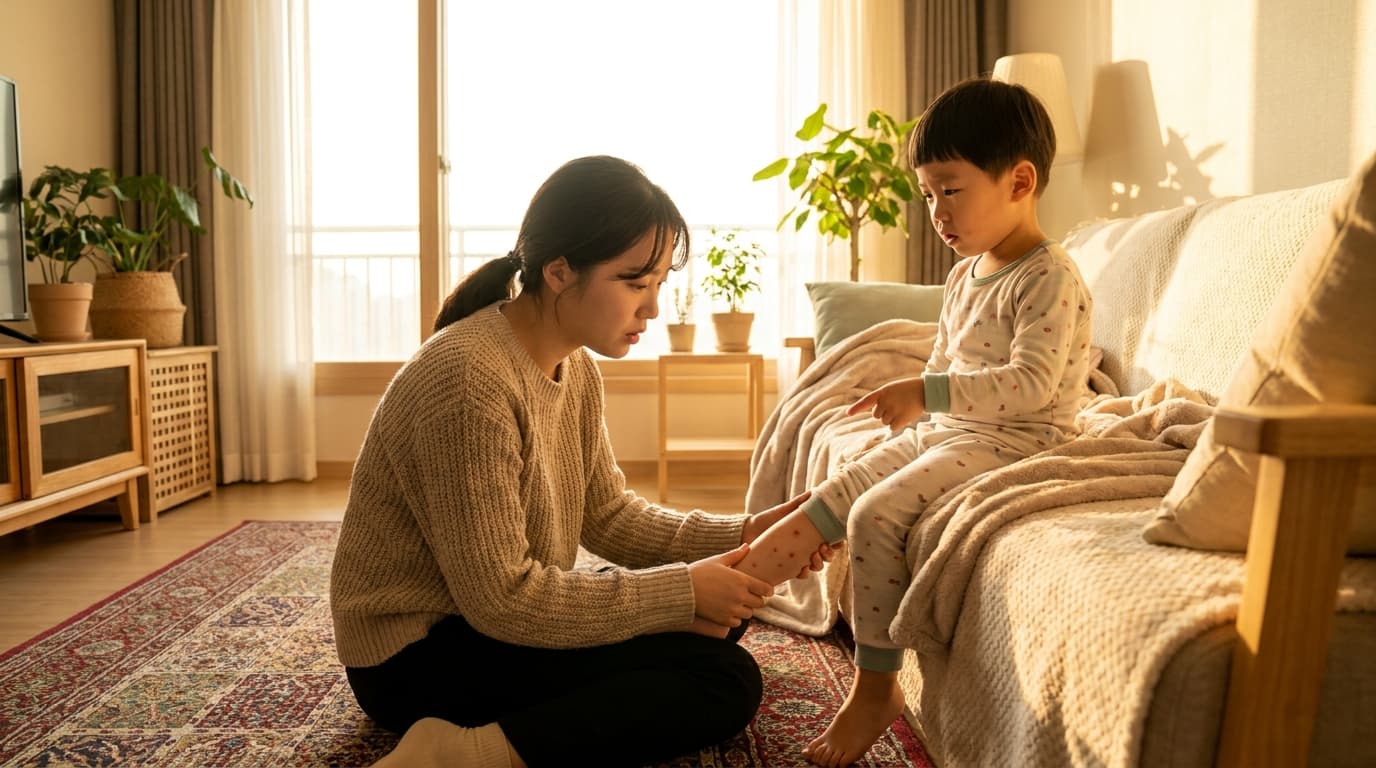
Why Early Treatment Is Important for Purpura Not Just Heat Rash When Red Spots Appear on a Child's Leg
안녕하세요. 달임채한의원입니다. # Why Early Treatment Is Important for Purpura Not Just Heat Rash When Red Spots Appear on a Child's Leg "A red spot appeared on my child's leg." When parents suddenly notice red spots on their child's leg who was playing actively as usual, their hearts become heavy with anxiety and worry about a potential illness. Many cases end up visiting a Korean medicine clinic belatedly after waiting and thinking it was a simple heat rash or hives, only for symptoms to worsen or unexpected complications to arise. In particular, childhood purpura has mild initial symptoms making it easy to mistake for a simple skin problem, but it is deeply related to abnormalities in our body's immune system and should never be taken lightly. 💡 **[Core Answer]** **The 3 most common causes of purpura with red spots on a child's leg:** ① Vascular inflammation due to immune system imbalance / ② External stimuli such as colds and medication, and stress / ③ Blood circulation abnormalities due to 'blood heat' and 'stasis' in Korean medicine. Dalimchae Korean Medicine Clinic helps prevent the recurrence of purpura and supports fundamental recovery through constitutional improvement treatments that correct the root of this immune imbalance. ## Why Do Red Spots Suddenly Appear on a Child's Leg? Many parents wonder why such sudden symptoms appear when they see red spots on their child's leg. Purpura is a condition where bleeding occurs in small blood vessels under the skin, resulting in red or purple spots, mainly appearing on areas affected by gravity such as legs and arms. The fundamental cause of such purpura lies in abnormalities of the immune system and inflammatory reactions of blood vessels. Our body's immune system plays an important role in protecting the body from external invaders, but when the balance of the immune system collapses due to stress, overwork, frequent infections, or poor dietary habits, it can cause an autoimmune response attacking itself. This immune imbalance causes inflammation in blood vessels, weakening blood vessel walls and resulting in bleeding. In pediatric purpura, it often occurs after viral infections such as colds or upper respiratory infections, and hypersensitivity reactions to certain medications or foods can also be causes. In Korean medicine, this immune imbalance is explained as problems of 'blood heat (血熱)' and 'blood stasis (瘀血)'. In other words, unnecessary heat accumulates inside the body making blood turbid (blood heat), and in the process where blood circulation stagnates and waste accumulates due to this (blood stasis), blood vessels are damaged and red spots appear. This blood circulation problem is also deeply related to autonomic nervous system regulation abnormalities. ## Purpura, Does It Apply to My Child As Well? Symptom Checklist Check through the following questions to see if your child's symptoms correspond to purpura. **3 or more items apply** → Suspected immune imbalance purpura → Consider Korean medicine complex treatment **5 or more items apply** → Immediate clinic visit and precise medical examination recommended * □ Did red spots that do not disappear when pressed appear on your child's legs or buttocks? * □ Do they frequently complain of abdominal pain along with spots, or experience diarrhea and vomiting? * □ Do they experience joint pain, especially swelling and pain in the knees or ankles? * □ Did spots appear after suffering from a cold or upper respiratory infection? * □ Does urine color become darker or foam significantly? (Kidney complication possibility) * □ Is immunity normally weak and frequent minor illnesses experienced? * □ Does purpura recur repeatedly even after steroid treatment? * □ Do you frequently experience loss of appetite or indigestion symptoms? These symptoms can mean that a red light has turned on in our child's immune system beyond a simple skin rash. In particular, when accompanied by systemic symptoms such as abdominal pain, joint pain, and kidney involvement, closer observation and treatment are required. ## How Does Korean Medicine View and Treat Purpura? Korean medicine does not view purpura simply as symptoms appearing on the skin, but understands it as a result of broken balance throughout the entire body. In particular, the goal is to improve 'constitution', which is closely related to decreased immunity, to prevent recurrence of symptoms and recover fundamental health. Dalimchae Korean Medicine Clinic Songdo branch improves children's constitution centered on herbal medicine treatment that removes blood heat and blood stasis, which are the causes of purpura, and enhances immunity. Research results on the effectiveness of Korean medicine treatment have actually been reported. A meta-analysis published in the BioMed Research International journal in 2024 evaluated the clinical efficacy of Chinese/Korean medicine in treating adult Henoch-Schönlein purpura (the medical term for purpura). Analyzing 18 clinical studies involving a total of 1632 patients (811 in the experimental group, 821 in the control group), the study confirmed that Korean medicine treatment alone or in combination with Western medicine treatment is more effective than Western medicine treatment alone in overall efficacy and improvement of skin purpura, digestive, and joint symptoms. In particular, the overall clinical response rate in the experimental group was significantly higher than in the control group (OR = 6.04, 95% CI [4.01, 9.10], p \< 0.001), and a statistically significant difference was also shown in skin purpura symptom improvement (SMD = -1.09, 95% CI [-1.22, -0.96], p \< 0.001). The researchers concluded that these results suggest Korean medicine shows superior efficacy in treating purpura. In addition, a systematic review study published in the journal Complementary Therapies in Medicine in 2015 analyzed the efficacy and safety of herbal medicine adjuvant treatment in 1112 children with Henoch-Schönlein purpura without kidney damage (including 15 clinical trials). As a result of this study, oral herbal medicine adjuvant treatment reduced kidney damage (6 trials, RR 0.47, 95%CI 0.31-0.72, I(2)=0%) and shortened purpura resolution time (5 trials, mean difference -3.60 days, 95%CI -4.21 ~ -2.99, I(2)=23%). It also suggested that it can have a positive effect on reducing joint pain (5 trials, mean difference -1.04, 95%CI -1.33 ~ -0.74, I(2)=1%) and abdominal pain (5 trials, mean difference -1.69, 95%CI -2.51 ~ -0.86, I(2)=74%). Researchers stated that no serious adverse effects were reported. Based on these data, Dalimchae Korean Medicine Clinic Songdo branch aims for fundamental treatment by prescribing customized herbal medicine that calms blood vessel inflammation and strengthens immunity according to children's constitution and symptoms. ## Pediatric Purpura, Fundamental Treatment to Prevent Recurrence? Purpura is known as a disease with a high recurrence rate once it occurs. In particular, if not treated properly when symptoms first appear, the risk of becoming chronic or leading to kidney complications increases. Therefore, the treatment of purpura requires a fundamental approach that goes beyond simply eliminating visible symptoms to restoring our body's immune balance and preventing recurrence. The constitutional improvement treatment of Dalimchae Korean Medicine Clinic Songdo branch focuses not just on suppressing symptoms, but on cultivating the body's own power to overcome illness. This is like making a body that doesn't turn back on rather than just turning off symptoms. By finding and resolving the root causes that weaken children's immune systems, it can have a positive effect on other immune-related diseases such as atopic dermatitis, rhinitis, and frequent colds. In addition, when improvement efforts across daily life such as dietary habits, sleep habits, and stress management are combined with purpura treatment, faster and more stable recovery can be expected. If you are looking for a Songdo purpura Korean medicine clinic, please consider customized Korean medicine treatment considering your child's overall health and growth. Q. How long should pediatric purpura be treated? A. Purpura treatment duration varies depending on the child's symptom severity, constitution, and presence of complications. Generally, intensive treatment is required for about 1 to 3 months initially, and steady management is important for recurrence prevention. Q. Can purpura heal naturally? A. Some mild purpura may improve naturally, but it can recur or be accompanied by complications such as abdominal pain, joint pain, and kidney problems, so it is important to consult a medical professional and receive appropriate treatment early. Q. Purpura and atopic dermatitis are together, can they be treated together? A. Yes, since purpura and atopic dermatitis are both closely related to immune system imbalance, the constitutional improvement treatment of Dalimchae Korean Medicine Clinic can address the root causes of both diseases together and help improve symptoms simultaneously. Red spots appearing on a child, purpura is not a problem that can be solved by enduring. You no longer have to ignore the body's signals sent for a long time. When approached in the right direction, the body responds faster than you think. Bring the symptoms you are experiencing right now as they are. Dalimchae Korean Medicine Clinic Songdo branch will help you find the causes together and help your child regain a healthy daily life. A place where life blooms. Herbal medicine is Dalimchae Korean Medicine Clinic. Check your similar symptoms first through the Dalimchae Korean Medicine Clinic website AI consultation! This health information was compiled together by Dalimchae medical staff based on questions frequently received in the clinic room. Medical Supervision | Dermatology treatment standards Dalimchae Korean Medicine Clinic Songdo branch Korean medicine doctor Hyunmin Oh (Purpura Column)