
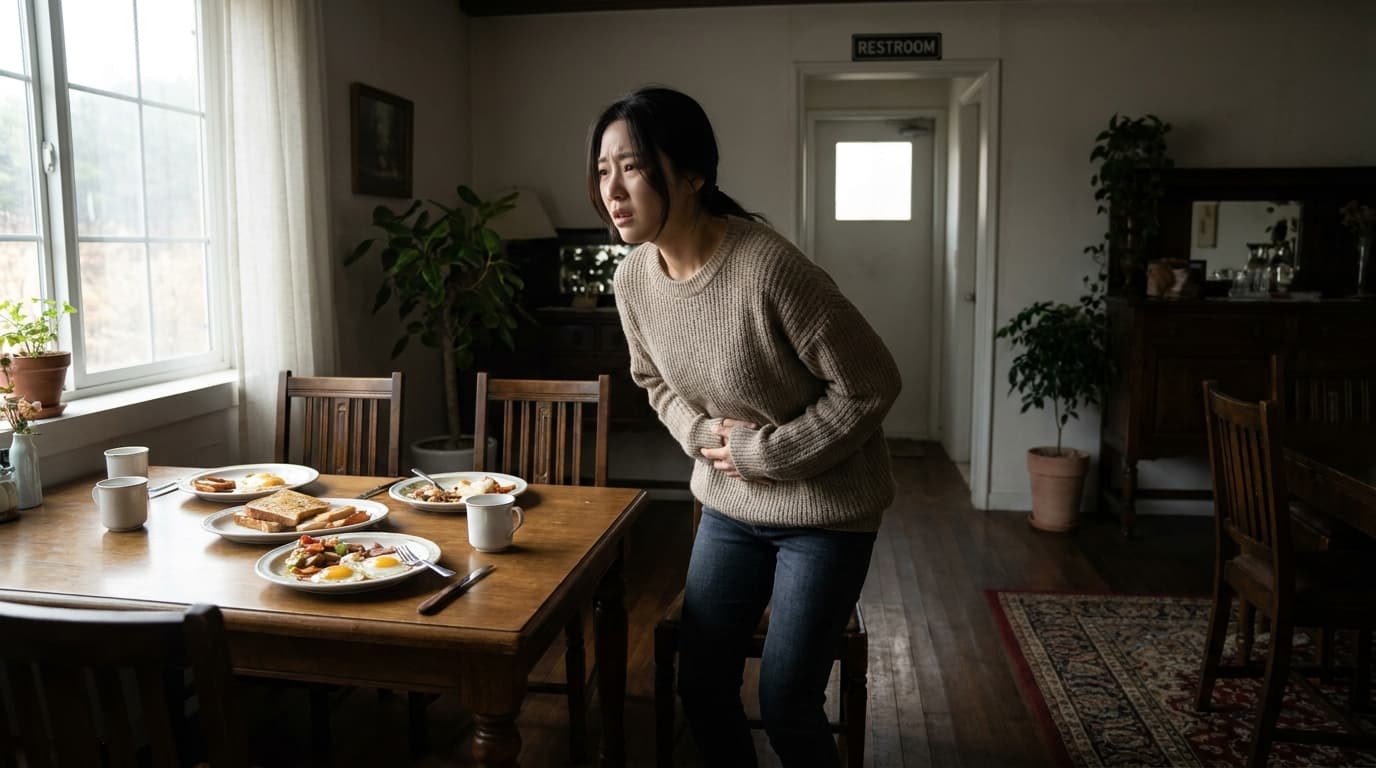
Why Do I Run to the Restroom Right After Eating? Time for Your Tired Gut to Find Comfort.
Hello, this is Dalimchae Korean Medicine Clinic. # Why Do I Run to the Restroom Right After Eating? Time for Your Tired Gut to Find Comfort. Do you experience a bloated stomach and find yourself rushing to the restroom as soon as you finish a meal, day after day? Why do I run to the restroom right after eating? This discomfort can severely impair our daily lives and quality of life. In particular, feeling anxious before eating out or important appointments, and having to check for the nearest restroom first, is a common suffering for patients with irritable bowel syndrome (IBS). While people often say your gut is just sensitive, understanding and solving the exact cause of that sensitivity is never easy. 💡 **[Core Answer]** The 3 most common causes of **"Why do I run to the restroom right after eating?"**: ① **Excessive stress and tension** / ② **Gut microbiome imbalance** / ③ **Gastric motility abnormalities** Dalimchae Korean Medicine Clinic helps restore fundamental gut health through gut detoxification and autonomic stabilization treatment approaches. ## Why You Have to Run to the Restroom Right After Eating: Is It Really Just Being Sensitive? Going to the restroom immediately after a meal is one of the representative patterns of Irritable Bowel Syndrome (IBS). Many people dismiss it as "a sensitive gut" or "psychosomatic," but our gut actually possesses a complex neural network so closely communicating with the brain that it is called the "second brain." This is known as the \"Gut-Brain Axis.\" Psychological factors such as stress and anxiety directly affect the brain, which in turn influences the autonomic nervous system that regulates gut motility and sensation. In other words, when you are stressed, your gut reacts hypersensitively. Additionally, imbalance in the gut microbiome environment is a crucial factor. A healthy gut maintains a balance between various beneficial and harmful bacteria, but when this balance is disrupted due to poor dietary habits, medication use, or stress, gut permeability increases, making it prone to inflammatory responses. Consequently, undigested food debris or toxins can travel through the bloodstream throughout the body, causing chronic gut trouble. Abnormal gastric motility is also an issue. When food is ingested, the gut moves contents downward via peristalsis, but if this movement is too rapid or irregular, it induces diarrhea before proper digestion occurs. The background of this discomfort where patients "run to the restroom right after eating" stems from these complex causes. Many patients visiting the Songdo IBS Korean medicine clinic nod in agreement upon hearing explanations of these complex causes. ## Irritable Bowel Syndrome: How Does Korean Medicine Make Your Gut Comfortable? At Dalimchae Korean Medicine Clinic, IBS is not viewed merely as a local gut problem. We comprehensively consider the imbalance of the gut-brain axis, the gut microbiome environment, and gastric motility issues to aim for fundamental treatment. In particular, through **'Gut Detoxification'** treatment, which detoxifies toxins accumulated on the gut wall and normalizes gut function, we help the gut regain its own functions. According to a 2026 report in Minjok Medicine News by a joint research team led by Dr. Kim Hyung-jun and Dr. Choi Yu-jin from the Korea Institute of Oriental Medicine, along with Professor Kim Jin-sung and Professor Hana-yeon from Kyung Hee University, administering Kwakjeong-tang-gami to 60 adult patients with diarrhea-predominant IBS for 4 weeks showed a treatment response rate more than twice as high as the placebo group. Specifically, the overall symptom improvement rate of the Kwakjeong-tang-gami group was 55.2%, significantly higher than the 26.7% of the placebo group, and zero drug-related side effects or adverse events occurred during the treatment period, proving its safety. The researchers concluded that this result provides clinical evidence that Kwakjeong-tang-gami is effective in improving symptoms for diarrhea-predominant IBS patients. These research findings are in perfect harmony with the treatment philosophy of Songdo Dalimchae Korean Medicine Clinic, which ensures patient gut comfort through gut detoxification. Furthermore, in a clinical study published in 2020, administering an essential oil complex of Zataria multiflora, Anethum graveolens, and Trachyspermum ammi for 2 weeks to 60 IBS patients showed significant symptom improvement compared to the control group (hyoscine butylbromide). As a result of the study, the IBS Symptom Severity Scale (IBS-SSS) improved by 87% in the herbal combination treatment group, whereas it improved by only 34.4% in the control group, showing a statistically significant difference (P \< 0.001). Abdominal pain, bloating, bowel movement frequency, and stool consistency also notably improved in the herbal combination treatment group. The researchers concluded that such medicinal plant-based treatments can be an effective and safe alternative for IBS patients. Based on these research data, Dalimchae Korean Medicine Clinic provides treatments that improve the gut environment, restore autonomic balance, and lower gut hypersensitivity. ### Gut Detoxification: Restoring the Gut's Innate Healing Power The 'Gut Detoxification' treatment at Dalimchae Korean Medicine Clinic does not merely suppress symptoms. It focuses on removing waste products and toxins accumulated on the gut wall, creating an environment favorable for beneficial bacteria, and enhancing the gut's own immunity and recovery capacity. It is akin to thoroughly cleaning and reorganizing old plumbing. Once gut toxins are removed, inflammatory responses decrease, gut motility stabilizes, and symptoms such as abdominal pain, diarrhea, and constipation naturally improve. Patients visiting the Songdo gut detoxification clinic experience overall physical condition improvement alongside digestive function enhancement. Because gut health is directly linked to whole-body immunity, gut detoxification positively impacts various related symptoms such as skin issues and chronic fatigue. ## Could You Also Have IBS? Symptom Checklist If you correspond to 3 or more of the following items, it is recommended to suspect IBS and consult a specialist. * You feel the urge to go to the restroom within 1 hour after eating. * Bowel movements tend to relieve abdominal pain after it occurs. * Constipation and diarrhea alternate, or a specific type of bowel irregularity repeats. * Stool consistency is irregular, and a feeling of incomplete evacuation is frequent. * When stressed or tense, your stomach hurts more and you visit the restroom more often. * Abdominal bloating, frequent gas, belching, or flatulence occur often. * Indigestion and a stuffy feeling in the stomach are frequent. **Judgment Criteria:** * 3 or more items → Suspect IBS → Consider herbal combination treatment * 5 or more items → Immediate visit for precise diagnosis recommended ## FAQ – Frequently Asked Questions About IBS **Q. How long do I need to treat IBS?** A. While IBS tends to be chronic, the duration of treatment varies depending on individual symptom severity, causes, and lifestyle improvement efforts. Usually, concentrated treatment and steady management over several weeks to months can significantly alleviate symptoms and prevent recurrence. **Q. Can the symptom of running to the restroom right after eating be treated with Korean medicine?** A. Yes, it can be sufficiently treated. At Dalimchae Korean Medicine Clinic, we view these symptoms as stemming from complex causes such as gut-brain axis imbalance, gut microbiome issues, and gastric motility abnormalities, and we support fundamental improvement through gut detoxification and autonomic stabilization treatment. **Q. Can IBS heal naturally?** A. Temporary symptom relief may occur, but without resolving root causes, recurrence is likely. If left unattended, it can become chronic and lead to other digestive disorders such tamjeok or reflux esophagitis, making active treatment important. **Q. I have both IBS and stress-induced gastritis. Can they be treated together?** A. Yes, they can be treated together. Since stress and autonomic nervous system imbalance are the primary causes for both conditions, Dalimchae Korean Medicine Clinic's gut detoxification and autonomic stabilization treatment is effective in simultaneously improving both sets of symptoms. The discomfort of running to the restroom right after eating is not a problem to be endured. You no longer need to turn away from the signals your body has been sending for a long time. When approached in the right direction, the body responds faster than you think. Bring the symptoms you are experiencing right now as they are. Dalimchae Korean Medicine Clinic will find the cause together with you. A place where life blossoms. Herbal medicine is, after all, Dalimchae Korean Medicine Clinic. Check your similar symptoms first through the AI consultation on the Dalimchae Korean Medicine Clinic website! This article is health information organized together by Dalimchae medical staff based on questions frequently received in the consulting room. Medical Supervision | Department of Gastrointestinal Medicine Standards, Dalimchae Korean Medicine Clinic Songdo Branch, Korean Medicine Doctor Oh Hyunmin (Digestive Column)