
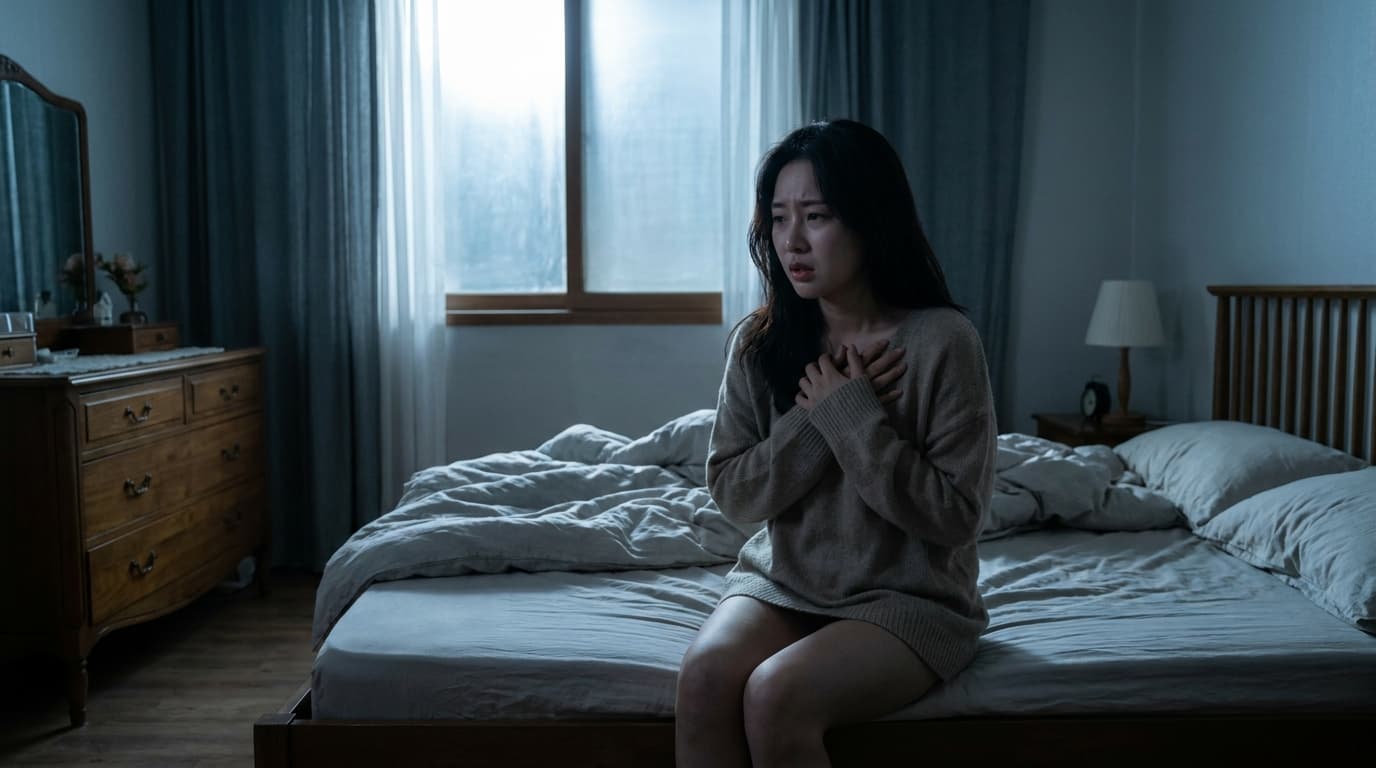
When Your Chest Feels Tight and Breathing Is Difficult, Internal Medicine or Psychiatry? The Real Cause Is Elsewhere.
Hello, this is Dalimchae Korean Medicine Clinic. # When Your Chest Feels Tight and Breathing Is Difficult, Internal Medicine or Psychiatry? The Real Cause Is Elsewhere. Have you ever suddenly felt your chest tightening and your breathing becoming difficult, leading you to visit internal medicine out of concern for your heart? Or perhaps you considered psychiatry due to unexplained anxiety accompanied by a suffocating feeling pressing down on your chest. Indeed, many people visit hospitals with such symptoms, only to be told that test results are 'normal,' leaving them feeling helpless. However, just because tests show no special abnormalities does not mean you should ignore the signals your body is sending. These symptoms that appear when your chest feels tight and breathing is difficult often originate from an imbalance in the autonomic nervous system, our body's vital regulatory system. 💡 **[Core Answer]** Top 3 most common causes when your chest feels tight and breathing is difficult: ① Autonomic imbalance caused by excessive stress / ② Neural hypersensitivity due to brain overload / ③ Weakened heart function and emotional instability. Dalimchae Korean Medicine Clinic helps restore a comfortable and healthy state of body and mind through autonomic stabilization treatment. ## Could It Be Autonomic Ataxia? Why Does It Hurt When Tests Are Normal? "The feeling that breath cannot be drawn all the way to the end," "The sensation of a heavy stone resting on the pit of the stomach." These are the most common descriptions shared by those complaining of chest tightness and difficulty breathing. More than half of the patients visiting emergency rooms with these symptoms turn out to have 'non-cardiac' causes rather than heart problems. Research results also show that 41% to 88% of non-cardiac chest pain patients are accompanied by anxiety disorders or depression. This means it is highly likely to be a warning sign of the autonomic nervous system controlling the overall balance of our body, rather than simply a problem with heart or lung function alone. The autonomic nervous system is a core system maintaining life activities regardless of our will, such as heartbeat, respiration, digestion, and body temperature regulation. The sympathetic nervous system handles tension and activity, while the parasympathetic nervous system handles relaxation and recovery; when the two are in balance, our body remains stable. However, modern people's excessive stress, irregular lifestyle habits, and sleep deprivation excessively hyperactivate the sympathetic nervous system and weaken parasympathetic function, causing autonomic imbalance. When the balance of the autonomic nervous system collapses like this, the brain continues to be unable to rest and functions like an overheated engine. Such a state leads to physical symptoms such as palpitation, chest tightness, and dyspnea, as well as emotional problems such as anxiety disorders and panic disorders. ## How Does Korean Medicine View Chest Tightness? In Korean medicine, chest tightness and difficulty breathing are viewed as 'chest oppression' (胸悶) or 'palpitation' (心悸亢進), and their cause is not viewed simply as a problem of a specific organ alone. Rather, it is interpreted as originating from functional imbalances of the five viscera and six bowels—such as the heart, liver, and spleen—and stagnation of qi and blood circulation. In particular, when stress becomes severe, the liver's qi becomes stagnated (hepatic qi stagnation), or the heart and gallbladder's functions become weakened (timidity of heart and gallbladder), which can induce anxiety along with chest tightness. In other words, even though you received a diagnosis that tests show no abnormalities, the fact that your body continues to feel uncomfortable is likely due to 'functional' problems that were not caught—in other words, autonomic imbalance where bodily harmony has broken down. Dalimchae Korean Medicine Clinic's Incheon branch meticulously examines patients' symptoms based on this approach. ## Korean Medical Research Results on Chest Tightness and Anxiety Korean medicine researches various treatment methods to improve symptoms caused by autonomic imbalance. In a systematic review published in the *Autonomic Neuroscience* journal in 2022 by Ji-Eun Lee, A-Ram Cho, and Y. Nakagawa's research team, the efficacy of Korean medical treatments for autonomic ataxia was comprehensively analyzed. This study included 22 related clinical studies and concluded that both herbal medicine and acupuncture treatments showed significant effects in improving heart rate variability (HRV) indicators and alleviating autonomic ataxia symptoms. This suggests that Korean medical treatment can be an effective intervention for restoring autonomic balance. In addition, according to the research results of Professor Jung-Mi Park's team in the Department of Internal Korean Medicine at Kyung Hee University Hospital at Gangdong in 2020, administering the herbal medicine 'Pyeongjinsumseonsan' to chronic chest pain without special causes such as cardiac or respiratory issues confirmed that pain intensity significantly decreased from moderate to mild. This study explained that Pyeongjinsumseonsan is expected to be actively utilized for unexplained chest tightness as well, as it has symptom-improving effects not only on cardiac chest pain such as angina pectoris but also on non-cardiac chest pain such as reflux esophagitis and panic/anxiety disorders. These research results align with the treatment philosophy pursued by Dalimchae Korean Medicine Clinic's Songdo branch. Rather than simply suppressing symptoms, it aims to improve autonomic imbalance, the root of symptoms, promote physical and mental stability, and foster the body's own power to recover. ## How Does Dalimchae Korean Medicine Clinic's Autonomic Stabilization Treatment Work? Symptoms that appear when your chest feels tight and breathing is difficult are like warning lights sent by our body's autonomic nervous system. Dalimchae Korean Medicine Clinic focuses on autonomic stabilization treatment that goes beyond turning off these warning lights to finding the fundamental balance of the body so they do not turn on again. Just as an unbalanced autonomic system prevents the brain from resting and overheats it, excessive neural excitation causes imbalances throughout the body. Dalimchae Korean Medicine Clinic's autonomic stabilization treatment proceeds with the following principles: 1. Calming Overheated Brain and Nervous Systems: Stabilize the sympathetic nervous system excited by stress and overwork, and increase parasympathetic activity to create an environment where the brain can comfortably rest. In Korean medicine, this is called 'Water Up and Fire Down' (水昇火降), aiming for harmony where hot energy is lowered and cold energy is raised. 2. Improving Qi and Blood Circulation: Communicate blocked energy and supplement deficient blood to smooth systemic circulation. Alleviate chest pressure and comfortably assist respiration by resolving qi stagnation, one of the main causes of chest tightness. 3. Strengthening Body and Mind Functions: Reinforce weakened heart and spleen (digestive) functions to relieve physical fatigue and reduce anxiety to help regain psychological stability. Ultimately, this contributes to raising the body's resistance to stress and preventing recurrence of symptoms. At Dalimchae Korean Medicine Clinic, we precisely diagnose each individual's autonomic state through pulse wave tests and autonomic balance tests, and according to the results, combine custom herbal medicine, acupuncture, pharmacopuncture, moxibustion, and cupping treatments to help restore autonomic balance. In particular, overall improvement can be expected through autonomic stabilization treatment even when symptoms such as insomnia, dizziness, and headaches are experienced together. ## Chest Tightness, Could I Have Autonomic Ataxia Too? Symptom Checklist If 3 or more of the following items apply to you, you are advised to suspect symptoms caused by autonomic imbalance, and if 5 or more apply, receive a precise diagnosis at Dalimchae Korean Medicine Clinic Incheon branch. - Suddenly, my chest feels tight and breathing is difficult. - My heart beats rapidly or palpitates for no reason. - A foreign body sensation (maeheuk-gi) like something is stuck in the throat is frequently felt. - Digestion is poor, and the pit of the stomach feels tight or bloated. - I am frequently dizzy, and my head feels unclear. - It is difficult to fall asleep, wake up frequently during sleep, or fail to sleep deeply. - I easily become anxious and restless over small matters. - Hands and feet are cold, cold sweats occur frequently, and the face flushes. - Fatigue does not recover well and my body always feels heavy. - Mood swings are severe, and irritation or anger occurs easily. --- **Q. How should emergency situations be judged when the chest feels tight and breathing is difficult?** A. When squeezing chest pain spreads to the left arm or jaw, cold sweats, or breathing difficulties worsen accompanied by fainting, it may be a cardiovascular emergency, so you should immediately call 119. It is important to check for organic disease through internal medicine examination before visiting a Korean medicine clinic. **Q. Can anxiety disorders and chest tightness be treated together?** A. Yes, anxiety disorders and chest tightness often appear due to a common cause called autonomic imbalance and can be treated together. At Dalimchae Korean Medicine Clinic, we help simultaneously improve both symptoms through Korean medical treatments that stabilize the autonomic nervous system. **Q. Can chest tightness heal naturally?** A. Mild symptoms caused by temporary stress or overwork can improve with sufficient rest and lifestyle improvements. However, if symptoms persist for more than 2 weeks or interfere with daily life, it is important to find the cause through professional diagnosis and receive appropriate treatment. **Q. Is it okay to parallel Korean medical treatment with western medication?** A. Yes, if you are taking western medication, you can simply inform the medical staff during consultation. Korean medical treatment is prescribed safely considering interactions with western medication, and in some cases helps reduce side effects of western medication or enhance treatment effectiveness. --- When your chest feels tight and breathing is difficult, it is an important signal sent by our body. It is not a problem that can be resolved by enduring it for a long time. Now, do not turn away from your body's signals, and experience how body and mind can respond faster than you think by approaching in the right direction. Bring the symptoms you are currently experiencing as they are. Dalimchae Korean Medicine Clinic will find the cause together. A place where life blossoms. Herbal medicine is Dalimchae Korean Medicine Clinic. Check symptoms similar to yours first through Dalimchae Korean Medicine Clinic website AI consultation! This article is health information compiled together by Dalimchae medical staff based on questions frequently received in the consulting room. Medical Supervision | Brain & Autonomic Nervous System Treatment Standard, Dalimchae Korean Medicine Clinic Incheon Branch, Korean Medicine Doctor Yang Yuchan (Anxiety Disorder Column)