
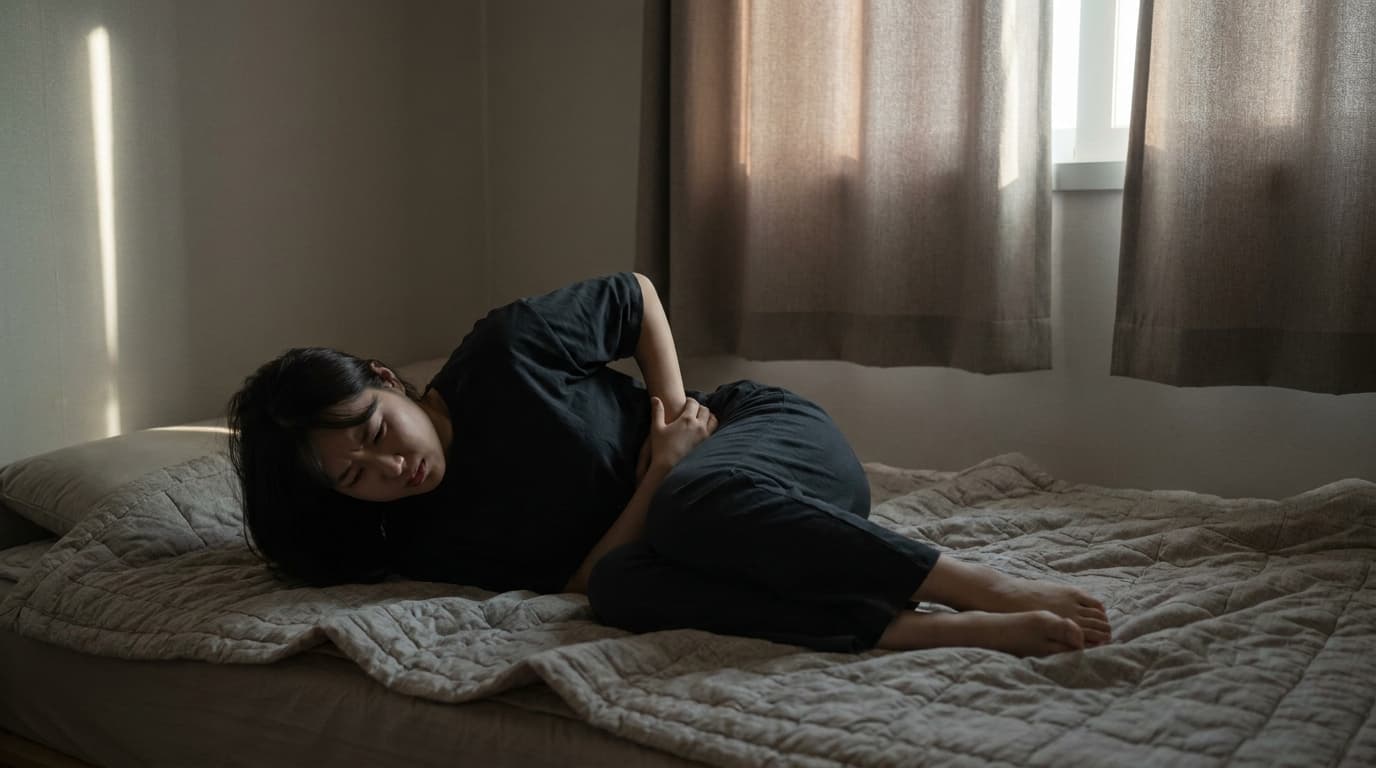
When Menstrual Pain Killers Don't Work, It's Time to Find the Root Cause
Hello, this is Dalimchae Korean Medicine Clinic. # When Menstrual Pain Killers Don't Work, It's Time to Find the Root Cause. Every month when that day arrives, many people express frustration, asking "What do you do when menstrual pain killers don't work?" From cramping pain in the lower abdomen to heavy discomfort extending to the back, and sometimes accompanied by headaches or nausea, menstrual pain that makes daily life difficult is an important signal sent by our bodies, not a simple rite of passage. Especially if the pain cannot be resolved with painkillers, it may be a strong warning sign from somewhere inside your body. 💡 **[Core Answer]** **The 3 most common causes when menstrual pain killers don't work:** ① Blood stasis (stagnant blood) due to reduced blood circulation in the uterus and pelvis ② Autonomic nervous system imbalance caused by stress and irregular lifestyle habits ③ Systemic coldness (cold energy) and decreased qi and blood circulation Dalimchae Korean Medicine Clinic resolves the root cause of menstrual pain as well as symptoms through **constitutional improvement** treatment to create a healthy body without recurrence. ## Why don't menstrual pain killers work? The causes of menstrual pain can be largely divided into 'primary dysmenorrhea', which occurs without specific diseases in the uterus, and 'secondary dysmenorrhea', which occurs due to specific conditions such as uterine fibroids or endometriosis. Most menstrual pain corresponds to primary dysmenorrhea, known to be caused by excessive secretion of a substance called prostaglandin, which contracts the uterus and causes pain. Painkillers reduce pain by inhibiting the production of this prostaglandin. However, many people find that painkillers do not provide adequate relief. According to a Korean study, 20-25% of women experiencing menstrual pain reported that anti-inflammatory painkillers were ineffective. This is because painkillers only temporarily suppress pain without solving its root cause. When complex factors interact—such as poor circulation around the uterus and pelvis accumulating blood stasis (瘀血), autonomic nerve imbalance from stress impairing blood flow to the uterus, or overall body coldness stagnating qi and blood circulation—painkillers alone have limitations. These root problems lead to a vicious cycle where symptoms recur once painkillers are stopped. ## How does Korean medicine view menstrual pain? In Korean medicine, menstrual pain is not viewed simply as a uterine problem, but as an issue of overall body balance and qi and blood circulation. Especially from the perspective of 'pain arises from blockage' (不通즉痛), conditions like blood stasis, cold condensing in the womb (寒凝胞中), and qi stagnation with blood stasis (氣滯血瘀) are seen as primary causes. Also, from the perspective of 'pain arises from deficiency in nourishment' (不榮즉痛), systemic weakness such as qi and blood deficiency (氣血虛弱) or liver and kidney deficiency (肝腎虛弱) can cause menstrual pain due to insufficient nutrient supply. At the Songdo branch of Dalimchae Korean Medicine Clinic, diagnosing menstrual pain comprehensively considers not just pain intensity, but also menstrual cycles, menstrual blood patterns, accompanying symptoms (headaches, indigestion, breast pain, anxiety, depression), constitution, and lifestyle habits. When the autonomic nervous system's balance is broken, lower abdominal blood circulation is impaired, which worsens menstrual pain. Autonomic imbalance easily appears due to stress, lack of sleep, and overwork. Through this multi-faceted approach, we clearly identify individual causes and propose customized treatments. ## Can menstrual pain really be improved with Korean medicine treatment? Recent studies scientifically prove the effectiveness of Korean medicine treatment for menstrual pain. Herbal medicine and acupuncture treatments help suppress inflammation, improve blood circulation, and regulate uterine contractions, contributing to menstrual relief. A 2018 systematic review and meta-analysis published in the international journal <Medicine> analyzed 60 randomized controlled trials (including 49 meta-analyses). This study showed that manual acupuncture and electroacupuncture significantly reduced menstrual pain compared to the untreated group (SMD = -1.59, 95% CI [-2.12, -1.06]). Furthermore, manual acupuncture and warm acupuncture were more effective in reducing menstrual pain than non-steroidal anti-inflammatory drugs (NSAIDs) (Manual Acupuncture vs NSAIDs: SMD = -0.63, 95% CI [-0.88, -0.37]), and the effect was maintained during short-term follow-up. The researchers concluded that acupuncture can be used as an effective and safe treatment for women with primary dysmenorrhea. Additionally, according to a 2021 systematic review and meta-analysis on Danggui Sini Decoction cited in a health blog, analyzing 11 randomized controlled trials involving 1,005 women with primary dysmenorrhea, the Danggui Sini Decoction treatment group showed significant improvement in treatment rates compared to conventional treatment (RR = 1.42, 95% CI = 1.30-1.55, p\<.01). This study shows that herbal treatment contributes to increasing treatment rates and positively impacts reducing recurrence rates. Based on these data, the Songdo branch of Dalimchae Korean Medicine Clinic combines acupuncture, moxibustion, and herbal medicine to relieve pain and reduce recurrence. Through constitutional improvement, we treat root causes, helping the body maintain healthy menstrual cycles on its own. ## How does Dalimchae's constitutional improvement treatment proceed? Dalimchae's constitutional improvement treatment aims to create a body where symptoms do not recur, rather than temporarily suppressing pain. Menstrual pain is often the result of systemic imbalance beyond the uterus and lower abdomen. Especially stress and irregular living affect the autonomic nervous system, breaking female hormone balance and worsening menstrual pain. Dalimchae applies the following treatment principles: **1. Customized Herbal Prescriptions:** We precisely diagnose individual constitution and causes (blood stasis, coldness, qi/blood deficiency) to prescribe customized herbal medicine. Herbal medicine promotes uterine and pelvic circulation, removes blood stasis, expels coldness, replenishes deficient qi and blood, and improves the uterine environment. It strengthens overall bodily function and restores autonomic balance. **2. Acupuncture and Moxibustion:** Acupuncture stimulates meridians related to pain sites to smooth qi and blood circulation and control pain. Moxibustion delivers warm energy to the lower abdomen to improve uterine coldness, dissolve blood stasis, and promote circulation. **3. Lifestyle Management and Dietary Coaching:** Even with good treatment, bad habits can worsen menstrual pain. The Songdo branch provides dietary coaching, exercise, and stress management tailored to each patient. ## What self-care can be done at home when menstrual pain is severe? While painkillers are common, consistent daily management reduces pain intensity and frequency. Warm compresses, warm tea, and light stretching help relieve tension. --- ### **Q. How long does Korean medicine treatment take for menstrual pain?** A. Duration varies by severity and constitution, typically 3-6 months for noticeable improvement. ### **Q. Can I take herbal medicine while taking painkillers?** A. Yes, they work through different mechanisms and can be combined under professional guidance. ### **Q. Can menstrual pain resolve naturally?** A. Mild pain may improve, but severe pain unresponsive to painkillers requires active treatment. ### **Q. Can menstrual pain and indigestion be treated together?** A. Yes, Korean medicine views them as connected through overall circulation decline. --- Menstrual pain is not something to endure. Bring your symptoms to Dalimchae Korean Medicine Clinic Songdo branch, and we will find the root cause together. Medical Supervision | Women's & Pregnancy Care Standard, Dr. Oh Hyunmin, Dalimchae Korean Medicine Clinic Songdo Branch (Menstrual Pain Column)