
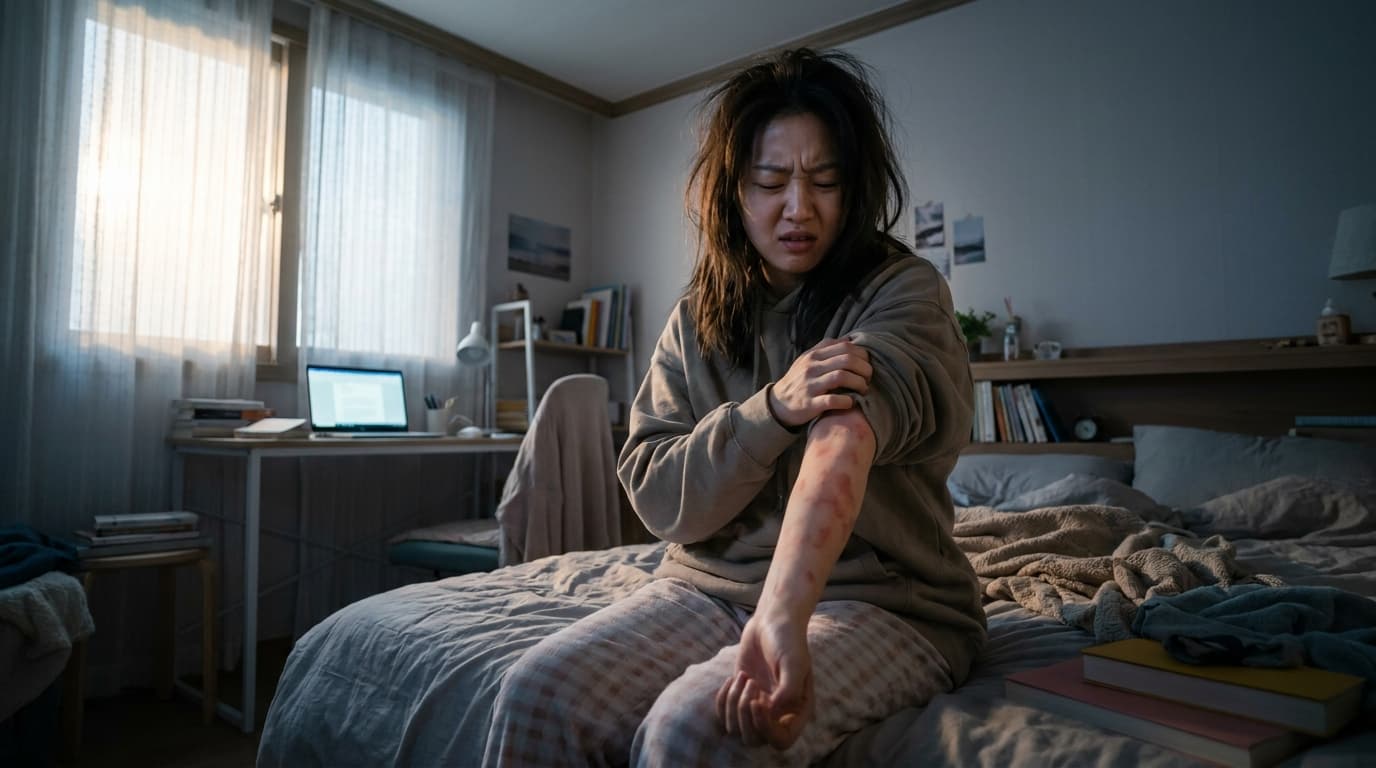
When I am stressed red patches spread on my skin Could it be stress dermatitis
Hello, this is Dalimchae Korean Medicine Clinic. # When I'm stressed, red patches spread on my skin. Could it be stress dermatitis? Have you ever had trouble sleeping due to sudden red patches, itching, and stinging on your skin? Have you ever visited a hospital complaining that "red patches spread on my skin when I'm stressed," but failed to find a clear cause or only received temporary ointment prescriptions? Especially if you have experienced your skin breaking out right before important events or during emotionally unstable periods, this may not be a simple skin problem. Our body reacts very sensitively to stress, and the skin is the mirror that shows that signal first. 💡 **Key Answer** 3 most common causes of "red patches spread on my skin when I'm stressed": ① Autonomic nervous system imbalance / ② Gut health deterioration and toxin increase / ③ Immune system disruption Dalimchae Korean Medicine Clinic helps the body recover fundamentally through "gut detoxification" treatment. ## Why do red patches appear on the skin when stressed? Skin is not just an organ in contact with the external environment, but an important indicator reflecting the internal state of our body. In particular, stress has a very direct impact on skin health. Severe stress breaks the balance of the autonomic nervous system, which in turn becomes a major cause of promoting skin inflammatory responses or worsening existing skin conditions. Through this process, various forms of skin trouble such as red patches, itching, and rashes can appear. A 2020 study published in the 「Korean Journal of Internal Medicine」 by a domestic research team analyzed the prevalence of anxiety, depression, and stress and their correlation with disease activity in 79 patients with Chronic Urticaria (CU). The results showed that 48.1% of chronic urticaria patients suffered from depression and 38.0% from anxiety, with depression being significantly higher in urticaria patients than in the control group (asthma patients) (48.1% vs 28.2%, p\<0.05). In addition, the more severe the anxiety symptoms, the higher the Urticaria Activity Score (UAS-6) and Pruritus Visual Analog Scale (pruritus-VAS) statistically significantly (each r=0.256, r=0.272, p\<0.05), and stress was also closely related to urticaria activity and sleep difficulty (all p\<0.05). This study suggests that anxiety, depression, and stress frequently accompany Korean chronic urticaria patients, and that these psychological factors are deeply involved in symptom worsening and quality of life deterioration in urticaria. Therefore, if symptoms such as red patches on the skin recur, it is important to focus on solving fundamental body problems along with stress management. ## Stress dermatitis may be an internal body problem, not just a skin problem. In Korean medicine, skin problems are not viewed simply as symptoms appearing on the outside, but as internal organ imbalances and qi-blood circulation problems. In particular, stress can generate heat in the body and hinder circulation, just like 'liver qi stagnation' or 'heart fire upper flaming', inducing skin symptoms. This perspective is consistent with the 'Gut-Brain Axis' theory discussed in modern medicine. The gut and brain are closely connected, so stress affects gut function, and poor gut health can worsen skin health. According to a 2021 report in 「Evid Based Complementary and Alternative Medicine」 by a joint research team from Dongguk University College of Korean Medicine and the Korea Institute of Oriental Medicine, the traditional Korean medicine prescription 'Gyogamdan' showed an effect of improving skin inflammation and hypersensitive behavior in an atopic dermatitis mouse model exposed to psychological stress. This study evaluated the effect and mechanism by orally administering Gyogamdan ethanol extract (GGDE) after exposing mice with atopic dermatitis induced by 2,4-Dinitrochlorobenzene (DNCB) to social isolation stress. Consequently, it was confirmed that Gyogamdan is effective in alleviating skin inflammatory responses and improving hypersensitive behavior in an atopic dermatitis model worsened by stress. The researchers concluded that these results suggest Gyogamdan can be usefully utilized for atopic dermatitis patients whose condition is worsened by psychological stress. Thus, Korean medicine provides treatments that understand the complex relationship between stress and skin diseases and approach their root causes. The Incheon branch of Dalimchae Korean Medicine Clinic values gut detoxification treatment, which makes the inside of the body healthy and enhances immunity for patients whose red patches spread on the skin due to stress. This is because toxins accumulated on the gut wall create systemic inflammation through the blood, which manifests on the skin. Gut detoxification goes beyond simply cleaning the gut; it aims to restore the immune balance of the entire body by creating a beneficial gut microbiota environment and strengthening gut mucosal function. This contributes to reducing skin inflammation, stabilizing the autonomic nervous system, and increasing the body's resistance to stress responses. As a result, the skin regains the power to heal itself. ## Self-Checklist for My Stress Dermatitis Answer the following questions. The more items apply, the higher the possibility of stress dermatitis. * Do you feel like you are under a lot of stress recently? * Do red patches or hives appear and disappear repeatedly on your skin? * Do skin symptoms become worse in specific situations (exams, presentations, important meetings, etc.)? * When you are tired or cannot sleep well, does your skin itch more and cause trouble? * Are digestive issues such as indigestion, constipation, or diarrhea accompanied? * Does itching disturb your sleep or interfere with daily life? * Are you okay when taking dermatology medications, but symptoms come back when you stop? **Criteria:** * If 3 or more apply: High possibility of stress dermatitis. Consider autonomic testing and complex Korean medicine treatment. * If 5 or more apply: The body is in a state of severe overload, and immediate examination and treatment may be needed. We recommend visiting the Incheon branch of Dalimchae Korean Medicine Clinic for precise diagnosis. ## What effects can you expect from Dalimchae Korean Medicine Clinic's gut detoxification treatment? Dalimchae Korean Medicine Clinic focuses on gut detoxification treatment to resolve the root causes of stress dermatitis that induce red patches and itching on the skin. Our gut is not just a digestive organ, but an important immune organ where over 70% of immune cells reside. When gut function deteriorates due to stress and poor dietary habits, the gut wall is damaged, allowing undigested toxins and inflammatory substances to spread through the blood throughout the body, intensifying skin inflammation. This is a major cause of promoting allergic reactions and worsening various skin diseases such as atopic dermatitis, urticaria, and eczema. Gut detoxification treatment at the Incheon branch of Dalimchae Korean Medicine Clinic prescribes herbal medicine tailored to individual constitutions and symptoms to improve the gut environment and help excrete toxins that cause inflammation. Through this, it aims to restore damaged gut mucosa and recover beneficial gut microbial balance to normalize immunity. When gut health is recovered, nutrient supply to the skin becomes smooth, and internal inflammation responses are reduced, naturally improving skin symptoms such as red patches and itching. In addition, through the interaction of the gut-brain axis, physical responses to stress become stable, bringing psychological comfort. For those looking for a Songdo stress dermatitis Korean medicine clinic, this fundamental treatment approach will greatly help prevent recurrence beyond simple symptom relief. **Q. How long should stress dermatitis be treated?** A. Treatment duration may vary depending on individual symptom severity, disease duration, and lifestyle habits. Generally, the goal is symptom improvement and recurrence prevention through about 3 months of intensive treatment and subsequent steady management. **Q. Can stress dermatitis be treated with Korean medicine?** A. Yes, it can be fully treated. Korean medicine has strengths in improving the root causes of stress dermatitis, which are autonomic imbalance and gut health problems, helping the skin regain its self-healing power. **Q. Is dietary management necessary?** A. Yes, very important. Since gut health is directly linked to skin health, dietary management to reduce intake of instant foods, flour, dairy products, and excessive sugars that can burden the gut is necessary along with treatment. **Q. How should stress be managed?** A. Regular exercise, sufficient sleep, meditation, and hobbies—finding stress-relief methods that suit you and practicing them steadily is important. Dalimchae Korean Medicine Clinic increases your stress resistance through Korean medicine treatments that stabilize the body's autonomic nervous system. Stress dermatitis is not a problem that can be solved by enduring it. You no longer need to ignore the body's signals you have sent for a long time. If you approach it in the right direction, your body reacts faster than you think. Bring the symptoms you are experiencing as they are. The Incheon branch of Dalimchae Korean Medicine Clinic will find the cause together. Where life blooms. Herbal medicine is Dalimchae Korean Medicine Clinic. Check symptoms similar to yours first through the AI consultation on the Dalimchae Korean Medicine Clinic website! This article is health information organized together by Dalimchae medical staff based on questions actually received often in the consultation room. Medical Supervision | Department of Skin Disease Treatment Standards, Incheon Branch of Dalimchae Korean Medicine Clinic, Korean Medicine Doctor Min Jihong (Allergic Skin Disease Column) #StressDermatitis #RedPatches #Itching #Urticaria #GutDetox #IncheonKoreanMedicine #IncheonSkinDisease #DalimchaeIncheon #KoreanSkinTreatment