
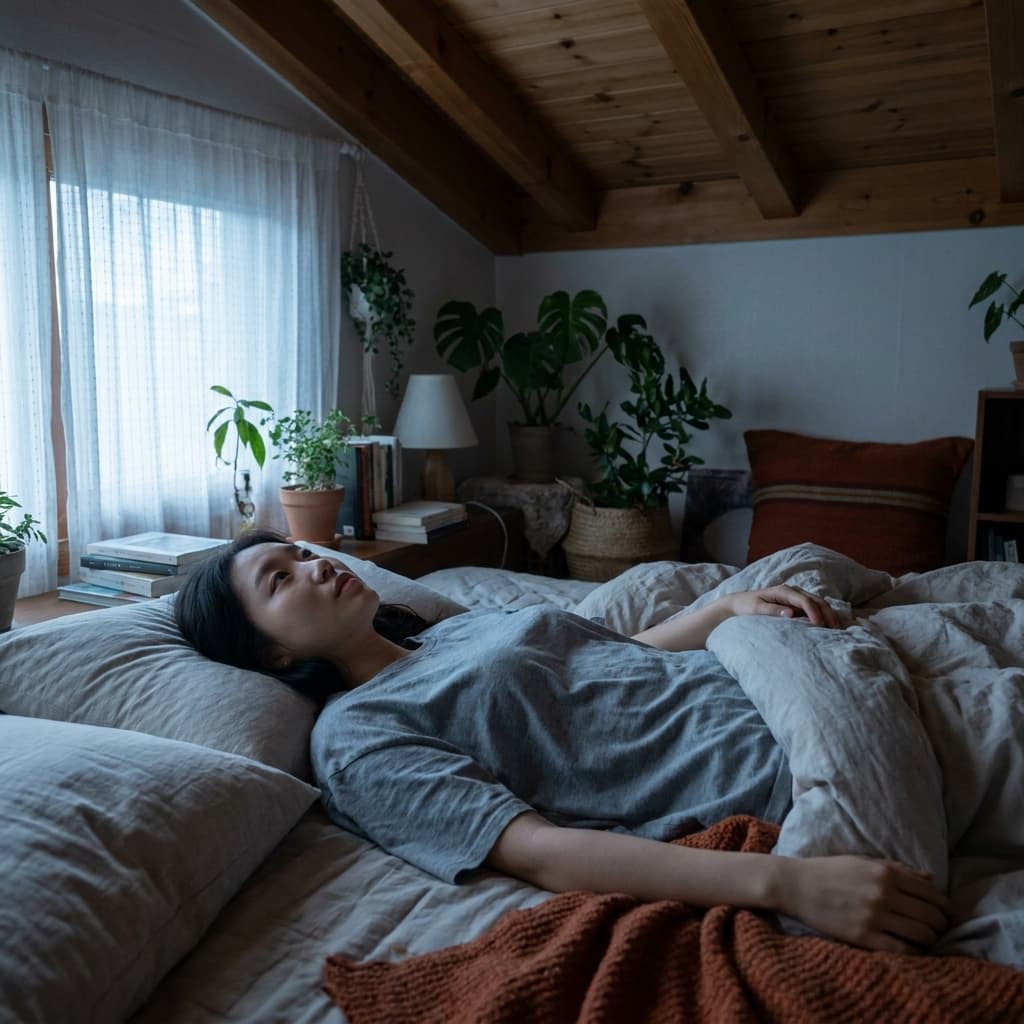
Waking Up Tired and Not Refreshed: It Could Be a Sleep Regulation System Problem
Hello. This is Dalimchae Korean Medicine Clinic. # Waking Up Tired and Not Refreshed: It Could Be a Sleep Regulation System Problem Many people say, "I feel tired even after waking up." Even after seemingly enough sleep, the body feels heavy like lead, and the head isn't clear, leading to a dazed state throughout the day. This symptom may not be simply due to a lack of sleep. It is highly likely a signal that an imbalance in the body's complex sleep regulation system, especially the autonomic nervous system, is causing a decline in sleep quality. You might be in a state of 'non-restorative sleep,' where the body doesn't recover even though you seem to sleep enough, beyond just having difficulty falling asleep (insomnia). This is a significant issue that affects overall health beyond simple fatigue. 💡 **Key Answer** The 3 most common causes of "feeling tired even after waking up": ① **Autonomic Nervous System Imbalance:** A decline in the function of the autonomic nerves that regulate the rhythm of falling asleep and waking up. ② **Brain Fatigue:** A decline in brain function due to excessive stress and brain activity. ③ **Decline in Sleep Quality:** Insufficient deep sleep (slow-wave sleep) leading to inadequate physical recovery. Dalimchae Clinic restores the freshness of your mornings by fundamentally improving sleep quality through autonomic stabilization treatment. ## Why do I feel tired and not refreshed even after waking up? Our bodies resolve the fatigue accumulated during the day and recharge energy for the next day through sleep during the night. However, sufficient recovery might not occur through sleep time alone. When you are in a 'non-restorative sleep' state where the brain and body cannot rest properly even though you appear to be sleeping, symptoms like "I feel tired even after waking up" appear. This phenomenon mainly occurs when the balance of the autonomic nervous system is broken due to stress, anxiety, and overwork. The autonomic nervous system regulates all unconscious functions of our body, especially playing a crucial role in sleep and arousal. When the sympathetic nervous system is excessively hyperactive, it keeps the body in a state of tension even at night, making it difficult to fall into a deep sleep, and even if you do fall asleep, you only get light sleep. ## How does autonomic imbalance ruin sleep quality? The autonomic nervous system is divided into the sympathetic and parasympathetic nervous systems, maintaining homeostasis in our body through antagonistic actions. During daytime activities, the sympathetic nervous system is activated to induce tension and arousal, and at night, the parasympathetic nervous system is activated to relax the body and induce sleep. However, if stress persists or lifestyle habits become irregular, the sympathetic nervous system becomes excessively hyperactive and suppresses the activity of the parasympathetic nervous system. In this case, the body does not relax even when night comes, and the brain maintains a state of wanting to continue activity. As a result, difficulty falling asleep or light sleep repeats, preventing deep sleep, and the brain cannot rest sufficiently, leading to feeling unrefreshed and tired the next day. This can also affect the secretion of sleep hormones such as melatonin, disrupting the sleep-wake cycle. ### How can Korean medicine treatment help improve sleep quality? In Korean medicine, sleep problems are not seen simply as a problem of sleep, but the function of the five organs and six viscera, the balance of the autonomic nervous system, and the overall harmony of the body are considered important. Especially, the focus is on improving sleep quality by stabilizing the functions of the brain and autonomic nervous system. This is in line with the recovery of the balance of neurotransmitters and the regulation of stress hormones (cortisol) mentioned in modern medicine. In a study published in the *Journal of Korean Medicine* in 2021, Kim Ji-young's research team reported that as a result of applying herbal medicine treatment to 60 insomnia patients, the Insomnia Severity Index (ISI) significantly decreased from an average of 19.5 points to 8.2 points after 8 weeks of treatment (p\<0.001). Also, sleep efficiency (SE) and total sleep time (TST) significantly increased statistically. The researchers concluded that herbal medicine treatment contributes to improving insomnia by restoring the balance of the autonomic nervous system and regulating stress responses. Another study, a report published in *Complementary Therapies in Medicine* in 2023, revealed that as a result of applying combined Korean medicine treatment (acupuncture, moxibustion, herbal medicine) for 12 weeks to 120 chronic fatigue syndrome patients, the Fatigue Assessment Scale (FAS) score significantly improved from an average of 35.8 points before treatment to 24.1 points after treatment (p\<0.01). Especially, through heart rate variability (HRV) analysis, a significant recovery of autonomic nervous system function, such as an increase in parasympathetic activity and a decrease in sympathetic activity, was observed. The researchers saw these results suggesting that Korean medicine treatment is effective in improving sleep quality and resolving chronic fatigue through autonomic nervous system regulation. Based on this data, Dalimchae Clinic Songdo Branch helps the brain and body recover a healthy sleep rhythm on their own by regaining the balance of the autonomic nervous system beyond simply inducing sleep. Lowering the excessive heat of the nervous system and creating an environment where the brain can rest comfortably—in Korean medicine, this is called 'Suseunghwagang (水昇火降)'—is the core of the autonomic stabilization treatment pursued by Dalimchae Clinic. ## Am I having autonomic-type sleep problems? Self-Diagnosis Checklist If 3 or more of the following items apply, there is a high possibility of sleep problems due to autonomic imbalance. Consider the combined Korean medicine treatment of Dalimchae Clinic Songdo Branch. If 5 or more apply, immediate professional consultation is recommended. * Difficulty falling asleep or waking up frequently in the middle. * Tired no matter how much you sleep and having a hard time waking up in the morning. * Heart palpitations or a feeling of stuffiness in the chest occurs frequently. * Digestion is poor and the stomach often feels bloated or stuffy. * Reacting sensitively even to small things and feeling anxiety. * Experiencing headaches or dizziness frequently. * The body is always tense and the shoulders or neck are stiff. * Hands and feet are cold or, conversely, sweating a lot. * Feeling depressed or lethargic for no particular reason. ## How does Dalimchae, an insomnia clinic in Songdo, treat? Dalimchae Clinic Songdo Branch closely diagnoses the state of the individual's constitution and autonomic nervous system regarding the symptom of "feeling tired and not refreshed even after waking up." We understand which parts of the body are currently imbalanced through pulse wave tests, autonomic balance tests, etc., and establish a 1:1 customized treatment plan accordingly. Through acupuncture, moxibustion, and cupping treatment, as well as herbal medicine prescriptions that regain the balance of the autonomic nervous system, we calm the excessive excitement of the brain and help activate the parasympathetic nervous system. Also, we fundamentally improve sleep quality by resolving brain fatigue and alleviating inflammation of the nervous system. Rather than simply suppressing symptoms, Dalimchae Clinic helps restore a healthy sleep rhythm by resolving the autonomic nervous system imbalance, which is the root of the symptoms. For those looking for a Songdo clinic, Korean medicine treatment that restores body harmony will be a good choice. --- **Q. Is not feeling refreshed even after waking up insomnia?** A. Even if there is no difficulty falling asleep, if you feel unrefreshed and tired when waking up, it can be seen as a form of 'non-restorative sleep' or 'insomnia.' Sleep quality is more important than sleep time. **Q. I have severe chronic fatigue, can Korean medicine treatment help?** A. Yes, chronic fatigue is often caused by autonomic nervous system imbalance and brain fatigue. Dalimchae Clinic's autonomic stabilization treatment is effective in improving chronic fatigue by solving these fundamental causes. **Q. I am taking sleeping pills, can I take them with herbal medicine?** A. If you are currently taking medication, you must inform the medical staff. Herbal medicine can be treated in parallel in a direction that helps reduce dependence on sleeping pills and gradually stop them. **Q. I want to find a clinic that treats autonomic nerves well in Songdo.** A. Dalimchae Clinic Songdo Branch focuses on treating brain and autonomic nervous system-related diseases such as sleep problems, chronic fatigue, headaches, and dizziness due to autonomic imbalance. We provide fundamental solutions through scientific tests and customized Korean medicine treatment. --- "Feeling tired and not refreshed even after waking up" is not a problem that can be solved by enduring. You no longer have to ignore the signals your body has been sending for a long time. If you approach in the right direction, the body responds faster than you think. Bring your symptoms exactly as they are. At Dalimchae Clinic, we will find the cause together. Where life blooms. For herbal medicine, it's Dalimchae Korean Medicine Clinic. Check your symptoms similar to mine through the AI consultation on the Dalimchae Clinic website first! This article is health information compiled by Dalimchae medical staff based on questions frequently received in the treatment room. Medical Supervision | Brain/Autonomic Nerve Treatment Standards Dalimchae Clinic Songdo Branch Korean Medicine Doctor Oh Hyunmin (Insomnia Column)