
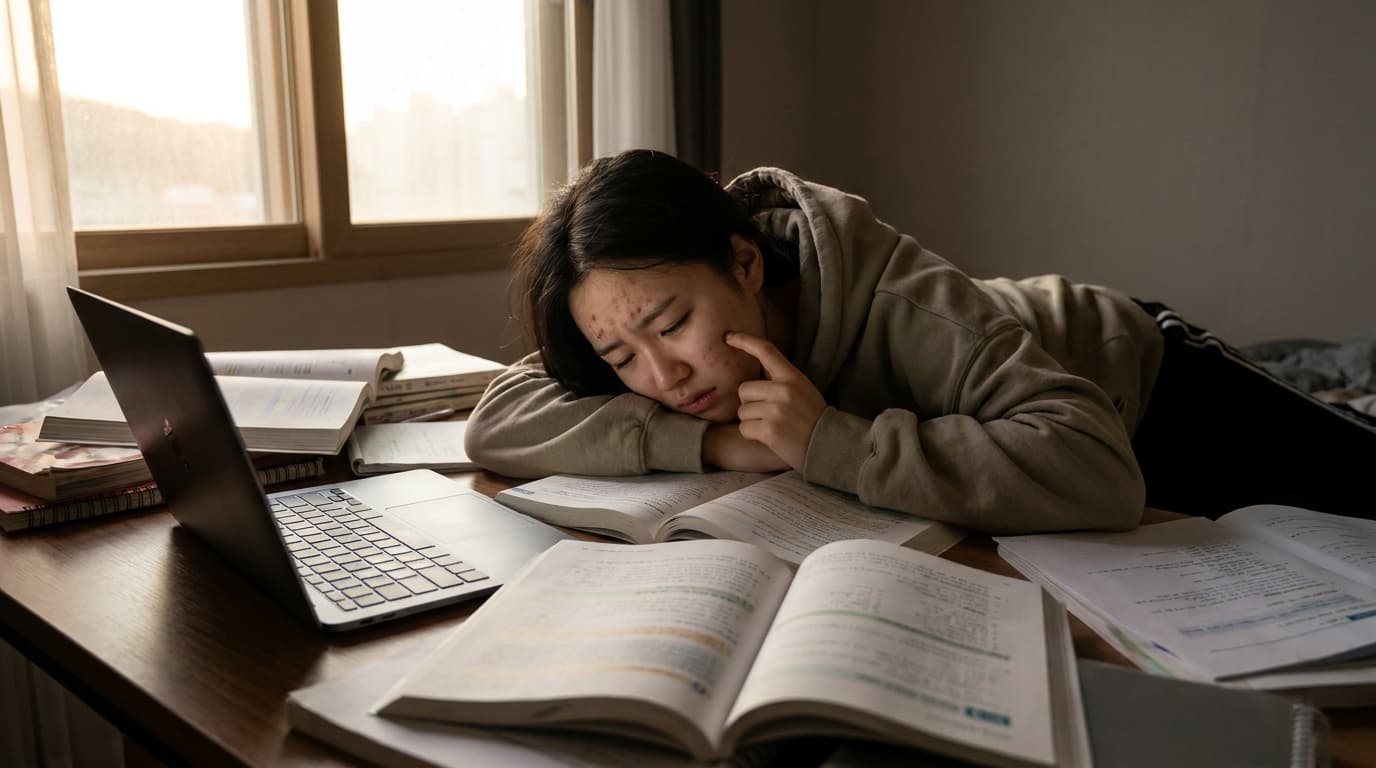
Sudden acne breakout Get to the root cause of student stress acne before it festers
Hello, this is Dalimchae Korean Medicine Clinic. # Sudden acne breakout? Get to the root cause of student stress acne before it festers If you are a student preparing for the CSAT or an office worker working on an important project, you may find yourself sighing in front of the mirror more often. Late-night studying, work, and sleepless anxiety can turn your skin upside down in an instant. Many people visit the Incheon branch of Dalimchae Korean Medicine Clinic complaining that their acne suddenly exploded. Stress acne, which suddenly worsens in stressful situations for skin that was previously fine, has complex causes that cannot be solved simply through basic skincare. 💡 **[Core Answer]** Top 3 most common causes of sudden acne explosions: ① **Stress hormone imbalance** / ② **Weakened skin barrier function** / ③ **Sleep deprivation and increased inflammation** Dalimchae Korean Medicine Clinic helps you regain the balance of your body closely connected to your skin through **autonomic nervous system stability**, providing you with healthy skin. ## Can stress really cause acne? Yes, stress is a strong factor that causes or worsens acne. When our body experiences stress, the hypothalamic-pituitary-adrenal (HPA) axis is activated, increasing the secretion of stress hormones such as cortisol. These stress hormones affect the sebaceous glands, increasing sebum secretion and promoting inflammatory responses, directly contributing to the occurrence of acne. Especially in cases of prolonged stress like students, this process can become chronic, making skin problems much more severe. According to a study published in the 2025 journal 'Stress-Induced Changes of the Skin: A Narrative Review', stress induces excessive cortisol secretion and elevated neuropeptide levels through HPA axis activation, which leads to impaired skin immune response regulation, barrier function damage, and increased inflammation, worsening skin diseases such as acne, psoriasis, and atopic dermatitis. The researchers concluded that the biochemical relationship between stress and skin diseases manifests through altered inflammatory mediators, mast cell activation, and neurotransmitter imbalance, supporting the clinical presentation of acne. Furthermore, a 2017 study published in 'Clinical, Cosmetic and Investigational Dermatology' involving 144 female college students in Jeddah, Saudi Arabia reported statistically significant results showing that as stress severity increased, acne severity showed a strong correlation (p\<0.01). A 2023 study conducted at Shanghai Medical College on medical students revealed that as academic stress worsened during the semester, sleep quality and anxiety severity deteriorated significantly, which was closely linked to skin barrier function damage. As such, stress breaks our body's balance and prevents the skin from functioning properly. Based on these data, the Incheon branch of Dalimchae Korean Medicine Clinic focuses on treatments that go beyond simply treating acne to improve autonomic imbalance and weakened skin barrier function caused by stress. ## What type of stress acne do I have? Stress acne appears in a form similar to general acne, but exhibits characteristics of worsening specifically in stress situations. Key symptoms include: * **Inflammatory acne:** Red and festering forms of acne suddenly appear frequently on the face, chin, and neck line. * **Increased sebum secretion:** Excessive sebum secretion centered around the T-zone leads to severe greasiness. * **Weakened skin barrier:** Skin becomes dry and sensitive, easily turning red or feeling itchy with minor stimuli. * **Decreased immunity:** The skin's self-defense ability drops, making once-appearing acne difficult to subside and prone to frequent relapses. * **Decreased sleep quality:** Stress often leads to difficulty falling asleep or frequent waking, causing insomnia. This hinders skin regeneration and further aggravates inflammation. These symptoms can be a sign that the body's autonomic nervous system is out of balance. This is because skin reflects the internal health state of our body. ## How does Dalimchae Korean Medicine Clinic treat stress acne? Dalimchae Korean Medicine Clinic finds the root cause of stress acne in autonomic imbalance and focuses on **autonomic nervous system stability** treatment to stabilize it. When the balance of the autonomic nervous system breaks down, the brain cannot rest, leading to systemic inflammatory responses and decreased immunity, which manifest as skin problems. When stressed, the sympathetic nervous system is overly activated, keeping the body in a state of tension, reducing blood circulation, and preventing smooth nutrient supply to the skin. Korean medicine treatment goes beyond simply suppressing acne symptoms to restore the balance of the autonomic nervous system, helping the skin recover and defend itself. Lowering the overheated fever of the nervous system and creating an environment where the brain can rest comfortably—known in Korean medicine as 'Su-seung-hwa-gang' (water up, fire down)—is crucial. To this end, personalized herbal medicine prescriptions tailored to individual constitutions and symptoms help relieve stress and regulate the autonomic nervous system, while acupuncture, pharmacopuncture, and moxibustion treatments are combined to soothe skin inflammation and enhance regenerative power. In particular, stress-induced acne often manifests as inflammatory. A Korean medicine study published in the 2024 'Journal of Alternative and Complementary Medicine' analyzed the effects of acupuncture treatment on inflammatory acne. Analyzing four randomized controlled trials (RCTs), the experimental group receiving acupuncture showed clinically significant improvements in acne symptoms and results compared to the control group, with lower recurrence rates. The researchers concluded that acupuncture treatment can be a reliable, safe, and effective alternative treatment for inflammatory acne. Based on these treatment principles, Dalimchae Korean Medicine Clinic strives to help not only the skin but also the overall health recovery of stressed students as an Incheon acne Korean medicine clinic. ## Stress Acne Self-Diagnosis Checklist Check how many of the following items apply to you: * Experiencing extreme stress recently due to studies or work. * Red, inflammatory acne has suddenly broken out all over the skin. * Skin easily becomes greasy with increased sebum secretion compared to before. * Skin becomes sensitive and easily reddens with minor stimulation. * Poor sleep quality, such as difficulty falling asleep at night or waking up frequently. * Severe fatigue and a persistent feeling of decreased condition. * Experiencing other stress symptoms such as indigestion, headaches, or dizziness. * Feeling depressed due to increased appearance stress caused by acne. **Criteria:** * **3 or more items apply:** Suspected stress-type acne. Autonomic imbalance is possible, so Korean medicine combination treatment is recommended. * **5 or more items apply:** Immediate visit and professional diagnosis are important to solve the root cause. Get detailed counseling at Dalimchae Songdo Acne Korean Medicine Clinic. ## FAQ: Questions About Stress Acne **Q. How long does stress acne treatment take?** A. The treatment period for stress acne varies depending on individual constitution, degree of stress, and skin condition. It usually takes 2 to 3 months of treatment, and recovery can be faster if lifestyle habits are improved in parallel. **Q. Can student acne be treated with Korean medicine?** A. Yes, student acne is closely related to autonomic nervous system issues such as stress and lack of sleep, making Korean medicine treatment very effective. It promotes skin regenerative power by simultaneously addressing stress relief and physical strength enhancement alongside skin symptoms. **Q. Can stress acne heal naturally?** A. Symptoms may ease when stress factors are resolved, but without solving the fundamental autonomic imbalance, it can recur at any time. Active treatment and management are important to prevent recurrence. **Q. Can acne and insomnia be treated together?** A. Yes, acne and insomnia are representative symptoms caused by autonomic imbalance, and Dalimchae Korean Medicine Clinic views them as connected problems and treats them together. Improving sleep quality through autonomic stability treatment also positively affects skin recovery. Stress acne is not a problem that can be solved by simply enduring it. You no longer have to ignore the signals your body has been sending for a long time. When approached in the right direction, the body responds faster than you think. Bring the symptoms you are currently experiencing as they are. Dalimchae Korean Medicine Clinic will find the cause together. A place where life blooms. Herbal medicine is Dalimchae Korean Medicine Clinic. Check your similar symptoms first through the Dalimchae Korean Medicine Clinic website AI consultation! This article is based on questions frequently received in the treatment room, and is health information compiled together by Dalimchae medical staff. Medical Supervision | Skin Disease Treatment Standard Dalimchae Korean Medicine Clinic Incheon Branch Korean Medicine Doctor Min Jihong (Acne Column) #StressAcne #SuddenAcne #StudentAcne #AdultAcne #SkinBreakout #AutonomicNervousSystem #IncheonAcneClinic #SongdoAcne #KoreanMedicineTreatment Skin - Itching Allergy