
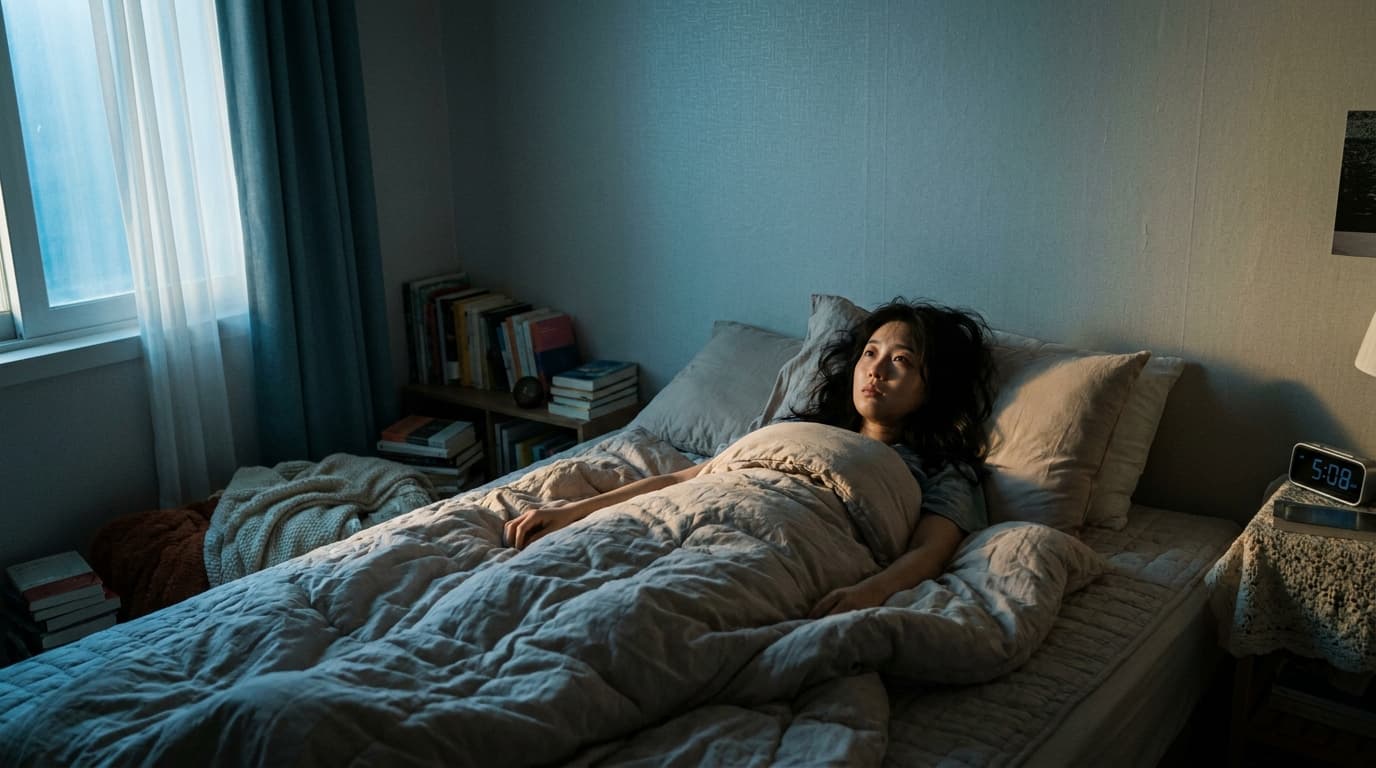
Restless Nights and Overheated Brains: Understanding Your Sleep Signals
Hello. This is Dalimchae Korean Medicine Clinic. # Tossing and turning all night, finally falling asleep; it's a signal from an overheated brain. You toss and turn all night and barely fall asleep. Even when you close your eyes, your brain keeps running without rest, and the longer you lie in bed, the more anxious you feel. Even if you manage to fall asleep, you wake up several times with light sleep rather than deep sleep, and many people repeat the painful pattern of finally falling asleep at dawn. This situation is more than just being tired; it can be an important warning signal sent by our body and brain. In particular, many people who visit the **Incheon Insomnia Korean Medicine Clinic** complain about this 'overheated brain' problem. 💡 **[Key Answer]** The 3 most common causes of **tossing and turning all night and barely falling asleep**: ① Excessive brain activity and autonomic imbalance / ② Stress and psychological pressure / ③ Poor sleep habits and environment Dalimchae Clinic helps deep sleep by cooling down the overheating of the brain and regaining the balance of the body and mind through 'autonomic stabilization' treatment. ## Why do we toss and turn all night and barely fall asleep? It's because the brain is overheated. The symptom of insomnia, 'tossing and turning all night and barely falling asleep,' is not simply a matter of will. It's because our brain is not resting enough even at night and is excessively activated. If the sympathetic nervous system, which was activated by stress or overwork during the day, cannot be calmed down at night, the brain continues to maintain a state of arousal. Just like an overheated computer doesn't turn off, it becomes difficult for the brain to enter deep sleep while it is 'overheated.' This autonomic imbalance acts as a key cause of deteriorating sleep quality. ## How does Korean medicine view insomnia? In Korean medicine, sleep problems are seen as a state where the balance between body and mind is broken. In particular, insomnia is explained through concepts such as 'heart heat (心熱)' or 'liver fire (肝火),' which represent the overheating of the brain. Stress and excessive thoughts fuel 'heart heat,' and emotional suppression or fatigue induce 'liver fire,' which interferes with sleep. These internal imbalances are difficult to solve fundamentally with just sleeping pills. It is important to restore the natural harmony of the body and create an environment where the brain itself can fall asleep comfortably. **Songdo Insomnia Korean Medicine Clinic** identifies the constitution and symptoms of each patient from this perspective and provides customized treatment. ## How does Korean medicine treatment improve sleep quality for insomnia? Latest clinical studies show that Korean medicine treatment can have a positive effect on improving insomnia. In a study published by Min-Jee Kim's research team in 2021, the results of applying Cheonwangbosim-dan (CWBSD), a herbal prescription, for 6 weeks to 56 patients with primary insomnia showed that both the Pittsburgh Sleep Quality Index (PSQI) and the Insomnia Severity Index (ISI) scores decreased significantly. In particular, the decrease in PSQI was more pronounced in the group with the heart-yin deficiency pattern, and the sleep time also tended to increase. The researchers concluded that these results suggest Cheonwangbosim-dan can improve sleep quality according to the patient's tongue diagnosis and oral microbial type. Based on these data, Dalimchae Clinic closely analyzes the symptoms and constitution of insomnia patients to cool down the overheating of the brain and promote autonomic stability through the most appropriate herbal prescription for each individual. In addition, a systematic review and meta-analysis study published in Frontiers in Pharmacology in 2024 analyzed 70 randomized controlled trials (RCTs) involving 6,035 menopausal women with insomnia. According to the results of this study, East Asian herbal medicine (EAHM) treatment significantly improved the Pittsburgh Sleep Quality Index (PSQI) by an average of -2.18 points (95% CI -2.56 to -1.80) compared to sleeping pills and also decreased the Kupperman Index (menopausal symptom index). Furthermore, herbal medicine treatment showed significantly fewer side effects compared to sleeping pills (risk ratio 0.15, 95% CI 0.07-0.34). The researchers concluded that herbal medicine could be an effective and safe alternative for the treatment of menopausal insomnia. This shows that Korean medicine treatment can go beyond simple symptom relief and help solve the root cause of insomnia by restoring overall body balance. Dalimchae Clinic Incheon Branch strives to improve the sleep quality of those struggling with insomnia based on such scientific evidence. ## Dalimchae Clinic's Autonomic Stabilization Treatment, the Wisdom to Cool Down an Overheated Brain Dalimchae Clinic finds the root cause of sleep problems such as **tossing and turning all night and barely falling asleep** in 'autonomic imbalance.' The brain and the autonomic nervous system regulate all functions of our body, and if that balance is broken, the brain cannot rest and becomes excessively excited. Stress, overwork, worry, and anxiety accumulated during the day excessively activate the sympathetic nervous system, and even at night, the parasympathetic nervous system is not sufficiently activated, making it difficult to fall asleep. Dalimchae Clinic's 'autonomic stabilization' treatment focuses on cooling down such an overheated brain and regaining autonomic balance. We focus on lowering the heat of the nervous system and creating an environment where the brain can rest—in Korean medicine, this is called Suseunghwagang (水昇火降). Rather than simply inducing sleep, we aim to create a state where the body itself can fall asleep comfortably. We help relax tensed nerves, calm down anxiety and irritability, and recover energy consumed during the day so that you can sleep deeply at night. Through this, we help those looking for **Incheon sleep disorder Korean medicine clinics** regain their vibrant daily lives. ## Am I having insomnia? Autonomic Imbalance Self-Diagnosis Checklist Do many of the following questions apply to you? (If applicable 3 or more times a week for the last 3 months) * ① It is difficult to fall asleep for more than 30 minutes even after lying in bed. * ② I wake up frequently during sleep, or once I wake up, it is difficult to fall back asleep. * ③ I wake up too early in the morning and can no longer fall asleep. * ④ Even after sleeping, I do not feel refreshed and feel severely tired during the day. * ⑤ I feel anxious or nervous even about trivial things. * ⑥ I frequently feel my heart pounding or feel stuffy in my chest. * ⑦ I have poor digestion or suffer from chronic headaches and dizziness. * ⑧ I have become sensitive and wake up easily even to surrounding sounds or light. * ⑨ I feel my concentration or memory deteriorating during the day. * ⑩ I have severe worry and stress about sleep. **Diagnosis Results:** * If 3 or fewer apply → You need to listen to your body's signals along with efforts to improve sleep habits. * If 4-6 apply → We suspect autonomic-type insomnia and recommend identifying the cause through professional consultation and considering complex Korean medicine treatment. * If 7 or more apply → There is a high possibility that the brain's overheating and autonomic imbalance have intensified. Immediate diagnosis and treatment through an **Incheon sleep disorder Korean medicine clinic** are necessary. ## FAQ **Q. How long should insomnia be treated?** A. The treatment period for insomnia varies depending on the severity of the individual's symptoms, the cause of onset, and lifestyle habits. Usually, improvement of symptoms can take from several weeks to several months, and steady treatment and management are important for fundamental autonomic balance recovery and recurrence prevention. **Q. Can I fall asleep without sleeping pills?** A. Yes, it is definitely possible. Dalimchae Clinic's autonomic stabilization treatment does not aim only at inducing sleep, but at helping the body and brain themselves naturally regain their sleep rhythm. We guide you to sleep deeply without dependence on sleeping pills by gradually recovering body functions. **Q. Is autonomic problem always accompanied if there is insomnia?** A. Insomnia and autonomic imbalance have a very close relationship. In particular, in the case of chronic insomnia, over-arousal of the brain and corresponding sympathetic hyperactivity are commonly observed. If the harmony of the autonomic nervous system is broken, there is a high possibility that sleep quality will deteriorate, and this often accompanies other autonomic dysfunction symptoms such as headaches or dizziness. **Q. I toss and turn all night and barely fall asleep in the morning, is it simply because I'm tired?** A. There are cases where you cannot sleep simply because you are tired, but if these symptoms persist more than 3 times a week for more than 3 months, it is highly likely to be chronic insomnia. This may be a state where the body's autonomic nervous system is overloaded and the brain cannot rest sufficiently, requiring professional diagnosis and treatment beyond simple fatigue relief. **Tossing and turning all night and barely falling asleep** is not a problem that can be solved by enduring. You no longer have to ignore the signals your body has been sending for a long time. If you approach in the right direction, the body responds faster than you think. Bring your symptoms exactly as they are. At Dalimchae Clinic, we will find the cause together. Where life blooms. For herbal medicine, it's Dalimchae Korean Medicine Clinic. Check your symptoms similar to mine through the AI consultation on the Dalimchae Clinic website first! This article is health information compiled by Dalimchae medical staff based on questions frequently received in the treatment room. Medical Supervision | Brain/Autonomic Nervous System Treatment Standards Dalimchae Clinic Incheon Branch Korean Medicine Doctor Min Jihong (Insomnia Column)