
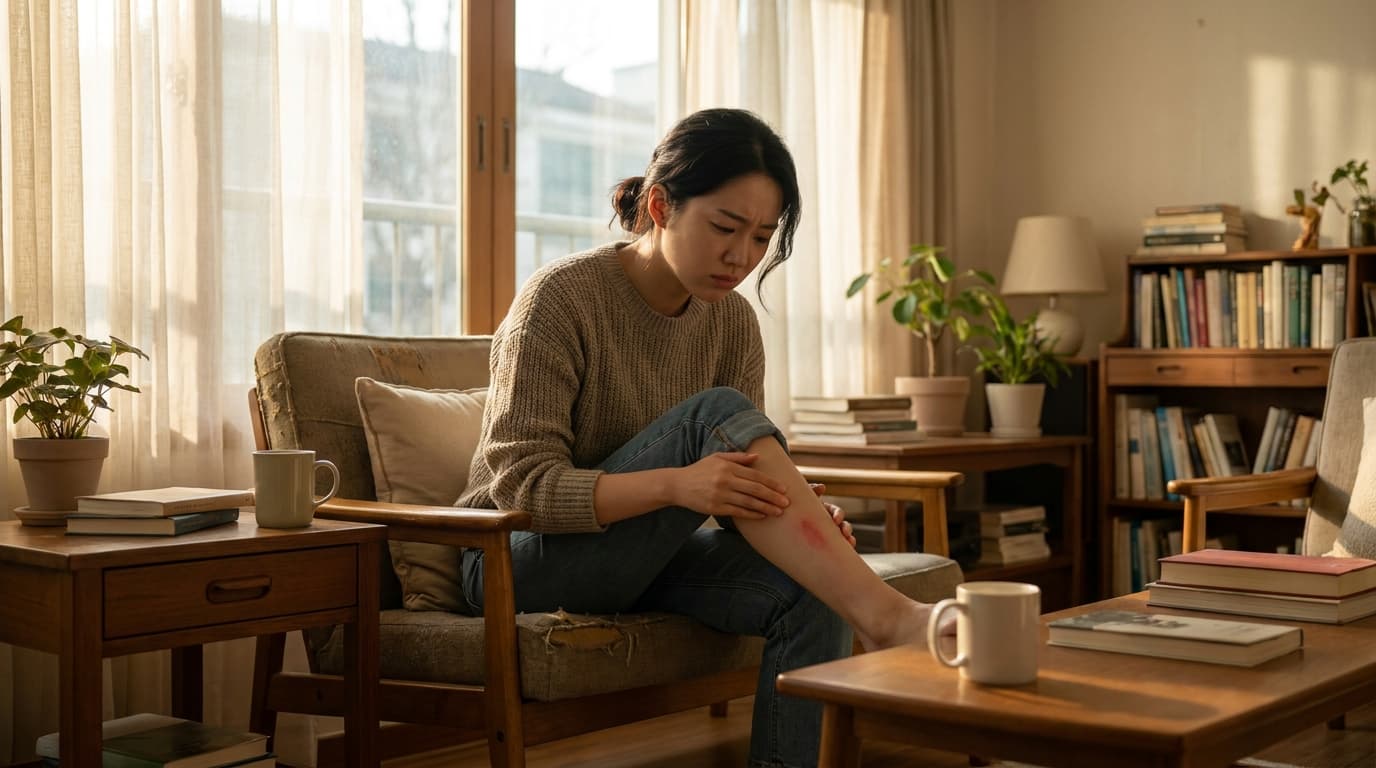
Red Spots on Legs Could It Be More Than a Simple Hives
안녕하세요. 달임채한의원입니다. # Red spots on legs, could it be simple hives? Have you ever been surprised to suddenly find several red spots on your legs? It might look like bruising or small chili powder sprinkled on the skin, and if these spots are not itchy, you might find it even more puzzling. While it's easy to dismiss them as simple skin trouble or burst capillaries, these red spots can be an important signal that something is wrong with our immune system. Especially if the pattern starts from the ankles or calves and spreads to the knees, thighs, and even arms or torso, you need to suspect 'purpura'. 💡 **[Key Answer]** Top 3 most common causes of **red spots on legs**: ① Vascular inflammation due to immune system disturbance / ② Hypersensitivity reaction to external stimuli (infection, medication, food) / ③ Decreased blood circulation and barrier function Dalimchae Korean Medicine Clinic solves the root cause of purpura with an approach of **intestinal detoxification** and **immune balance recovery**. ## Red spots on legs, why aren't they just simple hives? Red spots appearing on the legs, especially those that do not disappear when pressed and feel palpable, may not be a problem confined merely to the skin surface. This can be a major symptom of a disease called 'purpura', which occurs when small blood vessels under the skin become inflamed and blood leaks out of the vessels. This causes subcutaneous bleeding, appearing as red or purple spots. Purpura is often closely related to hypersensitivity reactions or disturbances of the immune system. In particular, 'allergic purpura' or 'Henoch-Schönlein Purpura (HSP)' easily occurs due to immune reactions after upper respiratory infections such as colds, and although common in children, it can also appear in adults. This is a systemic vasculitis that, in addition to skin spots, can invade the abdomen, joints, and in severe cases, even the kidneys, causing hematuria or proteinuria. Therefore, if red spots appear on your legs, it is important not to dismiss them as itchy-free hives or bruises, but to listen to the signals your body is sending. ## Purpura, what kind of changes inside the body cause it? Although the exact cause of purpura is not yet fully understood, it is known to be deeply related to autoimmune reactions where our immune system gets confused and attacks its own blood vessels. In particular, immunoglobulin A (IgA) often accumulates excessively in blood vessels, causing inflammation. Such immune disturbances can be triggered by various external factors. The most common triggers include viral or bacterial infections such as colds or pharyngitis, specific drug reactions, and even food or insect stimuli can induce immune system activation. In Korean medicine, this immune imbalance is viewed as arising from 'heat toxin' (熱毒) or 'blood stasis' (瘀血) accumulated in the body, making qi and blood circulation smooth impossible. In particular, gut health is closely linked to the immune system; when barrier function weakens, un-detoxified toxins travel through the blood throughout the body and can cause inflammation in blood vessels. This can be understood as our body's defense system overloading and malfunctioning, much like an overheated engine causing trouble. ## Korean medicine, how does it approach purpura treatment? In treating purpura, Korean medicine focuses on restoring the body's immune balance and fundamentally managing blood vessel inflammation. Especially when steroid treatment is difficult or relapses are frequent, oriental medicine treatment can be a good alternative. In a study by Seong-gyun Kim et al. published in 『Journal of Pharmacopuncture』 in 2014, the administration of the herbal medicine 'Jarotang (JRT)' to 5 patients with Henoch-Schönlein Purpura (HSP) showing Yin deficiency (陰虛) symptoms was reported. As a result of the study, purpura and abdominal pain symptoms improved in all patients, and even symptoms that did not improve with steroid treatment disappeared, showing positive results without recurrence after 6 months. The researchers concluded that Jarotang is effective in treating HSP by nourishing Yin and Qi and cooling blood heat (血熱). Also, in a paper by Hyun-jong Kim et al. published in 『Explore (NY)』 in 2023, clinical cases of administering the herbal medicine 'Jarotang (JRT)' to 2 adult Henoch-Schönlein Purpura nephritis (HSPN) patients (26 and 27-year-old females respectively) were presented. Both patients showed 'complete remission' where kidney invasion symptoms such as proteinuria and hematuria and skin purpura improved or completely disappeared. The researchers explained that Jarotang can be an effective treatment option for adult HSPN treatment through qi and blood supplementation and immunological regulatory action. These research results show that Korean medical treatment can have a meaningful effect not only on the skin symptoms of purpura but also on managing internal organ invasion. At Dalimchae Korean Medicine Clinic, based on these data, we focus on **intestinal detoxification**, the root cause of the body's immune imbalance, rather than simply suppressing externally visible symptoms. From the Korean medical perspective that toxins accumulated in the intestinal barrier can travel through the blood and cause systemic inflammation, our goal is to restore intestinal function and strengthen immunity to help the body overcome the disease by itself. ## How is Dalimchae Korean Medicine Clinic's intestinal detoxification treatment different? Dalimchae Korean Medicine Clinic views purpura as a problem of our body's immune system and gut health. In particular, **intestinal detoxification** treatment views that toxins accumulated in the intestinal barrier travel through the blood to cause systemic inflammation, which appears as purpura on the skin or blood vessels. Since the gut is an important immune organ where over 70% of our body's immune cells exist, improving the gut environment is the first step in regaining systemic immune balance. At Dalimchae Korean Medicine Clinic, decoctions, pharmacopuncture, acupuncture treatments, etc. are applied complexly according to each purpura patient's constitution and symptoms. We remove heat toxins in the body, improve blood circulation, and strengthen barrier function to help excrete toxins. This is like the main breaker switch dropping to release overload and helping healthy electricity flow again. Such treatments can have a good effect not only on allergic purpura causing red spots on legs, but also on other immune-related skin diseases such as chronic recurrent hives or atopic dermatitis. Among Songdo purpura Korean medicine clinics, Dalimchae Korean Medicine Clinic helps patients escape the suffering of purpura and regain a healthy daily life through such intestinal detoxification and immune balance treatment. ## Could I also have purpura? Self-diagnosis checklist If 3 or more of the following items apply to you, it is recommended to suspect purpura and consult with Dalimchae Korean Medicine Clinic Songdo branch. * Red spots suddenly appeared on your legs or buttocks. * The spots do not disappear when pressed and feel palpable above the skin. * Abdominal pain and joint pain (especially knees, ankles) appear along with the spots. * You have a history of suffering a severe cold or taking specific medications recently. * Blood in urine comes out or proteinuria is suspected. * Your body is significantly weakened due to overwork, stress, and irregular eating habits. * Spots appear and disappear repeatedly with a tendency to recur. **Verdict:** * **If 3 or more apply:** High possibility of purpura. Suspect vasculitis due to immune imbalance. Recommendation to review Korean medicine complex treatment. * **If 5 or more apply:** Immediate professional examination required. ## FAQ: Frequently Asked Questions about Purpura **Q. Can red spots on legs (purpura) heal on their own?** A. In cases of mild Henoch-Schönlein Purpura, recovery can sometimes happen naturally, but professional treatment is definitely necessary when relapses are frequent or abdominal pain, joint pain, and especially kidney invasion is suspected. Leaving it unattended can lead to chronic conditions or serious complications such as renal failure. **Q. Purpura is said to be more common in children, can adults get it too?** A. Yes, purpura commonly appears in children aged 2-11, but it can also occur in adults. In adults, symptoms appear more severely and the possibility of complications such as kidney problems is higher, so caution is needed. For Incheon purpura treatment, a customized approach is important regardless of age. **Q. Is it okay if blood tests or urine tests for purpura come back normal?** A. Blood and urine tests are important to check for other diseases such as thrombocytopenia or kidney involvement, but allergic purpura often shows no special findings on tests. Visible red spots and accompanying symptoms must be comprehensively judged, and rather than being relieved solely by test results, continuous observation and examination by a specialist are necessary. **Q. How long does purpura treatment take?** A. The treatment period for purpura can vary depending on the patient's symptom severity, duration of onset, recurrence, and constitution. Generally, it can take from several weeks to several months, and steady management is necessary in chronic or frequently recurring cases. Songdo Korean Medicine Clinic Dalimchae Korean Medicine Clinic helps prevent recurrence and supports fundamental health recovery through personalized treatment plans. Red spots appearing on legs are not a problem solved by enduring. You no longer need to turn away from the signals your body has been sending for a long time. When approached in the right direction, the body responds faster than you think. Bring the symptoms you are experiencing right now as they are. Dalimchae Korean Medicine Clinic will find the cause together with you. A place where life blooms. Herbal medicine is definitely Dalimchae Korean Medicine Clinic. Check similar symptoms to yours first through Dalimchae Korean Medicine Clinic website AI consultation! This article was organized together by Dalimchae medical staff based on questions frequently received in the treatment room. Medical Supervision | Skin Disease Treatment Standard Dalimchae Korean Medicine Clinic Songdo Branch Korean Medicine Doctor Hyun-min Oh (Purpura Column)