
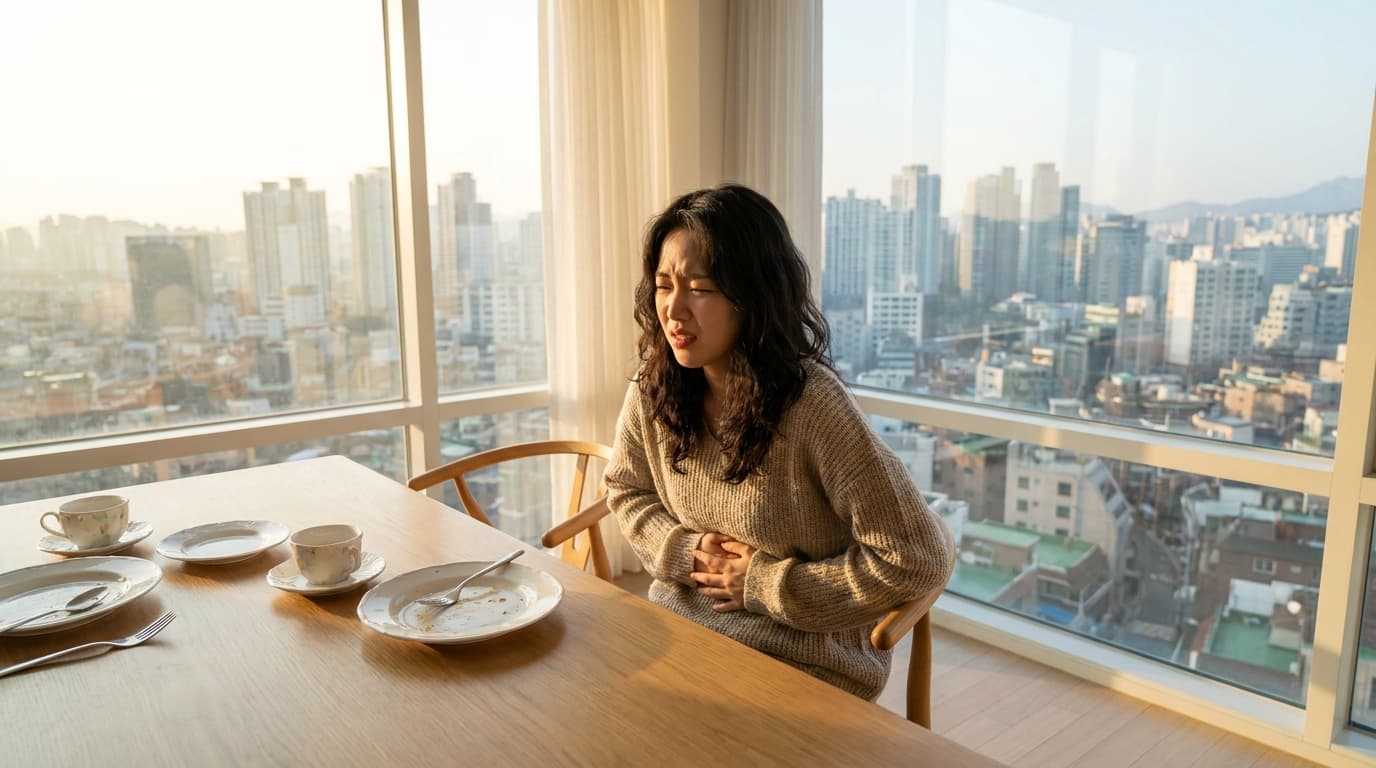
If You Go to the Bathroom Right After Eating, Could It Be Irritable Bowel Syndrome?
Hello, this is Dalimchae Korean Medicine Clinic. # If You Go to the Bathroom Right After Eating, Could It Be Irritable Bowel Syndrome? Have you ever experienced a sudden abdominal pain forcing you to run to the restroom right after an enjoyable meal? If you frequently wonder, "Why do I have to go to the bathroom immediately after eating?", this repetitive issue can make daily life, important gatherings, or travel stressful. You might hesitate to enjoy good food due to anxiety or avoid going out entirely because of unpredictable bowel activity after meals. This may be a representative sign of irritable bowel syndrome (IBS), affecting not just mild indigestion but our overall gut health and quality of life. 💡 **[Core Answer]** Top 3 most common causes of going to the bathroom right after eating: ① Increased intestinal hypersensitivity / ② Gut-Brain Axis imbalance / ③ Gut microbiota imbalance Dalimchae Korean Medicine Clinic restores fundamental intestinal function through **intestinal detoxification** to recover the intestinal mucosal lining and stabilize the gut-brain axis. ## Why Do You Have to Run to the Bathroom Right Immediately After Eating? The urge to have a bowel movement right after eating is closely related to postprandial diarrhea, a common symptom of irritable bowel syndrome (IBS). The intestines react very sensitively to the type or amount of food we eat, as well as psychological factors like stress. Especially in IBS patients, intestinal motility is excessively activated or visceral hypersensitivity is increased compared to normal individuals, causing the intestines to react violently to the minor stimulus of a meal. This reaction is closely linked to the imbalance of the "Gut-Brain Axis" connecting the gut and brain. When stress or anxiety stimulates the brain, the brain sends signals back to the gut, abnormally hyperactivating bowel motility or inducing inflammatory responses in the intestinal mucosa. ## How Effective Is Herbal Medicine for Diarrhea-Predominant Irritable Bowel Syndrome? IBS is a chronic disorder affecting about 10% of the global population, significantly reducing patients' quality of life due to recurring abdominal pain and diarrhea. Because conventional treatments often provide only temporary relief or carry concerns about side effects, interest in traditional Korean medicine treatments is growing. A 2026 study published in the `Integrative Medicine Research` journal by joint research teams from the Korea Institute of Oriental Medicine (Dr. Hyungjun Kim, Dr. Yujin Chae) and Kyung Hee University (Prof. Jinsung Kim, Hanayeon Kim) demonstrated the significant therapeutic efficacy of the herbal prescription 'Kwakjeong-tang-gami' (Guozheng Tang) for diarrhea-predominant irritable bowel syndrome (IBS-D). This study was conducted as a randomized, double-blind, placebo-controlled clinical trial involving 60 adult patients meeting the 'Rome IV' criteria, where participants took either Kwakjeong-tang-gami or placebo three times daily for 4 weeks. The clinical results showed that the symptom improvement rate in the herbal medicine group was 55.2%, more than double the 26.7% in the placebo group. The therapeutic response was defined as cases where abdominal pain decreased by 30% or more and stool consistency recovered to the normal range, maintained for more than half of the total treatment period. No adverse events or side effects related to the medication were reported during the 4-week administration period, ensuring safety. The research team explained that this study scientifically validates the efficacy and safety of Kwakjeong-tang-gami, laying the foundation for large-scale clinical trials. Furthermore, a 2015 meta-analysis published in `Evidence-Based Complementary and Alternative Medicine` (covering 14 studies with 1,551 patients) on Chinese herbal treatments for IBS-D showed that herbal treatment significantly improved overall symptoms (RR = 1.62; p \< 0.00001), abdominal pain (RR = 1.95; p \< 0.00001), and diarrhea (RR = 1.87; p \< 0.00001) compared to placebo, with no significant difference in side effects. The researchers concluded that herbal medicine is an effective and safe treatment for IBS-D. Based on these data, Dalimchae Korean Medicine Clinic Songdo branch focuses on treatments that regulate intestinal hypersensitivity and help recover the intestinal mucosal lining, going beyond mere symptom suppression. ## Irritable Bowel Syndrome Must Be Addressed at Its Root Through Intestinal Detoxification IBS, where patients complain, "I have to run to the bathroom right after eating," is deeply connected not only to digestive dysfunction but also to systemic health. In particular, toxins accumulated in the intestines and damage to the intestinal mucosa are the main culprits destroying gut health. Dalimchae Korean Medicine Clinic applies the principle of **intestinal detoxification** to fundamentally solve these problems. Toxins accumulated on the intestinal barrier can travel through the bloodstream throughout the body, causing inflammation and contributing to lowered immunity. A weakened intestinal barrier creates an environment favorable for harmful bacteria proliferation, which deepens gut microbiota imbalance and worsens IBS symptoms. Dalimchae's intestinal detoxification treatment focuses on breaking this vicious cycle. First, accumulated waste products and toxins in the intestines are eliminated to cleanly purify the intestinal environment. Afterward, it supports the regeneration of damaged intestinal mucosa and creates an environment where beneficial bacteria can actively thrive, normalizing bowel function. In this process, the balance of the gut-brain axis—the interaction between the gut and brain—is restored to regulate intestinal hypersensitivity and reduce symptoms like postprandial diarrhea or abdominal pain. In Korean medicine, this process enables the intestines to recover their innate detoxification and absorption functions, and further strengthens systemic immunity to create a healthy body immune to IBS recurrence. Sometimes patients also report tinnitus, headaches, or dizziness, which can be connected to autonomic nervous system imbalance and require an integrated approach. If you are looking for a Songdo irritable bowel syndrome clinic, we recommend experiencing fundamental gut health recovery through intestinal detoxification at Dalimchae Korean Medicine Clinic Songdo branch. ## Symptom Checklist: Do You Have Irritable Bowel Syndrome? If 3 or more of the following questions apply to you, you should suspect IBS and seek professional consultation: * Frequent urge to go to the bathroom along with abdominal pain within 1 hour after meals. * Abdominal pain tends to be relieved after bowel movements. * Constipation and diarrhea alternate, or loose stools occur frequently. * Frequent abdominal bloating, gas, and frequent passing of gas. * Discomfort in the stomach makes going out or important appointments burdensome. * Stress or tension causes stomachaches and diarrhea. * Difficulty falling back asleep after waking up due to abdominal pain or diarrhea. * Symptoms worsen when consuming milk, flour products, spicy foods, etc. **If 3 or more apply → Suspected IBS stage → Consider integrated Korean medicine treatment** **If 5 or more apply → Immediate visit and thorough diagnosis recommended** ## FAQ: Questions About Going to the Bathroom Right After Eating **Q. How long does treatment take for the symptom of going to the bathroom right after eating?** A. IBS is a chronic condition, and treatment duration varies depending on individual symptom severity, lifestyle habits, and treatment response. Usually, consistent treatment for 3 to 6 months or more is required, and symptoms gradually stabilize as intestinal function recovers through intestinal detoxification. **Q. Can irritable bowel syndrome be treated with Korean medicine?** A. Yes, IBS can be effectively managed with Korean medicine. Korean medicine focuses on fundamentally improving gut function imbalance and gut-brain axis problems to alleviate symptoms and prevent recurrence. A combination of herbal medicine, acupuncture, and moxibustion is effective. **Q. Can the symptom of going to the bathroom right after eating resolve naturally?** A. Temporary diarrhea may resolve naturally, but chronic IBS symptoms like "having to run to the bathroom right after eating" are difficult to resolve on their own. Leaving it unattended can worsen symptoms or severely diminish quality of life, so proper diagnosis and treatment are important. **Q. Can irritable bowel syndrome and reflux esophagitis be treated together?** A. Yes, they can be treated together. Both IBS and reflux esophagitis are closely related to digestive functional problems, autonomic nervous system imbalance, and gut-brain axis issues. Dalimchae Korean Medicine Clinic Songdo branch identifies the common causes of both conditions and provides integrated treatment through intestinal detoxification and autonomic nervous stabilization, aiming to improve both symptoms simultaneously. Going to the bathroom right after eating is not a problem to simply endure. You no longer need to ignore the signals your body has been sending for a long time. When approached in the right direction, your body responds faster than you think. Bring the symptoms you are experiencing just as they are. Dalimchae Korean Medicine Clinic will find the cause together with you. Where life blossoms. Herbal medicine is Dalimchae Korean Medicine Clinic. Check your similar symptoms first through Dalimchae Korean Medicine Clinic's website AI consultation! This article is health information organized together by Dalimchae medical staff based on questions frequently received in the treatment room. Medical Supervision | Dalimchae Korean Medicine Clinic Songdo Branch, Oriental Medicine Doctor Oh Hyunmin (Digestive Disease Column) #IBS #PostprandialDiarrhea #GutHealth #SongdoIBS #SongdoKoreanMedicineClinic #IntestinalDetox #GutBrainAxis #AbdominalPainDiarrhea