
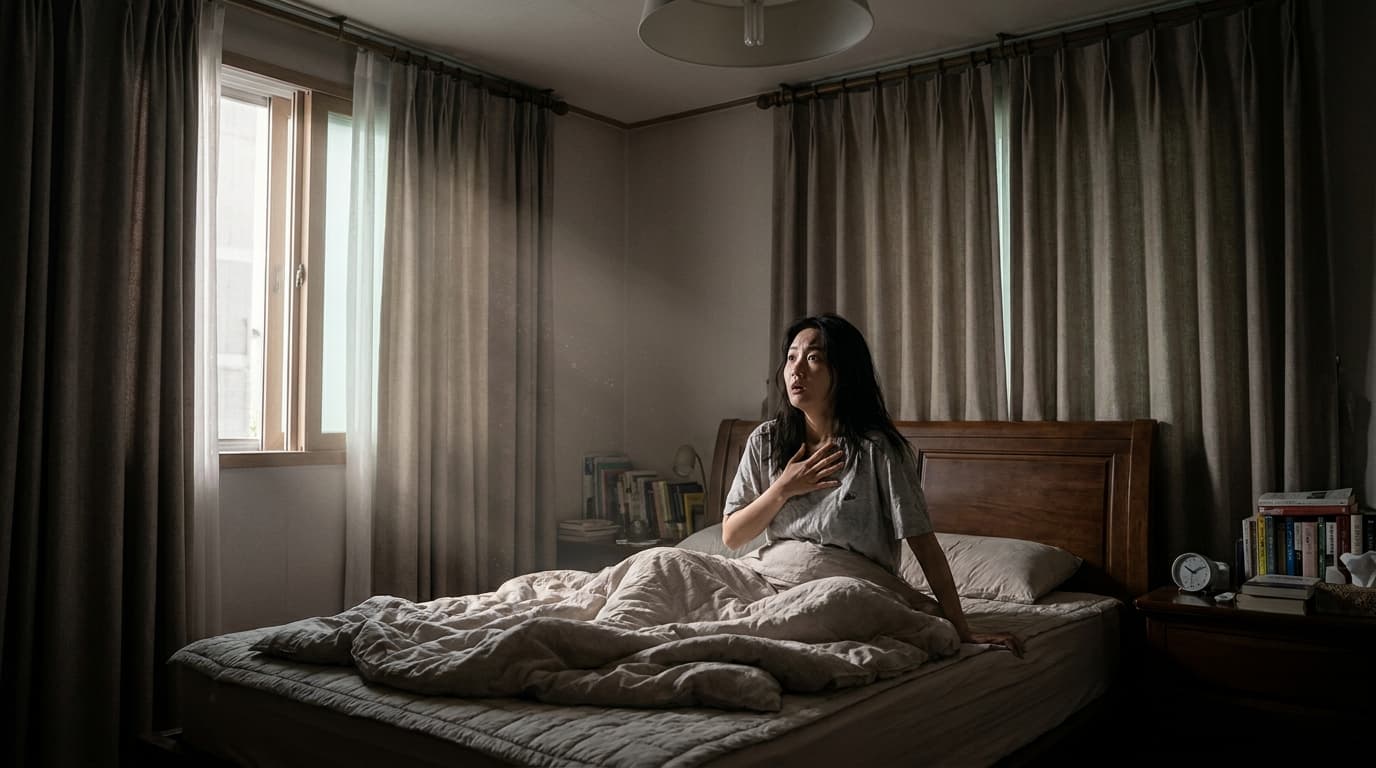
I Wake Up Suddenly Short of Breath at Night Is It a Panic Attack Nighttime Anxiety Answered by Dalimchae
Hello, this is Dalimchae Korean Medicine Clinic. I Wake Up Suddenly Short of Breath at Night, Is It a Panic Attack? Nighttime Anxiety Answered by Dalimchae In the pitch-black dawn, have you ever woken up with a start feeling like your breath is suddenly cut off while fast asleep? Your heart races, cold sweat flows, and experiencing this terror as if you are going to die is truly a nightmare. Those who complain 'I wake up suddenly short of breath at night' are spending painful hours where daytime stress and fatigue lead to nighttime anxiety, disturbing even deep sleep. Such nocturnal dyspnea can be a strong signal that an important balance in our body has broken beyond a simple sleep disorder. 💡 [Key Answer] Top 3 most common causes of 'I Wake Up Suddenly Short of Breath at Night': ① Autonomic Nervous System Imbalance: Excessive sympathetic nerve activation increases heart rate and induces breathing difficulties. ② Nocturnal Panic Attack: Extreme anxiety and physical symptoms occurring unconsciously during sleep. ③ Stress and Overwork: The brain cannot rest sufficiently and maintains a alert state even at night. Dalimchae Korean Medicine Clinic cools down overheated brains through autonomic stabilization, restoring body and mind balance to grant deep night peace. ## What is the Real Cause of Sleepless Nights and Breathless Suffering? When you go to bed at night, breathing comfortably is natural. However, if you experience symptoms like 'my breath is short at night' or 'waking up gasping for breath' for unknown reasons, you must examine the cause closely. Many worry it might be a heart or lung problem and get tested, but they usually hear 'normal'. What should be noted here is the autonomic nervous system, which controls our body's unconscious functions. The autonomic system handles essential life-maintaining functions such as heart rate, respiration, digestion, and body temperature regulation. Among these, sympathetic nerves activate during tension, stress, and activity, while parasympathetic nerves activate during relaxation, rest, and digestion, achieving balance. However, if excessive stress, irregular lifestyle habits, and overwork persist, sympathetic nerves abnormally hyperactivate, leading to a 'hyperarousal' state where the brain cannot rest even at night. Such autonomic imbalance can cause difficulty falling asleep at night as well as nocturnal panic attacks inducing sudden nocturnal dyspnea or chest pressure during sleep. Especially many busy people in Incheon region visit Incheon nocturnal dyspnea Korean medicine clinic complaining of such sleep panic attacks caused by autonomic imbalance. ## The Mechanism Where Autonomic Imbalance Induces 'Shortness of Breath at Night' The core of the autonomic nervous system is in the brainstem, which is like a control tower overseeing our body's life activities. When sympathetic nerves hyperactivate, heart rate variability (HRV) becomes unstable, and the brain's amygdala overreacts, causing anxiety and fear even to minor stimuli. This overheating of the brain and autonomic system continues during sleep, causing you to wake up from sleep with extreme terror and a feeling of 'breathlessness' even while asleep. This comes closer as a powerful threat feeling of 'going to die' beyond simply shortness of breath, sharply dropping sleep quality. It is known that these symptoms often appear during the light sleep stage when falling asleep starts. ## How Does Oriental Medicine Treatment Restore Night Peace by Stabilizing the Autonomic Nervous System? Dalimchae Korean Medicine Clinic views nocturnal dyspnea symptoms like 'I wake up suddenly short of breath at night' as a problem of autonomic nervous system imbalance, focusing on recovering the fundamental functions of the brain and zang-fu organs. Oriental medicine views the body as a single organism, not merely suppressing symptoms, but restoring internal harmony and balance to build self-recovery power. A study published in 2004 in the Journal of Ethnopharmacology confirmed the effect of the traditional Korean herbal medicine prescription Ondamtanggamibang on stress-related neuroendocrine responses. As a result of a randomized placebo-controlled trial targeting 40 medical students, the herbal medicine-taking group showed significantly decreased systolic blood pressure, norepinephrine, and cortisol levels, along with positive changes in psychological variables such as anxiety, depression, and stress. Researchers concluded that such results suggest herbal medicine can contribute to reducing blood pressure and catecholamine levels by stabilizing the autonomic nervous system and alleviating negative psychological symptoms. Also, in a meta-analysis study published in 2025 in Frontiers in Neuroscience, the clinical effect and safety of acupuncture treatment in regulating autonomic function were systematically analyzed. This study synthesized randomized controlled trials to confirm that acupuncture treatment significantly improved SDNN (Standard Deviation of all NN intervals), an indicator of Heart Rate Variability (HRV), by an average of 13.59ms (95% CI: 4.19 ~ 22.98, p = 0.0091). Researchers stated that these results suggest acupuncture treatment can show therapeutic effects on various diseases by regulating autonomic balance. Based on these research data, Dalimchae Korean Medicine Clinic Incheon Branch focuses on stabilizing overheated sympathetic nerves through herbal medicine prescriptions tailored to the patient's constitution and symptoms, and recovering the brain's autonomic regulation ability through acupuncture treatment. This is a treatment principle helping the body regain comfortable and deep sleep by itself, beyond simply calming anxiety. ### Autonomic Stabilization Treatment Principle of Dalimchae Korean Medicine Clinic Dalimchae Korean Medicine Clinic's 'autonomic stabilization' treatment applies to brain and autonomic nervous system-related diseases. When autonomic balance collapses due to excessive stress and tension, the brain cannot rest and keeps turning on warning lights. This is like an overheated engine continuing to run. In this state, the brain cannot stabilize even at night, disturbing deep sleep and appearing as physical symptoms like sudden dyspnea. Dalimchae Korean Medicine Clinic focuses on lowering the excessive heat of the nervous system and creating an environment where the brain can comfortably rest. In oriental medicine, this is called Suseunghwagang (water ascending and fire descending), emphasizing the circulation balance of the body making the head cool and the lower body warm. Through this treatment, we help calm and soothe body and mind by reducing the overactive response of the amygdala, the center of anxiety and fear, and inducing parasympathetic nerve activation. Consequently, various symptoms appearing from autonomic imbalance such as headaches, dizziness, and chronic fatigue can be improved together. Dalimchae Korean Medicine Clinic as an Incheon panic disorder Korean medicine clinic helps many patients regain night peace through such autonomic stabilization treatment. ## Am I Experiencing Nocturnal Panic Attacks? (Self-Diagnosis Checklist) If 3 or more of the following apply, you can suspect nocturnal dyspnea or nocturnal panic attacks due to autonomic nervous system imbalance. * Unpleasant premonitions or vague anxiety often occur before falling asleep. * Waking up suddenly at night due to breathlessness or chest tightness. * Heart pounding and cold sweat flowing when waking up during sleep. * Very difficult to fall asleep again after waking up. * Feeling anxious or tense during the day without special reason. * Frequently experiencing physical symptoms like dizziness, headaches, and indigestion. * Anxiety increases in crowded places or when using public transportation. If 3+ apply: Suspect autonomic imbalance-type nocturnal dyspnea -> Consider complex oriental medicine treatment If 5+ apply: Immediate consultation and examination recommended to grasp exact cause and start treatment ## FAQ Section **Q. Why is shortness of breath during sleep dangerous?** A. Dyspnea occurring during sleep can be a sign that the body is not receiving sufficient oxygen supply, which disturbs brain rest and leads to chronic fatigue, anxiety, concentration drop, etc. Also, it places burden on the cardiovascular system, carrying the risk of causing surprising health problems. **Q. How do nocturnal panic attacks and sleep apnea differ?** A. Nocturnal panic attacks are psychiatric symptoms accompanied by sudden dyspnea and palpitations along with extreme anxiety, whereas sleep apnea is a physical problem where breathing cannot be performed due to airway blockage or brain respiratory center abnormalities. Symptoms may be similar, but causes and treatment approaches differ, making accurate diagnosis important. **Q. How long does oriental medicine treatment take?** A. Treatment period varies depending on various factors such as patient symptom degree, occurrence timing, accompanying symptoms, lifestyle habits. Generally, initial symptoms or mild symptom degrees show improvement in a relatively short period, and even chronic cases can be sufficiently improved through steady treatment. **Q. Can it be cured only with lifestyle habit improvement?** A. Healthy lifestyle habits (regular sleep, proper exercise, caffeine/alcohol restriction) help stabilize the autonomic nervous system, but if autonomic imbalance has already deepened or panic attacks are experienced, combining expert diagnosis and treatment is important. Especially those suffering from nocturnal dyspnea in Incheon are advised to consider active treatment. Symptoms like 'I wake up suddenly short of breath at night' are not problems solved by enduring. Signals sent by the body for a long time do not need to be ignored anymore. When approached in the right direction, the body responds faster than you think. Bring the symptoms you are experiencing as they are. Dalimchae Korean Medicine Clinic will find the cause together. Where life blooms. Herbal medicine is Dalimchae Korean Medicine Clinic. Check symptoms similar to yours first through Dalimchae Korean Medicine Clinic homepage AI consultation! This health information was organized together by Dalimchae medical staff based on questions frequently received in the clinic room. Medical Supervision | Brain & Autonomic Nervous System Treatment Standard: Dalimchae Korean Medicine Clinic Incheon Branch Oriental Medical Doctor Min Jihong (Panic Disorder Column)