
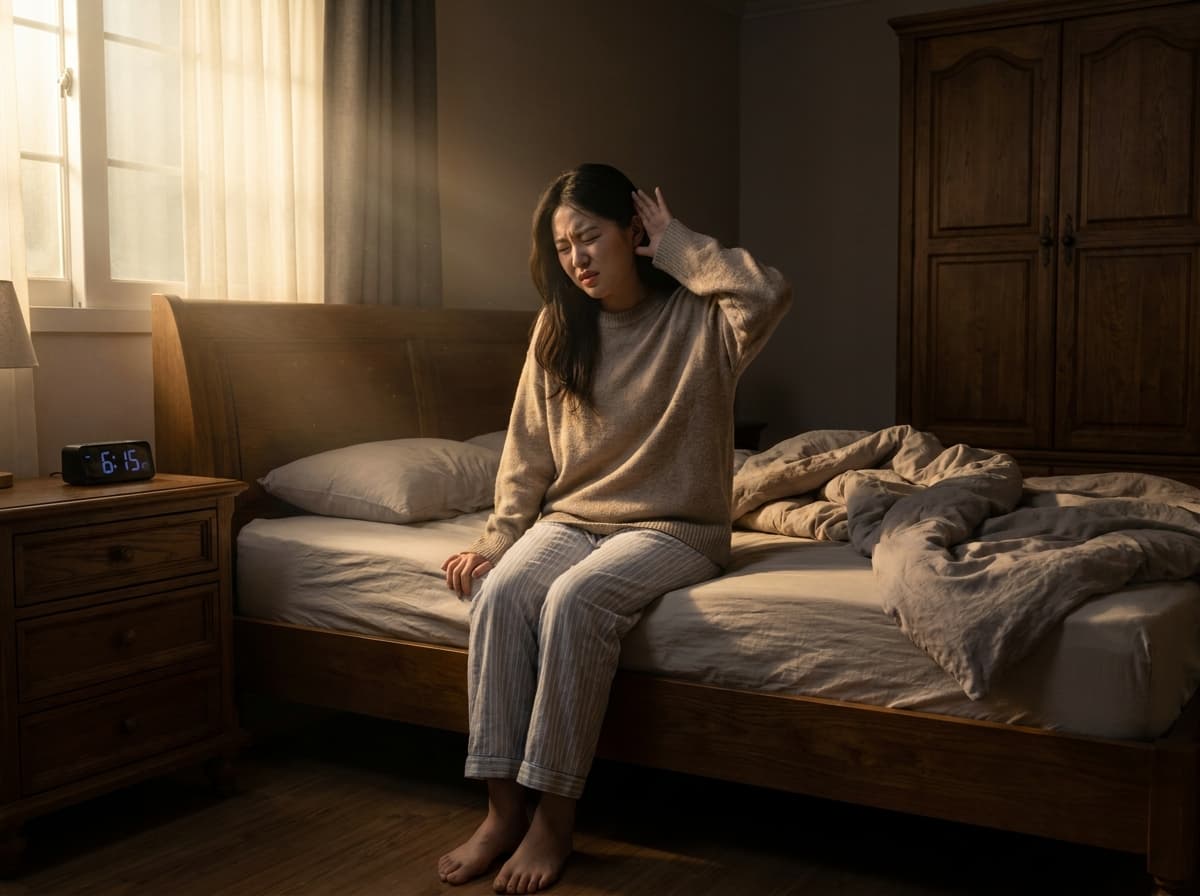
I hear a buzzing sound in my ears, could it be tinnitus?
Hello. This is Dalimchae Oriental Medicine Clinic. # I hear a buzzing sound in my ears, could it be tinnitus? Have you ever experienced hearing a buzzing sound in your ears all of a sudden, and it gets worse at night, making it hard to fall asleep? When it's quiet at night or when you're stressed, many people feel great discomfort in their daily lives due to various tinnitus symptoms such as buzzing, beeping, or cicada-like sounds. It's common to suffer alone with anxiety, wondering "Am I the only one hearing this sound?" and finding it difficult to talk to those around them. Even if you receive a diagnosis that there is no particular abnormality upon examination, the sound doesn't disappear and continues, so many people visit Songdo Tinnitus Clinic expressing their frustration. 💡 **[Key Answer]** The 3 most common causes of the symptom **"I hear a buzzing sound in my ears"**: ① Autonomic nervous system imbalance due to excessive stress / ② Micro-functional abnormality of the auditory nervous system / ③ Accumulation of brain fatigue and functional decline Dalimchae Clinic creates an environment where the overheated brain can rest through **autonomic nervous system stabilization**, solving the root cause of tinnitus. ## Is hearing a buzzing sound in your ears simply a problem with the ears? Many people visit an ENT clinic first when they experience a buzzing sound in their ears, i.e., tinnitus, thinking there's a problem with their ears. However, even after a thorough examination, they are often diagnosed with "no particular abnormality" or dismissed as simple noise-induced tinnitus. So where does this sound come from? It's often not just an ear problem, but stems from fatigue and imbalance in the brain and autonomic nervous system, the most important control towers of our body. The brain processes a vast amount of sensory information, and when the autonomic nervous system becomes unstable, the brain also becomes excessively tense. Like an overheated engine, the brain's excitation level rises, causing it to react hypersensitively to minute auditory signals, or the brain itself creates and perceives sounds even when there is no actual external sound. In particular, stress and lack of sleep further disturb the autonomic nervous system, becoming major causes that worsen tinnitus symptoms. ## How does Oriental medicine interpret and treat tinnitus symptoms? Many tinnitus patients who do not find a specific cause in Western medicine or see little effect from drug treatments such as steroids visit Songdo Tinnitus Clinic. In Oriental medicine, tinnitus is not viewed simply as an ear disease, but is interpreted as an imbalance in the whole body, especially a functional abnormality of the brain and autonomic nervous system. Our body's autonomic nervous system consists of the sympathetic and parasympathetic nervous systems, and if this balance is broken due to stress or overwork, it can negatively affect brain functions, including the brainstem, causing or worsening tinnitus. In fact, studies revealing the relationship between autonomic nervous system function and tinnitus are being published steadily at home and abroad. According to a study published in the 『Journal of Korean Acupuncture & Moxibustion Medicine Society』 in 2017, as a result of applying combined Korean medicine treatment (acupuncture, moxibustion, herbal medicine) for 4 weeks to 60 patients with stress-induced tinnitus, the tinnitus intensity (VAS scale) significantly improved from an average of 7.2 before treatment to 4.5 after treatment (p\<0.001), and statistically significant improvement was also confirmed in the heart rate variability (HRV) test, an indicator of autonomic nervous system balance. The researchers confirmed the effect of stress on the occurrence and worsening of tinnitus and concluded that Korean medicine treatment is effective in alleviating tinnitus symptoms by regulating the autonomic nervous system. Furthermore, a clinical study published in the 『Journal of Korean Medicine』 in 2021 reported that the Tinnitus Handicap Inventory (THI) score decreased by about 45% from an average of 58.3 points before treatment to 32.1 points after treatment as a result of prescribing autonomic regulation herbal medicine for 8 weeks to 80 tinnitus patients (p\<0.01). The research team explained that herbal treatment contributes to improving the quality of life due to tinnitus by calming the brain's over-excited state and restoring the balance of the autonomic nervous system. Based on these scientific data, Dalimchae Clinic Songdo Branch provides Oriental medicine treatment that corrects the balance of the brain and autonomic nervous system for those suffering from buzzing sounds in their ears. ## Dalimchae Clinic's autonomic nervous system stabilization treatment teaches the brain how to rest At Dalimchae Clinic, the core of tinnitus treatment is 'autonomic nervous system stabilization'. If the balance of the autonomic nervous system is collapsed, the brain continues to be excited and cannot rest. The brain remains in a state of overload like an excessively turned-on light, which eventually manifests as abnormal signals such as a buzzing sound in the ears. We calm this over-excited state of the brain and create an environment where the brain can rest comfortably by restoring the balance of the autonomic nervous system. In Oriental medicine, this is also called 'Suseunghwagang (水昇火降)', which is a principle of helping the body's energy circulate by keeping the head cool and the lower abdomen warm. Through this, it helps to lower the heat of the nervous system, improve blood circulation, and naturally reduce tinnitus symptoms by supplying sufficient oxygen and nutrients to the brain. In addition, headaches, dizziness, and sleep disorders that appear together due to autonomic imbalance can also be improved, enhancing the overall quality of life. Dalimchae Clinic Songdo Branch helps your body develop the strength to recover itself through customized herbal medicine and acupuncture treatment suitable for each individual's constitution and symptoms. ## Is it tinnitus for me too? Autonomic Tinnitus Self-Checklist Check how many of the following items apply to you. * When you are in a quiet place or go to bed at night, you hear buzzing or beeping sounds more clearly. * When you are stressed or tired, the tinnitus sound gets louder or newly occurs. * The quality of sleep is not good, such as having difficulty falling asleep or waking up frequently. * Usually, the shoulders or neck are often tight and stiff. * You are startled or react sensitively even to small sounds. * You often feel anxious or restless for no particular reason. * Digestion is not good, or it is accompanied by chronic headaches and dizziness. **Judgment Criteria:** * **If 3 or more apply:** It is highly likely to be tinnitus due to autonomic nervous system imbalance. It is good to consider active combined Oriental medicine treatment. * **If 5 or more apply:** The symptoms may have already progressed significantly. We recommend visiting Songdo Clinic for an accurate diagnosis and immediate treatment. ## FAQ: Frequently Asked Questions about Tinnitus **Q. How long should I be treated for tinnitus to see an effect?** A. The duration of tinnitus treatment varies depending on the severity of the individual's symptoms, the cause of occurrence, and chronicity. Generally, if you are treated steadily for about 3 to 6 months, you can expect significant improvement, and in the case of early symptoms, it may improve faster. **Q. I hear a buzzing sound in my ears, do I also have hearing loss?** A. About 80% of tinnitus patients are known to have hearing loss. However, even if the hearing test results are within the normal range, many people feel tinnitus due to increased auditory fatigue of the brain, so tinnitus treatment is important regardless of hearing loss. **Q. Can tinnitus also be treated with Oriental medicine?** A. Yes, in Oriental medicine, tinnitus is seen as a problem of bodily imbalance and is treated through autonomic nervous system regulation, brain function stabilization, and improvement of Qi and blood circulation. It is being proven through actual clinical studies to be effective in alleviating tinnitus symptoms and improving quality of life. **Q. Can tinnitus heal naturally?** A. Some acute tinnitus may improve naturally, but most chronic tinnitus is difficult to improve without active treatment. If left unattended, symptoms may become more severe or be accompanied by other nervous system symptoms, so it is important to treat it early. Tinnitus is not a problem that can be solved by enduring it. You no longer have to ignore the signals your body has been sending for a long time. If you approach it in the right direction, your body reacts faster than you think. Bring the symptoms of buzzing in your ears as they are. We will find the cause together at Dalimchae Clinic Songdo Branch. Where life blooms. For herbal medicine, it's Dalimchae Clinic. Check your symptoms first with the AI consultation on the Dalimchae Clinic website! This post is health information compiled by the Dalimchae medical staff based on questions frequently received in the consultation room. Medical Supervision | Dalimchae Clinic Songdo Branch Doctor of Oriental Medicine Hyunmin Oh, brain and autonomic nervous system specialist (Tinnitus Column)