
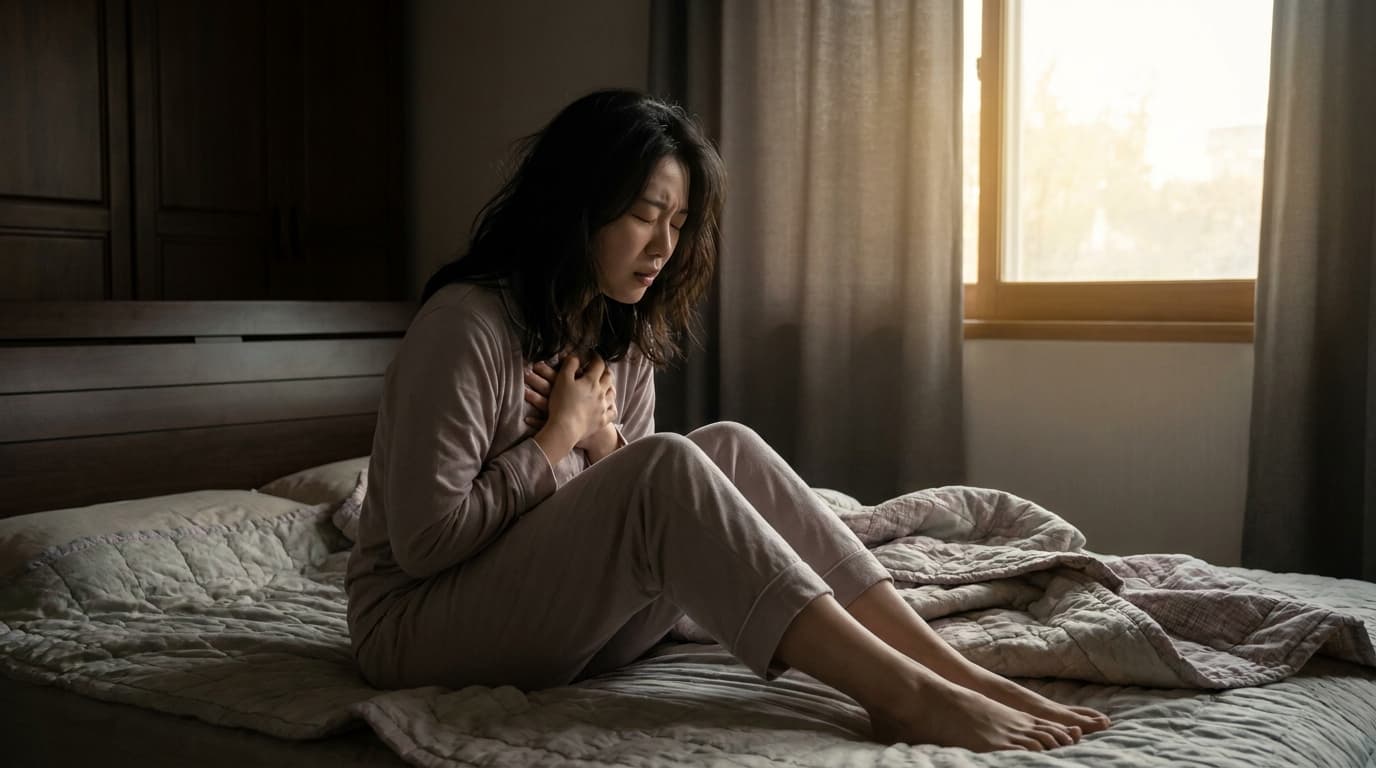
I Feel Stuffy and Anxious in My Chest Is It Anxiety Disorder or Autonomic Dysfunction
Hello, this is Dalimchae Korean Medicine Clinic. # I Feel Stuffy and Anxious in My Chest: Is It Anxiety Disorder or Autonomic Dysfunction? Suddenly, your chest feels tight and your heart starts pounding. Breathing becomes difficult, and you might even be gripped by the fear that something terrible is about to happen. When you go to the hospital for tests, you are told "everything is normal," yet your body remains filled with anxiety and discomfort. Many people fall into deep contemplation in front of these symptoms: 'Am I suffering from an anxiety disorder? Or is it autonomic dysfunction?' Since these two share many overlapping symptoms, they are easy to confuse, but we must move in the right direction through accurate understanding. 💡 **Key Answer** The 3 most common causes when your chest feels tight and anxious: ① Autonomic imbalance caused by excessive stress / ② Hyperactivation of the brain's emotional regulation centers such as the amygdala / ③ Chronic fatigue and lifestyle habits. Dalimchae Korean Medicine Clinic helps the brain and body regain a comfortable balance through **autonomic stabilization** treatment. ## What is the Difference Between Anxiety Disorder and Autonomic Dysfunction? Anxiety disorder and autonomic dysfunction are closely connected, but they are distinctly different concepts. Anxiety disorder is a mental illness where daily life is disrupted due to excessive anxiety and fear about a specific object or situation. On the other hand, autonomic dysfunction refers to a state where various uncomfortable symptoms appear throughout the body because the balance of our body's autonomic nervous system is broken due to various causes such as stress, fatigue, and hormonal changes. To put it simply, if anxiety disorder is a state where the brain's 'warning light' operates excessively, autonomic dysfunction can be described as a situation where a problem occurs in the entire car's 'electrical system', causing errors in multiple functions including the warning light. Of course, the two influence each other and can worsen symptoms. When the autonomic nervous system becomes unstable due to stress, feelings of anxiety grow, and conversely, chronic anxiety induces excessive hyperactivity of the autonomic nervous system, forming a vicious cycle. ## You Can't Find Comfort in Being Told "You're Fine," Right? Don't Ignore Your Body's Signals. Many patients visit the hospital with symptoms of chest tightness and anxiety only to hear that they are 'normal'. This means there are no organic lesions in the body, but it does not mean the suffering experienced by the patient disappears. When tests show no special abnormalities, yet various symptoms such as heart palpitations, headaches, dizziness, and chronic indigestion appear, autonomic dysfunction can be suspected. Since the autonomic nervous system is a vital system that regulates all organs and functions in our body, problems here can lead to various physical symptoms as well as psychological anxiety. In particular, autonomic dysfunction related to stress can stand out from a traditional Korean medicine perspective that emphasizes the connection between mind and body (心身). ## Are My Symptoms Anxiety Disorder or Autonomic Dysfunction? Symptom Checklist Check your current state by answering the following questions: 1. Suddenly, without any special reason, symptoms of chest tightness and difficulty breathing appear. 2. Your chest pounds severely or you frequently feel a sinking sensation in your chest. 3. It is difficult to fall asleep at night, or you wake up frequently even after falling asleep, making it hard to get deep sleep. 4. Digestion is poor, the pit of the stomach feels stuffy, and you frequently feel nauseous. 5. Your head feels unclear and constantly foggy, or you frequently experience headaches and dizziness. 6. Body temperature regulation is difficult, such as cold hands and feet, increased sweating, or facial flushing. 7. You are easily startled or sensitive to even minor things, and feel chronic fatigue. 8. Groundless feelings of anxiety or worry continue in daily life, making it difficult to concentrate. 9. The neck and shoulder areas are frequently stiff and sore, and muscle tension is felt. 10. Nerves become sensitive, reacting sensitively to sound or light. **Criteria:** * **3 or fewer items apply**: High possibility of simple stress and accumulated fatigue. It can be sufficiently improved through lifestyle habit improvements. * **4 to 6 items apply**: May be the early stage of autonomic imbalance. Consider active stress management along with professional consultation such as an **Incheon Autonomic Nervous System Korean Medicine Clinic**. * **7 or more items apply**: High possibility of anxiety disorder or autonomic dysfunction. It is important to quickly start accurate diagnosis and customized treatment through **Incheon Anxiety Disorder Korean Medicine Clinic** treatment. ## What Happens to the Brain When the Autonomic Nervous System Collapses? — Dalimchae's Autonomic Stabilization Treatment The autonomic nervous system in our body consists of the sympathetic and parasympathetic nervous systems. The sympathetic nervous system arouses the body in tense or stressful situations, while the parasympathetic nervous system is responsible for rest and relaxation, helping the body recover. When the balance between these two nerves breaks, the brain and body cannot rest like an overheated engine and fall into an overload state. This is autonomic dysfunction, which can also lead to psychiatric symptoms such as anxiety disorder. Dalimchae Korean Medicine Clinic corrects this autonomic imbalance to create an environment where the brain can rest and recover. We call this **autonomic stabilization** treatment. The core is to calm the excessively hyperactive sympathetic nervous system and boost the lowered function of the parasympathetic nervous system, helping the body regain its own recovery power. This aligns with the traditional Korean medicine perspective of viewing mind and body (心身) as one and emphasizing the harmony of yin and yang. **Proven Effects of Traditional Korean Medicine Treatment Through Recent Clinical Studies** According to a study by Professor Lee Myung-soo's research team published in the *International Journal of Neuroscience* in 2005, the positive effects of herbal medicine treatment on heart rate variability (HRV) were confirmed. This study analyzed and compared the heart rate variability of 40 participants divided into a herbal medicine treatment group (20 people) and a placebo group (20 people). As a result of the study, the group taking herbal medicine (Ondamtang-gamibang) showed a decrease in heart rate and a statistically significant increase in heart rate variability, confirming that sympathetic-parasympathetic nerve function and cardiac autonomic nervous system were stabilized. In addition, the herbal medicine treatment group reported more pleasant and peaceful emotions than the placebo group. The researchers concluded that herbal medicine can contribute to simultaneously stabilizing the autonomic nervous system and emotional state. Based on these data, Dalimchae Korean Medicine Clinic helps the brain and body, exhausted by excessive stress, regain their natural rhythm through herbal prescriptions that calm autonomic instability and find emotional stability. Lowering excessive heat in the nervous system and creating an environment where the brain can rest comfortably—known as Su-seung-hwa-gang (水昇火降) in traditional Korean medicine—is an important process to fundamentally treat anxiety disorder and autonomic dysfunction. In addition, a retrospective study published in *Healthcare (Basel)* in July 2024 showed that traditional Korean medicine complex treatment (acupuncture, psychotherapy, chuna therapy, aromatherapy, herbal medicine, etc.) was effective in improving anxiety symptoms in 67 patients with anxiety disorder. As a result of at least 4 weeks of traditional Korean medicine treatment, patients' anxiety symptoms (STAI X-1, STAI X-2, BAI indicators) decreased statistically significantly compared to before treatment (p < 0.0001), and depression (BDI-II, p < 0.0001) and anger (AKI-K-I, AKI-K-O, p < 0.05) also decreased, while quality of life (EQ-5D, EQ-VAS) improved (p < 0.0001). The researchers suggested that traditional Korean medicine treatment can help improve clinical symptoms and quality of life in patients with anxiety disorder. At Dalimchae Korean Medicine Clinic Incheon Branch, based on these latest clinical research results, we focus on harmoniously restoring the autonomic nervous system and breaking the vicious cycle of anxiety through personalized herbal prescriptions as well as various traditional Korean complex treatments such as acupuncture, moxibustion, cupping, and oriental physical therapy. Rather than simply suppressing symptoms, our treatment philosophy is to maximize the body's natural healing ability so that you can regain a healthy and vibrant daily life. ## If You Are Looking for a Korean Medicine Clinic in Incheon for Anxiety Disorder and Autonomic Dysfunction Many people looking for an **Incheon Autonomic Dysfunction Korean Medicine Clinic** are curious about traditional Korean medicine treatment. Dalimchae Korean Medicine Clinic Incheon Branch comprehensively treats anxiety, agitation, heart palpitations, chest tightness, indigestion, insomnia, dizziness, and headaches caused by imbalance of the autonomic nervous system. We focus on finding the deep-rooted causes in the body and preventing recurrence through fundamental constitutional improvement. Especially for those suffering from persistent symptoms despite normal test results, traditional Korean medicine diagnosis and treatment can be a new hope. **Q. How does traditional Korean medicine view anxiety disorder and autonomic dysfunction?** A. In traditional Korean medicine, anxiety disorder and autonomic dysfunction are viewed as functional imbalances of internal organs such as the heart, liver, and spleen, disorders of qi and blood circulation, and the loss of mind-body harmony due to stress. Rather than just looking at symptoms, we comprehensively diagnose and treat the patient's constitution and overall health condition. **Q. How long should autonomic dysfunction be treated?** A. The treatment period may vary depending on the patient's symptom severity, duration of onset, and individual recovery capacity. Generally, 1 to 3 months for the early stage, and more than 3 months of steady treatment and lifestyle improvements may be needed for chronic cases. **Q. Can anxiety be reduced without medication?** A. Yes, it is fully possible. At Dalimchae Korean Medicine Clinic, we help the brain regulate anxiety on its own and find peace of mind through herbal medicine and acupuncture that restore the balance of the autonomic nervous system. We may also consider co-treatment so that Western medications can be gradually reduced as symptoms improve. **Q. I am looking for a clinic good at autonomic treatment in Incheon.** A. Incheon Dalimchae Korean Medicine Clinic Incheon Branch has rich clinical experience in brain and autonomic diseases such as autonomic dysfunction and anxiety disorder. Through precise diagnosis and customized traditional Korean medicine treatment optimized for each individual patient, we help you return to a healthy daily life. Chest tightness and anxiety are not problems solved by enduring them. You no longer need to ignore the signals your body has been sending for a long time. When approached in the right direction, the body responds faster than you think. Bring the symptoms you are experiencing as they are. Dalimchae Korean Medicine Clinic will find the cause together with you. A place where life blooms. Herbal medicine is, after all, Dalimchae Korean Medicine Clinic. Check similar symptoms first through Dalimchae Korean Medicine Clinic's website AI consultation! This article is health information organized together by Dalimchae medical staff based on questions frequently received in the treatment room. Medical Supervision | Brain & Autonomic Treatment Standard, Dalimchae Korean Medicine Clinic Incheon Branch Korean Medicine Doctor Yang Yuchan (Autonomic Dysfunction Column) #AnxietyDisorder #AutonomicDysfunction #AutonomicNervousSystem #IncheonAnxietyClinic #IncheonAutonomicClinic #ChestTightness #Anxiety #OrientalMedicineTreatment