
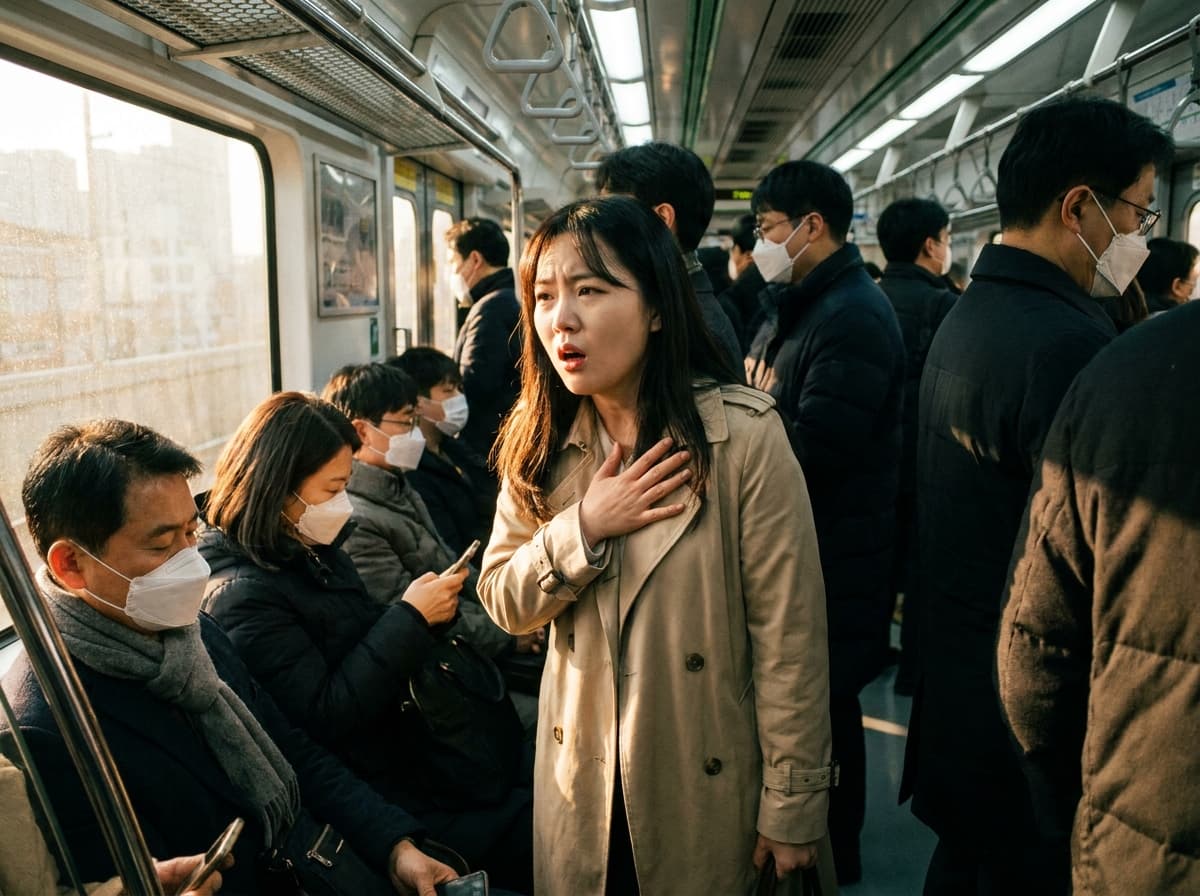
I can't breathe Is the sudden fear on the subway commute panic disorder
Hello. This is Dalimchae Korean Medicine Clinic. # I can't breathe. Is the sudden fear on the subway commute panic disorder? Have you ever experienced a sudden racing heart, cold sweats, and above all, a desire to scream "I can't breathe" in a crowded subway or bus on your way to work? A moment of extreme terror where you want to run out immediately regardless of the people around you, feeling like you might die. Even if you get tested and diagnosed with nothing wrong, this unpredictable fear repeats and increasingly constricts your daily life. This experience is not just a passing anxiety, but may be a typical symptom of 'panic disorder' where our body's warning light malfunctions. 💡 **[Key Answer]** **3 most common causes of panic attacks with the symptom "I can't breathe":** ① **Excessive stress and brain function overload** / ② **Collapse of autonomic nervous system balance** / ③ **Excessive anxiety response to physical sensations** Dalimchae Korean Medicine Clinic restores the balance of the overheated brain and unstable autonomic nerves with **autonomic stabilization treatment**, giving the gift of a healthy daily life. ## Sudden suffocating panic attack, why does it happen? A panic attack is a phenomenon where our body reacts as if it is in great danger even without a specific external threat. This is often caused by a malfunction of the brain's alarm system. Especially when stress and tension persist, the sympathetic nervous system is excessively activated, and the function of the parasympathetic nervous system decreases, breaking the balance of the autonomic nervous system. This imbalance causes physical symptoms such as increased heart rate, difficulty breathing, chest pressure, and dizziness, which in turn leads to the thought that 'I might die', creating a vicious cycle that amplifies the fear. Panic disorder patients tend to react excessively sensitively to sudden physical symptoms and interpret them catastrophically. For example, they mistake a slightly fast heartbeat for a heart attack, or perceive slightly rapid breathing as suffocation. These cognitive distortions increase the intensity of the panic attack and increase 'anticipatory anxiety' about the next attack, bringing great restrictions to daily life. ## How does Korean medicine view and treat panic disorder? In Korean medicine, panic disorder is not viewed as just a psychological problem. It is seen as caused by complex factors such as functional imbalance of the internal organs, obstruction of Qi and blood circulation, and instability of the mind and spirit due to stress. In particular, it is diagnosed as the function of the heart and gallbladder weakening (心膽虛怯, Simdamheogeop) or chronic stress causing phlegm (痰飮, Dameum) to disturb the mind and spirit. Treatment focuses not on simply suppressing symptoms, but on resolving the autonomic nervous system imbalance, which is the root of the symptoms, and restoring harmony to the overall body. To this end, herbal prescriptions, acupuncture, moxibustion, and Korean medicine psychotherapy tailored to the patient's constitution and symptoms are combined to alleviate anxiety and stabilize the body and mind. ## What are the actual research results of Korean medicine treatment for panic disorder? A study titled "The Mental Health Outcomes and Cost Estimates of Korean Medicine for Anxiety Disorder Patients" published in 2024 analyzed the effects of Korean medicine treatment on 67 patients with anxiety disorders. This study showed that more than 4 weeks of Korean medicine treatment (acupuncture, psychotherapy, Chuna therapy, aroma therapy, herbal medicine, etc.) significantly reduced anxiety, depression, and anger symptoms. Especially, anxiety (STAI X-1, STAI X-2, BAI scales) and depression (BDI-II scale) were confirm to have statistically significant improvement at the p\<0.0001 level, and anger (AKI-K-I, AKI-K-O scales) at the p\<0.05 level. Also, patients' quality of life (EQ-5D, EQ-VAS scales) was significantly improved at the p\<0.0001 level. Researchers concluded that these results suggest Korean medicine treatment can be effective in improving clinical symptoms and quality of life for anxiety disorder patients. These data present hope to patients seeking a panic disorder clinic in Songdo and support that Dalimchae's autonomic stabilization treatment is based on scientific evidence. Also, in "A Study on the Clinical Efficacy and Predictive Factors of Korean Medicine Treatment for Panic Disorder" by Yu Jong-ho's research team published in the 2015 Journal of Oriental Neuropsychiatry, the clinical effectiveness of Korean medicine treatment was analyzed for 67 panic disorder patients. As a result of the study, scores of most psychological scales significantly decreased after treatment, and improvement in quality of life was also confirmed. In particular, the fact that anxiety, depression, and anger symptoms improved together and quality of life increased through 4 weeks of Korean medicine treatment is in line with Dalimchae's treatment philosophy of approaching panic disorder as a complex body and mind problem rather than a single symptom. These studies show that the Korean medicine approach to panic disorder can have a positive impact on the overall health and quality of life of patients. ## Dalimchae's autonomic stabilization treatment turns off the switch of the overheated brain. Dalimchae Korean Medicine Clinic resolves the root cause of panic disorder through autonomic stabilization treatment. Our body's autonomic nerves control all organ functions by balancing like a car's accelerator and brake. When this balance is broken due to stress, overwork, or anxiety, the sympathetic nervous system is hyper-activated as if the accelerator is constantly pressed, and the brain cannot rest and becomes overheated. When the brain is overheated, it reacts sensitively to small stimuli and causes extreme anxiety symptoms such as panic attacks. Dalimchae focuses on creating an environment where the heat of the nervous system is lowered and the brain can rest—in Korean medicine, this is called Suseunghwagang (水昇火降). Specialized herbal prescriptions help restore the balance of the autonomic nerves by stabilizing the hyper-activated sympathetic nerves and activating parasympathetic nerve function. Also, acupuncture, moxibustion, and pharmacopuncture treatment help stabilize the brain and relax physical tension to alleviate physical symptoms of panic attacks. This treatment helps improve not only panic disorder but also associated diseases such as anxiety disorders, depression, chronic headaches, or dizziness that are easily accompanied. Dalimchae, a Songdo autonomic nerve clinic, goes beyond simply suppressing symptoms and boosts the body's recovery power so that patients can control anxiety themselves and lead a healthy daily life. ## Am I also suffering from panic disorder? Symptom Checklist If 3 or more of the following items apply, you need to suspect panic disorder due to autonomic imbalance and consider Korean medicine complex treatment. If 5 or more apply, immediate visit is recommended. * Suddenly the heart beats wildly and feels like it will explode. * It is difficult to breathe properly because of suffocation or stuffiness. * Pain or discomfort is felt in the chest. * Hands and feet are numb or trembling, and it feels like power is leaving the body. * Overwhelmed by extreme fear and thinking you will die soon. * Feeling dizzy or lightheaded, as if you will faint. * Feeling heat or chills in the body, and sweating a lot. * Feeling nauseous or having stomach pain, feeling like you will vomit. * Surrounding reality feels unrealistic or feeling like you are not yourself. * Overcome by fear of losing control or going crazy. ## FAQ: Frequently Asked Questions about Panic Disorder **Q. Can panic disorder be cured without medicine?** A. Since panic disorder is deeply related to the imbalance of the autonomic nervous system, you can expect symptom improvement or even freedom from drug dependency by treating the root cause from a Korean medicine perspective. Through herbal medicine, acupuncture, and moxibustion, we help restore the balance of the autonomic nerves and increase the body's recovery power to maintain a stable state. **Q. How long should I treat panic disorder?** A. The treatment period for panic disorder may vary depending on the severity of symptoms, onset period, and stress factors. Generally, several months to more than a year of steady treatment and lifestyle management are required, and Dalimchae helps step-by-step recovery through patient-tailored treatment plans. **Q. Once I have panic disorder, do I have to live with it for life?** A. Panic disorder is a disease that can be sufficiently overcome and recovered through appropriate treatment and management. If you resolve the root cause and restore the body's balance rather than simply suppressing symptoms, you can lower the recurrence rate and regain a healthy daily life. **Q. Is it possible to treat anxiety disorders accompanied by panic disorder at the Songdo clinic?** A. Yes, it is possible. Panic disorder is often accompanied by other mental health problems such as anxiety disorders or depression. Dalimchae's autonomic stabilization treatment focuses on balancing the overall body and mind by considering these complex symptoms together. Terrifying symptoms such as "I can't breathe" are not problems that can be solved by enduring. You no longer have to ignore the signals your body has been sending for a long time. If you approach in the right direction, the body responds faster than you think. Bring the symptoms you are experiencing as they are. We will find the cause together at Dalimchae Songdo Branch. Where life blooms. Herbal medicine is, after all, Dalimchae Korean Medicine Clinic. Symptoms similar to mine, check first with the AI consultation on the Dalimchae website! This article is health information compiled by the Dalimchae medical team based on questions actually received in the consultation room. Medical Supervision | Brain/Autonomic Nerve Treatment Standards Dalimchae Korean Medicine Clinic Songdo Branch Doctor Oh Hyunmin (Panic Disorder Column) #PanicDisorder #ICantBreathe #AutonomicNerve #SongdoPanicDisorderClinic #IncheonAutonomicNerve #AnxietyDisorder #PanicAttack #KoreanMedicineTreatment