
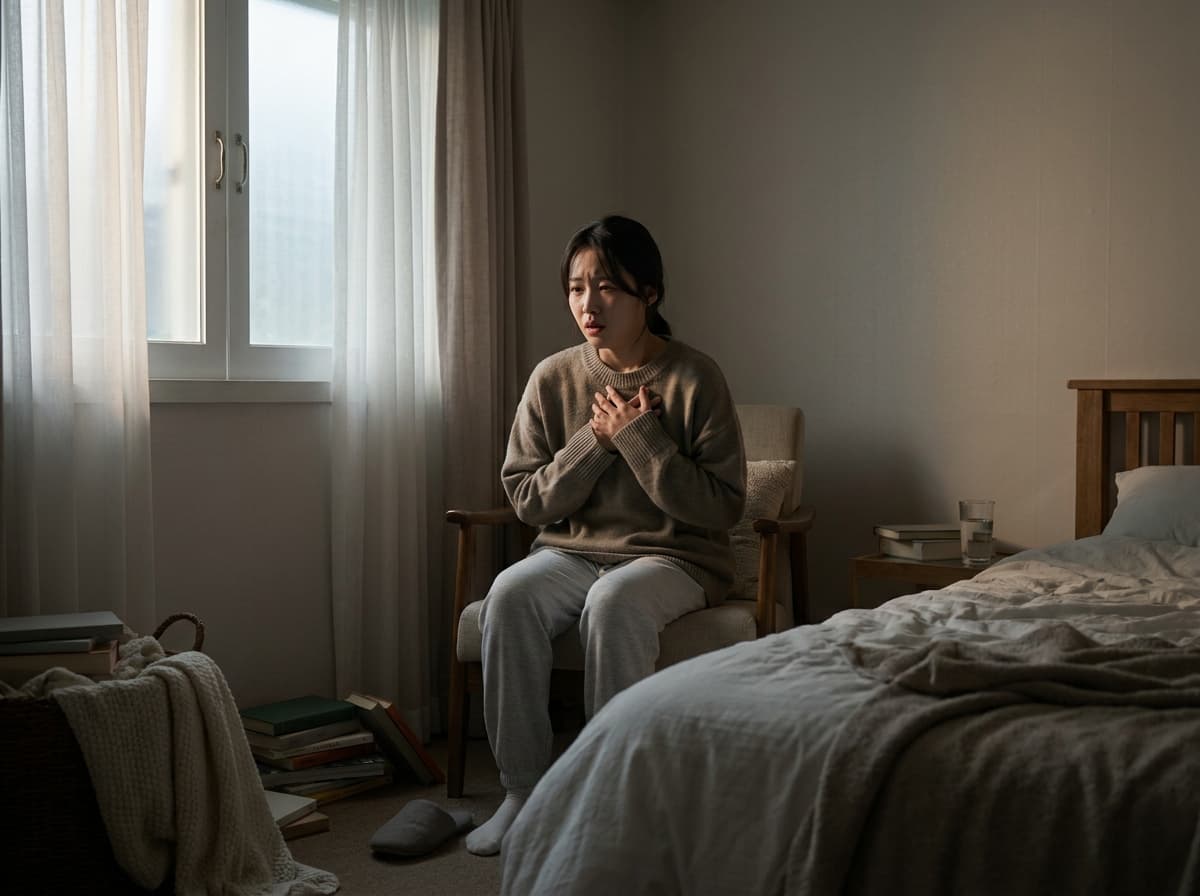
Heart Palpitations Why Do I Feel Anxious and Stuffy Despite Normal Test Results
Hello. This is Dalimchae Korean Medicine Clinic. # My heart is racing, why do I feel anxious and stuffy despite normal test results? In daily life, there are times when your heart suddenly races, your chest feels stuffy, and it's even hard to breathe. Worried that it might be a serious illness, you visit a hospital and undergo detailed tests, but surprisingly, you often feel more frustrated by results saying "nothing is wrong" or "it's normal." Your body is clearly sending out signals of distress, but because the cause is unknown, your frustration and anxiety only grow. If symptoms like "my heart is racing" repeat even over trivial matters, your daily life itself becomes restricted and your quality of life drops significantly. 💡 **[Key Answer]** **3 most common causes of "my heart is racing":** ① **Autonomic Nervous System Imbalance** / ② **Excessive Stress and Anxiety** / ③ **Functional Connection Problems between Brain and Gut** Dalimchae Korean Medicine Clinic helps turn off the warning lights of a hypersensitive body through **autonomic stabilization** and aids in fundamental balance recovery. ## What is the cause of your heart racing so hard? Heartbeats are influenced by the autonomic nervous system, which is regulated on its own regardless of our will. The autonomic nervous system is divided into the sympathetic nervous system and the parasympathetic nervous system. The sympathetic nervous system plays a role in tensing and exciting the body, while the parasympathetic nervous system plays a role in relaxing and stabilizing the body. When the balance between these two is broken, heart palpitations, where the heart beats fast or irregularly, can occur. In particular, stress and anxiety are the main culprits that excessively stimulate the sympathetic nervous system, increasing heart rate and elevating blood pressure. The brain perceives this state of tension and tries to supply more oxygen and nutrients to the heart, but this instead puts a burden on the heart, causing it to react even more sensitively. Additionally, since the brain and gut are closely connected via the 'Gut-Brain Axis', problems in gut health can affect the autonomic nervous system and trigger heart palpitations. ## Why does it keep racing even when tests are normal? A "normal" test result means there are no structural problems with the heart itself or any serious organic diseases. However, if there are functional problems, a patient can feel severe discomfort even if it doesn't show up in test results. Autonomic dysfunction refers to various symptoms occurring due to an abnormality in the regulation ability of the sympathetic and parasympathetic nervous systems, and among these, heart palpitations are one of the most common symptoms. It's like a car engine showing an overheat warning light, but the repair shop says there's no problem with the engine parts themselves. It's an 'operational problem' where the engine is normal but is overheating. In Korean Medicine, these palpitations are diagnosed as 'Gyeong-gye (驚悸)' and 'Jeong-chung (怔忡)'. Gyeong-gye refers to palpitations that appear temporarily due to external stimuli, while Jeong-chung refers to a state of being continuously anxious and having a racing heart without a clear trigger. Especially, Jeong-chung tends to worsen with fatigue. Besides this, palpitations can appear when 'Heart and Spleen Blood Deficiency (心脾血虛)' occurs, or when stress causes Qi to stagnate and phlegm-rheum (痰飮) to disturb the heart. Dalimchae Korean Medicine Clinic Incheon Branch analyzes each patient's symptom patterns and constitution to proceed with treatment according to these Korean Medical differentiations. ## How does Korean Medicine diagnose and treat heart palpitations? At Dalimchae Korean Medicine Clinic, to understand the root cause of heart palpitations, we don't just listen to symptoms but comprehensively diagnose the patient's overall body condition. Through pulse wave tests and heart rate variability (HRV) tests, we objectively identify the activity and balance of the sympathetic and parasympathetic nervous systems, as well as stress resistance. Along with these modern diagnostic tools, through traditional Korean medical examination methods—looking, listening, questioning, and feeling—we examine the functions of the five organs and six viscera related to the heart and the flow of Qi and Blood (氣血) and diagnose the patient's constitution. Symptoms related to autonomic dysfunction caused by stress are particularly deeply addressed in the field of Korean Medicine. **\<Effectiveness of Korean Medicine Treatment Proven by Actual Clinical Research\>** Recent studies show that Korean Medical treatments are effective in improving autonomic dysfunction symptoms, including heart palpitations. According to a study published in 2024 by Dr. Qineng Tan and Dr. Xiaomei Cai, in a clinical study of 30 female patients with autonomic dysfunction symptoms, acupuncture treatment was confirmed to help alleviate palpitations (heart racing), abdominal problems, and improve sleep. The research team explained that acupuncture treatment stabilizes autonomic function by regulating neurotransmitters in various brain regions that contribute to autonomic function, such as the hypothalamus, medulla, and dorsomedial prefrontal cortex. This supports the scientific basis of the autonomic stabilization treatment conducted at Dalimchae Clinic. Furthermore, in a case report published in 2025 by a research team from Wonkwang University College of Korean Medicine (D. Lee et al.), a 31-year-old male patient suffering from various autonomic dysfunction symptoms like chronic headaches, anxiety, palpitations, fatigue, and digestive problems received integrated Korean medical treatment—including acupotomy, Chuna therapy, acupuncture, and cupping—20 times over 4 months. As a result, anxiety (BAI scale) improved significantly from 37 to 23, depression (BDI scale) from 23 to 7, and headache severity (MIDAS scale) from 40 to 2. The patient also directly reported resolution of tension-type headaches, improved mood and energy, enhanced digestive function, and decreased autonomic symptoms. These results suggest that integrated Korean medical treatment can effectively alleviate various symptoms of autonomic dysfunction. Dalimchae Clinic provides customized autonomic stabilization treatment tailored to each patient's condition based on these Korean medical methods, helping the body regain its own balance beyond simply suppressing symptoms. ### How is Dalimchae Clinic's 'Autonomic Stabilization' Treatment Different? At Dalimchae Clinic, we set **autonomic stabilization** as the core treatment principle and focus on calming the autonomic nervous system, which is like our body's overheated engine. When the balance of the autonomic nervous system is broken, the brain cannot rest and continues to maintain a state of anxiety and tension. If this state persists, it leads to various physical symptoms like insomnia, dizziness, headaches, and indigestion, as well as heart palpitations. Dalimchae Clinic's autonomic stabilization treatment focuses on lowering the heat in the nervous system and creating an environment where the brain can rest comfortably. In Korean Medicine, this is also explained by the principle of 'Suseung-hwagang (水昇火降)', which aims to keep the head cool and the lower abdomen warm to facilitate systemic circulation and regain body balance. Many people visiting Incheon Heart Palpitation Korean Medicine Clinic complain of discomfort due to this autonomic imbalance. Dalimchae Clinic helps restore autonomic balance by nourishing the mind and body exhausted by stress through individualized herbal prescriptions and relaxing tensed nerves through acupuncture, moxibustion, and pharmacopuncture. Through this, we reduce the heart's hypersensitive reactions and ultimately help our body regain its power of self-regulation, or self-healing power. This approach is also effective for those suffering from headaches, dizziness, or insomnia together. --- ### **Heart Palpitations Self-Checklist** Check how many of the following items apply to you. * My heart races severely and I am easily startled even by trivial matters. * I feel stuffy in my chest for no particular reason and feel anxious frequently. * It's hard to fall asleep at night, I wake up often, and it's hard to get deep sleep. * I frequently experience dizziness or headaches, and my concentration is dropping. * Digestion isn't good, I have gas in my stomach, or constipation/diarrhea repeats. * My neck or shoulders are often stiff, and I feel tired for no reason. * It's hard to regulate body temperature, such as hands and feet being cold or sweating a lot. * It's hard to breathe or I sigh frequently. **Judgment Criteria:** * **If 3 or more apply:** Autonomic imbalance suspected → You can consider Korean medical treatment at Dalimchae Clinic Incheon Branch. * **If 5 or more apply:** High possibility of autonomic dysfunction → Immediate visit for precise diagnosis and customized treatment is recommended. --- ## **Q. Can symptoms of a racing heart heal naturally?** A. Mild palpitations due to temporary stress or caffeine intake can improve naturally through sufficient rest and stability. However, if symptoms repeat or are accompanied by other symptoms like anxiety and dizziness, it's better to suspect autonomic imbalance and seek help from a specialist. **Q. I have severe anxiety along with chest palpitations. Can panic disorder also be treated with Korean Medicine?** A. Yes, in Korean Medicine, chest palpitations and anxiety are treated closely together. Panic disorder is also seen as an imbalance of mind and body due to a sudden surge in the autonomic nervous system. Through herbal medicine, acupuncture, and moxibustion, we can stabilize the autonomic nervous system and restore the heart's regulatory function to help improve symptoms. **Q. I live in Incheon. What tests does Dalimchae Clinic Incheon Branch use to understand the cause of palpitations?** A. Dalimchae Clinic Incheon Branch objectively measures the balance state of the autonomic nervous system and stress index through Heart Rate Variability (HRV) tests. We also comprehensively diagnose the cause of palpitations by examining the patient's constitution and the functional state of the five organs and six viscera through Korean medical pulse diagnosis, tongue diagnosis, and questioning. **Q. How long does the treatment period take?** A. The treatment period for heart palpitations can vary depending on the severity of symptoms, the cause, individual constitution, and lifestyle habits. Generally, since we aim for fundamental balance recovery of the autonomic nervous system rather than just a quick change in symptom relief, steady treatment and management are important. It can usually take from several weeks to several months or more, and it's best to set a customized treatment plan after a detailed consultation at Dalimchae Clinic. --- The symptom of your heart racing even over trivial matters is not a problem that can be solved by just enduring. You no longer have to ignore the signals your body has been sending for a long time. If approached in the right direction, the body reacts faster than you think. Bring your symptoms as they are. At Dalimchae Clinic, we will find the cause together. Where life blooms. For herbal medicine, it's Dalimchae Korean Medicine Clinic. Check your symptoms similar to mine through the AI consultation on the Dalimchae Clinic website first! This article is health information compiled by Dalimchae medical staff based on questions frequently received in the treatment room. Medical Supervision | Brain and Autonomic Nervous System Treatment Standards Dalimchae Clinic Incheon Branch Korean Medicine Doctor Yang Yuchan (Anxiety Disorder Column)