
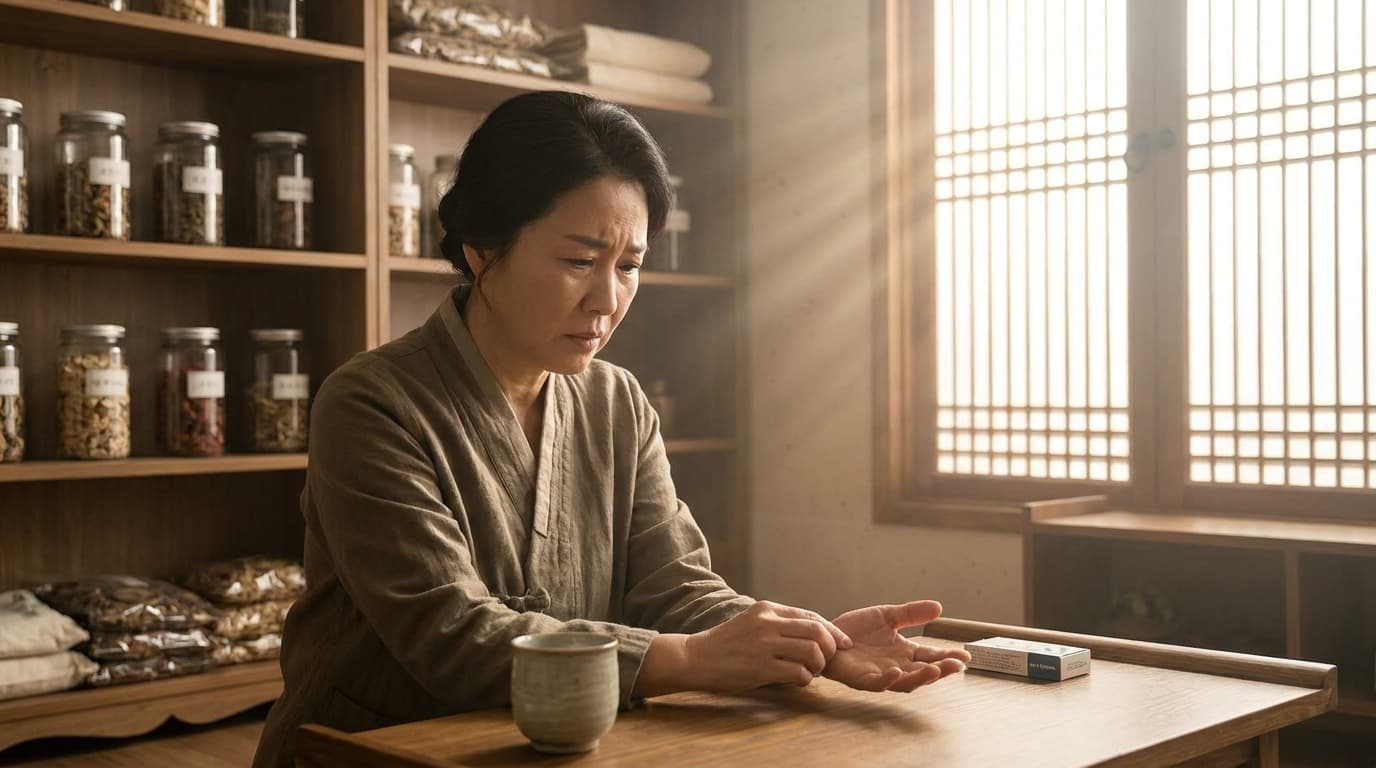
Hand Tremor and Stiffness in Your 40s Could It Be an Early Sign of Parkinsons Disease
안녕하세요. 달임채한의원입니다. # Hand Tremor and Stiffness in Your 40s Could It Be an Early Sign of Parkinsons Disease Did you one day suddenly notice a slight tremor in one hand, or feel it stiffly rigid as if it were not your own body when washing dishes or dressing? Particularly when such symptoms appear at the relatively young age of your 40s, it is easy to be caught in anxiety wondering if it might be a precursor to a serious illness. These small signals of the body that become increasingly nagging cannot be simply dismissed as mere fatigue. If these symptoms persist, the possibility that they are early signs of a degenerative brain disease such as Parkinson's disease cannot be ruled out. 💡 **[Core Answer]** The 3 most common causes of **hand tremor and stiffness in your 40s**: ① Damage to dopamine nerve cells in the brain / ② Dysfunction of the brainstem and autonomic nervous system / ③ Chronic inflammation and oxidative stress. Dalimchae Korean Medicine Clinic approaches the management of early Parkinson's symptoms by restoring decreased brain function and strengthening the body's natural healing power through **autonomic nerve stabilization**. ## Hand Tremor in Your 40s Is It Simple Fatigue? When you experience tremor or stiffness in one hand entering your 40s, many people easily think it is a temporary phenomenon due to overwork or stress. However, if these symptoms appear continuously or gradually worsen, they should be observed carefully. In particular, tremor worsening at rest ('resting tremor'), difficulty performing delicate actions such as writing or eating ('bradykinesia'), and stiffening of the body ('rigidity') starting on one side and spreading to the other may be early symptoms of Parkinson's disease. Parkinson's disease is a progressive degenerative brain disease occurring when nerve cells producing dopamine in the substantia nigra of the brain are damaged, mostly developing after the 50s, but increasingly diagnosed in the 40s recently. ## Why Does Parkinson's Disease Start on One Side? Parkinson's disease characteristically often presents symptoms on one side of the body first. This is known to be because dopamine nerve cell damage in the brain begins asymmetrically. Initially starting with tremor, stiffness, and slowed movement (bradykinesia) in one arm and leg, as the disease progresses it gradually spreads to both sides or leads to systemic symptoms such as gait disturbance and postural instability. This asymmetrical onset is also closely related to imbalance of the autonomic nervous system. Functional decline of brain nerve cells affects the autonomic nervous system, accompanying non-motor symptoms such as indigestion, constipation, sleep disorders, and depression. ## Does Autonomic Imbalance Affect Parkinson's Progression? Recent studies suggest that autonomic nervous system imbalance can play an important role in the onset and progression of Parkinson's disease. Abnormalities in the brain's dopamine system affect not only motor functions but also autonomic regulation, inducing various non-motor symptoms. Excessive stress and irregular lifestyle habits disrupt autonomic balance, inducing chronic fatigue and inflammation in the brain, which can accelerate dopamine nerve cell damage. In particular, the connection with the Gut-Brain Axis is also drawing attention, and research results reporting that gut health problems affect the brain nervous system and increase the risk of neurodegenerative diseases like Parkinson's have been reported. ## How Does Korean Medicine Treatment Help Improve Parkinson's Symptoms? Korean medicine treatment for Parkinson's focuses on alleviating symptoms, slowing disease progression, and improving quality of life. In particular, it can play a complementary role in managing side effects such as reduced efficacy or dyskinesia caused by long-term use of conventional Western medication. In a study published in the journal **Parkinsonism and Related Disorders** in 2012 by a research team led by Professor Park Sung-wook of Department of Korean Internal Medicine, Gangdong Kyung Hee University Hospital, results of applying bee venom pharmacopuncture and acupuncture treatment for 8 weeks to 43 Parkinson's patients were reported. Patients diagnosed with idiopathic Parkinson's disease and taking Parkinson's medications were randomly assigned to the bee venom pharmacopuncture group (18 patients), acupuncture group (17 patients), and waiting group, and treated. After 8 weeks of treatment, in Parkinson's evaluation scores, the bee venom pharmacopuncture group significantly improved from an average of 32.0 to 24.0 points, and the acupuncture group from 40.0 to 33.0 points. Particularly in Part III scores related to motor function, the bee venom pharmacopuncture group significantly improved from 15.0 to 10.0 points, and the acupuncture group from 17.0 to 13.0 points (p\<0.05). In addition, the bee venom pharmacopuncture group also significantly improved in activities of daily living evaluation index (Part II) from 9.0 to 7.0, and the acupuncture group significantly improved in the Beck Depression Inventory from 17 to 12 points. The researchers concluded that these results indicate bee venom pharmacopuncture and acupuncture treatment are effective in improving motor function, daily living function, and depression in Parkinson's patients. In addition, according to a meta-analysis study published by Korea Institute of Oriental Medicine researchers in 2026 (re-citing Jun P et al., 2023 paper), analyzing the effect when herbal medicine was combined with standard medication treatment, Unified Parkinson's Disease Rating Scale (UPDRS) scores in a total of 843 Parkinson's patients participating in 12 placebo-controlled trials showed an average decrease of 8.03 points more compared to the standard medication alone group. In particular, improvement widths of quality of life and non-motor symptom indicators appeared much larger, and the difference was more clearly confirmed in the herbal medicine treatment group prescribed tailored to individual patient patterns. These research results suggest that Korean medicine treatment can have a positive effect not only on motor symptoms of Parkinson's disease but also on non-motor symptoms such as depression, sleep disorders, and constipation, and overall quality of life improvement. Based on these data, Dalimchae Korean Medicine Clinic focuses on restoring the balance of the brain and autonomic nervous system through customized treatment considering each Parkinson's patient's symptoms and constitution to slow disease progression and enhance quality of life. ## Dalimchae Korean Medicine Clinic Autonomic Stabilization Treatment Principle Dalimchae Korean Medicine Clinic does not view Parkinson's disease simply as a problem of brain dopamine deficiency. We view that imbalance of the autonomic nervous system, the control center of the brain and body, is deeply involved in the onset and progression of the disease. 'When autonomic balance collapses, the brain cannot rest.' Autonomic nerves control all involuntary functions in our bodies, and when this balance breaks, the brain is placed in an overload state. Sympathetic nerves are excessively hyperactive and parasympathetic nerves are reduced, inducing chronic tension and inflammation in the brain, which can accelerate damage to dopamine nerve cells. At Dalimchae Korean Medicine Clinic, we perform treatments to lower heat in the nervous system, create an environment where the brain can rest, and improve systemic Qi and blood circulation to enhance the self-sustaining power of brain nerves. In Korean medicine, this is called 'Suseunghwagang (水升火降)', emphasizing the restoration of the body's natural circulation state of keeping the head cool and the lower body warm. Such autonomic stabilization treatment can help improve not only motor symptoms such as hand tremor and stiffness, but also non-motor symptoms commonly experienced by Parkinson's patients such as sleep disorders, depression, constipation, and dizziness. For those looking for Incheon Parkinson's Korean medicine clinics, Dalimchae Korean Medicine Clinic presents a way to regain overall body balance and sustainable health. ## Parkinson's Initial Symptoms Self-Checklist Check if any of the following questions apply to you. (※ This checklist is for self-diagnosis, and accurate diagnosis should be consulted with a medical expert.) 1. Tremor is felt in one hand or foot while resting quietly. 2. Handwriting has become progressively smaller, and writing speed has slowed. 3. Arm swinging on one side is reduced when walking, or foot drags on the ground. 4. People tell you your facial expression has stiffened and become expressionless. 5. Delicate actions such as dressing or buttoning are slower and more difficult than before. 6. You feel your body stiff and movements dull for no reason. 7. Grasping or releasing small objects is difficult, and you often drop items. 8. Chronic symptoms such as indigestion, constipation, and decreased sense of smell accompany. 9. Intense behaviors like acting out dreams during sleep (REM sleep behavior disorder) appear. 10. Feelings of depression, anxiety, and lethargy are persistently felt. **Judgment Criteria:** * **If 3 or more apply:** Autonomic nervous system imbalance and early Parkinson's symptoms suspected. It is recommended to consider accurate checkups and complex Korean medical treatment together with the medical staff at Dalimchae Korean Medicine Clinic Incheon Branch. * **If 5 or more apply:** Immediate medical institution visit and precise diagnosis are required. ## FAQ Frequently Asked Questions About Parkinson's and Korean Medicine **Q. In early Parkinson's, does autonomic treatment help?** A. Yes, in early Parkinson's, autonomic nervous system imbalance often accompanies. Autonomic stabilization treatment helps improve not only motor symptoms like tremor and rigidity but also non-motor symptoms like sleep disorders, constipation, and depression, having a positive effect on slowing disease progression and elevating quality of life. **Q. Hand tremor symptoms, when should I visit an Incheon Korean medicine clinic?** A. If hand tremor starts on one side and gradually worsens, or if resting tremor appears even when resting, or if other symptoms such as body stiffness and slowed movement accompany, it is advisable to visit Incheon Dalimchae Korean Medicine Clinic for consultation as soon as possible. Early diagnosis and treatment greatly impact prognosis. **Q. Parkinson's and autonomic abnormalities are present together, can they be treated together?** A. At Dalimchae Korean Medicine Clinic, Parkinson's disease is approached in connection with problems of autonomic nervous system imbalance. Therefore, autonomic abnormality symptoms appearing with motor symptoms due to Parkinson's (e.g., sleep disorders, indigestion, dizziness) are comprehensively diagnosed and treated, aiming for overall body balance and health recovery. Parkinson's disease is not a problem that can be solved by enduring. You do not need to turn a blind eye to body signals sent for a long time anymore. When approached in the right direction, the body responds faster than you think. Bring the symptoms you are experiencing as they are. Dalimchae Korean Medicine Clinic will find the cause together. Where life blooms. Herbal medicine is naturally Dalimchae Korean Medicine Clinic. Check similar symptoms to yours first through Dalimchae Korean Medicine Clinic website AI consultation! This article is based on questions frequently received in the consulting room, and is health information organized together by Dalimchae medical staff. Medical Supervision | Brain & Autonomic Nervous System Treatment Standard, Dalimchae Korean Medicine Clinic Incheon Branch, Korean Medicine Doctor Yang Yoo-chan (Parkinson's Disease Column)