
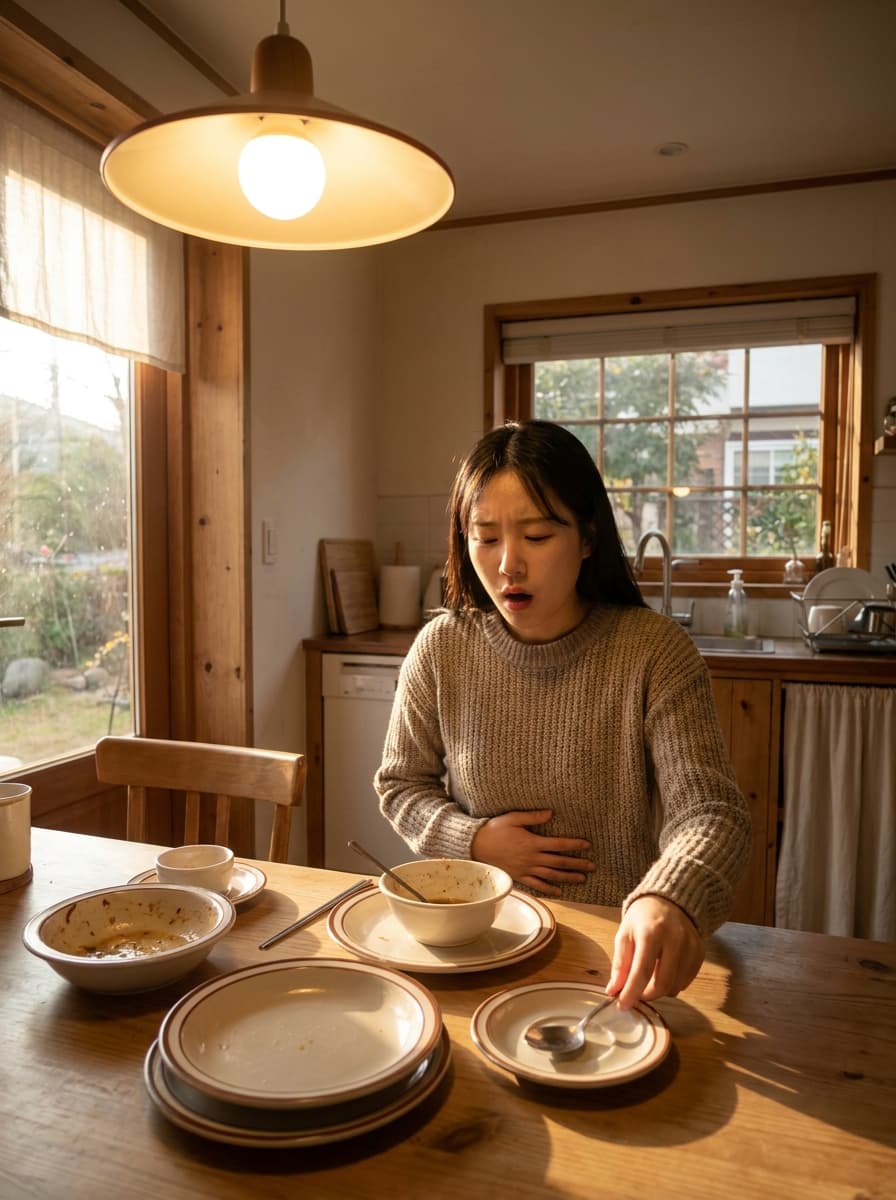
Feel full after eating just a little bit The start of solving a heavy stomach is here
## Why do I feel full so quickly? The Relationship Between Functional Dyspepsia and Dam-jeok The symptom of feeling full after eating just a little is often called 'early satiety' and is a major symptom of functional dyspepsia. In many cases, no specific organic abnormalities are found even in endoscopy or other imaging tests, so many people live with the discomfort without knowing the cause. However, in Korean medicine, the root cause of these symptoms is sought in the decline of stomach function and the accumulation of waste, namely 'Dam-jeok' (phlegm-accumulation). The stomach is not just an organ that digests food. It is closely connected to the autonomic nervous system and constantly communicates with the brain's state through the Gut-Brain Axis. Excessive stress, irregular eating habits, and weakened immunity can lead to decreased peristalsis of the gastric smooth muscle and problems with digestive enzyme secretion, causing undigested food debris and waste to accumulate on the intestinal wall. Korean medicine calls this 'Dam-eum' or 'Dam-jeok,' and it is believed that these phlegm toxins harden the outer wall of the stomach, interfering with its original function. ## Is Korean Medicine Effective for Improving Functional Dyspepsia and Early Satiety? Early satiety caused by functional dyspepsia significantly reduces the quality of life, but it can be sufficiently improved through a Korean medicine approach. Various clinical studies are revealing that Korean medicine treatment has a positive effect on functional dyspepsia and the alleviation of its symptoms. According to a Farm News article published in August 2024, titled \"Digestives are only temporary, consider Korean medicine for 'functional dyspepsia',\" a study showed that when Banhasasim-tang, commonly used for functional dyspepsia, was used alone or in combination with Western medicine, the treatment effect increased by about 15% and the recurrence rate decreased by about 50% compared to single treatment. These results were published in the May issue of the world-renowned international journal 'Frontiers in Pharmacology,' supporting the effectiveness of herbal medicine treatment. Researchers categorized functional dyspepsia into three types: Spleen Deficiency (비허), Food Stagnation (식적), and Liver Qi Stagnation (간울), and emphasized that customized herbal prescriptions and acupuncture for each type are effective in improving symptoms. Furthermore, a study by the Kyung Hee University Korean Medicine Hospital research team published in PubMed in June 2022, \"Saam Acupuncture for Treating Functional Dyspepsia: A Feasibility Randomized Controlled Trial,\" reported the results of a clinical trial involving 24 patients with functional dyspepsia. In this study, the group that received Saam acupuncture treatment showed a statistically significant improvement in the *early satiety sub-score* of the Gastrointestinal Symptom Scale (GIS) at 4 weeks compared to the control group (p\<0.05). Significant symptom improvement persisted in the 8-week and 12-week follow-ups, and the quality of life also tended to improve. The researchers concluded that Saam acupuncture could be a feasible, preliminarily effective, and safe treatment for functional dyspepsia. This data serves as a basis for the approach of combining acupuncture and herbal medicine to activate stomach function and remove phlegm toxins at Dalimchae Korean Medicine Clinic. Recently, in September 2025, the research on 'Dam-jeok Syndrome' by Director Choi Seo-hyeong of Widam Korean Medicine Hospital, which was listed in the SCI(E)-level international journal 'Healthcare' for the first time in the world, explained the pathophysiology of patients with refractory dyspepsia that is not diagnosed by endoscopy from a Korean medicine perspective and presented a new paradigm for diagnosis and treatment. This study revealed that Dam-jeok syndrome is related to increased serotonin metabolite levels in blood markers and decreased parasympathetic nerve activity, providing an important clue to the connection with gut-brain axis abnormalities. This suggests that the 'gut detox' treatment principle pursued by Dalimchae Korean Medicine Clinic can affect overall health and autonomic nervous system balance beyond simple improvement of stomach symptoms. ## Dalimchae's Gut Detox Treatment Principle: Finding the Root of Stomach Health Symptoms such as \"I feel full as soon as I eat a little bit\" eventually start from an imbalance in stomach function. Dalimchae Korean Medicine Clinic in Songdo applies the **Gut Detox** treatment principle to fundamentally solve these problems. Gut detox is not simply about emptying the intestines. Because toxins accumulated on the intestinal wall can travel through the blood to create systemic inflammation, leading to weakened immunity and autonomic imbalance, it is important to remove these toxins and increase the recovery power of the intestinal wall itself. At Dalimchae Korean Medicine Clinic, we closely identify each patient's stomach condition and constitution through Korean medicine diagnosis such as pulse diagnosis, abdominal diagnosis, and tongue diagnosis, along with autonomic nerve tests. Based on this, we break down and discharge phlegm toxins from the outer wall of the stomach through customized herbal prescriptions and normalize digestive function by activating the peristalsis of the stomach muscles. In addition, we combine acupuncture and moxibustion to promote blood circulation around the stomach and relax stiff muscles to relieve stomach tension. Through this process, the stomach regains its function and helps you escape from chronic dyspepsia and early satiety by preventing unnecessary waste accumulation. It is like removing foreign substances from an old drainpipe and letting the water flow coolly again. This contributes to preventing recurrence through remarkable changes in the gut and regaining overall vitality beyond digestive health. ## Am I also suffering from functional dyspepsia? Symptom Checklist If 3 or more of the following questions apply to you, you should suspect functional dyspepsia and consider Korean medicine treatment to improve stomach function. 1. Even if I eat just a little, I feel full quickly and find it difficult to eat more. 2. After eating, my stomach feels heavy and I often feel like the pit of my stomach is tightly blocked. 3. I burp frequently or stomach acid comes up (symptoms of acid reflux). 4. My stomach makes rumbling sounds or I often have gas. 5. When I get stressed, my digestion gets worse and my stomach feels uncomfortable. 6. Constipation or diarrhea is frequent, showing irregular bowel movements. 7. I feel severely fatigued and experience general lethargy throughout my body. 8. Non-digestive symptoms such as headache, dizziness, and shoulder stiffness are also accompanied. **If 3 or more apply:** Suspected stomach function decline → Review complex Korean medicine treatment including gut detox **If 5 or more apply:** High possibility of chronic functional dyspepsia and Dam-jeok → Immediate visit to Songdo Early Satiety Clinic for precise diagnosis recommended ## Frequently Asked Questions (FAQ) **Q. Can the symptom of feeling full after eating just a little heal naturally?** A. Symptoms caused by temporary stress or irregular meals may improve naturally, but if they appear chronically, it is highly likely that the cause is a decline in stomach function. If left unattended, Dam-jeok may worsen and lead to other systemic symptoms, so it is better to seek help from a professional. **Q. What kind of treatment will I receive at Dalimchae Korean Medicine Clinic in Songdo for dyspepsia?** A. At Dalimchae Korean Medicine Clinic in Songdo, we complexly apply herbal medicine, acupuncture, and moxibustion according to each patient's constitution and symptoms. We promote stomach peristalsis, remove phlegm toxins, and restore the balance of the autonomic nervous system to help the stomach function healthily. **Q. How long does functional dyspepsia treatment take?** A. The treatment period may vary depending on the individual's symptom severity, chronicity, and lifestyle habits. Usually, in the case of early symptoms, it takes about 1 to 3 months, and in chronic cases, steady treatment and management for more than 3 months may be necessary. At Dalimchae Korean Medicine Clinic, we also provide lifestyle coaching to prevent recurrence. **Q. Will Korean medicine treatment help even if there is no abnormality in the endoscopy?** A. Yes, functional dyspepsia is often a functional problem of the stomach that is not discovered by endoscopy. Korean medicine has strengths in diagnosing and treating functional problems such as phlegm toxins on the outer wall of the stomach or autonomic imbalance, so it can be particularly effective for patients with no abnormalities on tests. Stomach problems like \"I feel full as soon as I eat a little bit\" are not problems that are solved by enduring them. You no longer have to ignore the signals your body has been sending for a long time. If you approach it in the right direction, your body will react faster than you think. Bring the symptoms you are experiencing as they are. Dalimchae Korean Medicine Clinic will find the cause together. Where life blooms. For herbal medicine, it's Dalimchae Korean Medicine Clinic. Check for symptoms similar to yours first through the AI consultation on the Dalimchae Korean Medicine Clinic website! This article is based on questions frequently received in the consultation room, organized by the Dalimchae medical staff. Medical Supervision | Songdo Dalimchae Korean Medicine Clinic, Dr. Oh Hyun-min, based on gut and digestive treatment standards (Appetite Problem Column)