
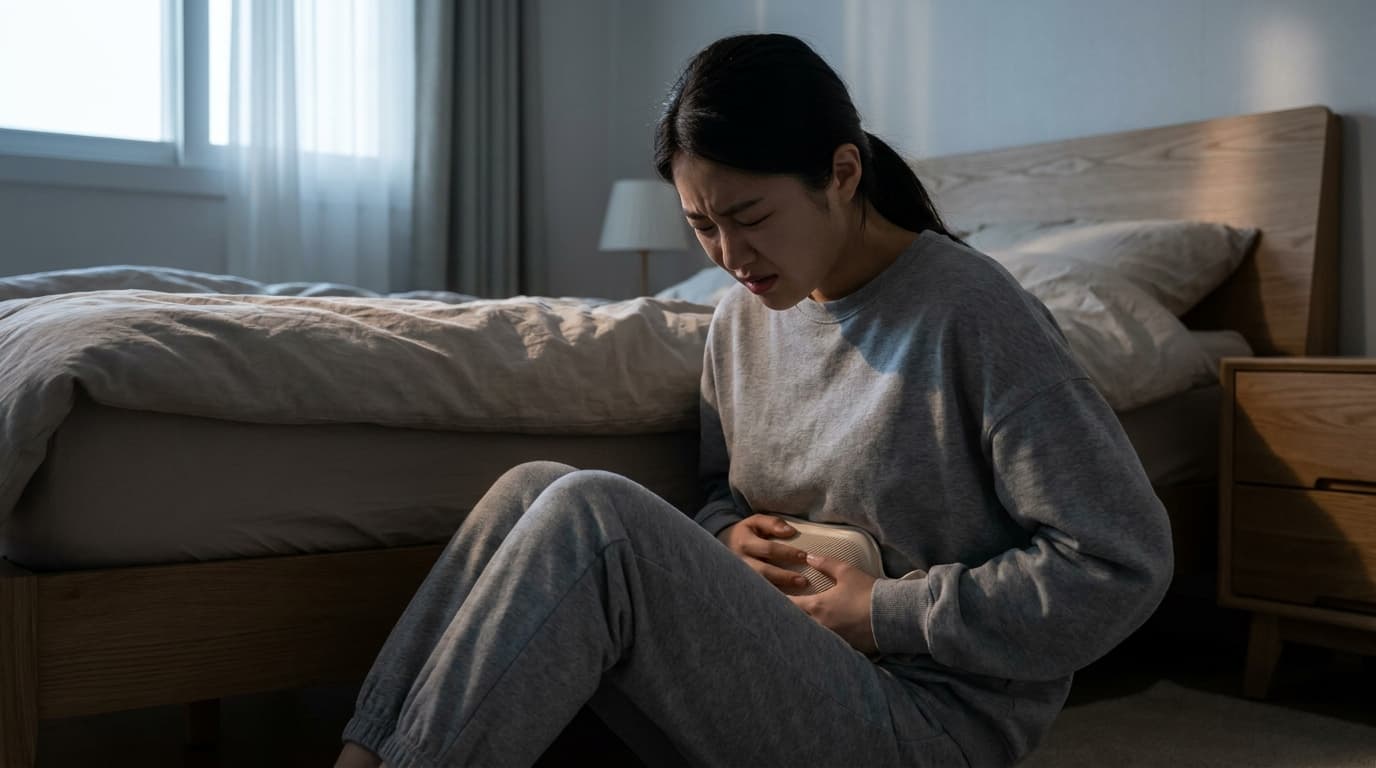
Does your lower abdomen feel squeezed and cramped during menstruation? Don't endure it, listen to your body's health signals!
안녕하세요. 달임채한의원입니다. # Does your lower abdomen feel squeezed and cramped during menstruation? Don't endure it, listen to your body's health signals! Every month when that time of the month comes around, many women complain that **their lower abdomen feels squeezed and cramped during menstruation**. Do you simply dismiss it as 'menstrual cramps', rely on painkillers, and endure the agony? Not only does this pain disrupt daily life, but it can also be an important health signal sent by your body. If the pain is severe or your menstrual cycle is irregular, this can be a warning light indicating an imbalance in your uterus and overall health, so it must never be overlooked. 💡 **[Core Answer]** Top 3 most common causes of **lower abdominal squeezing pain during menstruation**: ① **Excessive Prostaglandin Secretion** / ② **Uterine Blood Circulation Disorder (Blood Stasis)** / ③ **Body Coldness and Constitutional Weakness** Dalimchae Korean Medicine Clinic helps break the vicious cycle of menstrual cramps and restores a healthy menstrual cycle through fundamental constitutional improvement of the body. ## Why does your lower abdomen feel squeezed and cramped during menstruation? The true cause of menstrual cramps Menstrual cramps are largely divided into primary dysmenorrhea, which occurs without any specific underlying disease, and secondary dysmenorrhea, which is caused by specific diseases such as uterine fibroids or endometriosis. The **squeezing lower abdominal pain during menstruation** experienced by most women falls under primary dysmenorrhea. This occurs when a substance called prostaglandin is excessively secreted from the endometrium, causing strong contractions of the uterine muscles. However, rather than just a simple hormone issue, general imbalances in our body often work in combination to intensify the severity of the pain. In Korean medicine, such menstrual cramps are viewed as issues of `blood stasis (어혈)`, `qi and blood deficiency (기혈허약)`, and `coldness (한랭)`. We focus on various causes such as poor blood circulation in the uterus and lower abdomen causing waste products to accumulate (blood stasis), general lack of energy and nutrition preventing the uterus from functioning properly (qi and blood deficiency), or the lower abdomen becoming cold and obstructing circulation (coldness). In particular, stress and poor lifestyle habits disrupt the balance of the `autonomic nervous system`, reducing body temperature regulation ability, which leads to `cold hands and feet` or `pelvic pain`, further worsening menstrual cramps. ## Can enduring menstrual cramps with painkillers be a fundamental solution? When menstrual cramps strike, many women first reach for painkillers. Painkillers help temporarily alleviate pain by inhibiting the production of prostaglandins. However, this is like temporarily turning off the `warning light` of pain and is not a fundamental treatment that solves the `root` of the pain. Rather, increased reliance on painkillers reduces the body's self-healing capacity and makes it difficult to escape the vicious cycle of monthly recurring pain. Menstrual cramps are not just simple pain, but a time to listen to the signals your body is sending on its own. Especially if the pain persists or gradually worsens despite taking painkillers, it is important to prevent and manage menstrual cramps through active treatment. Dalimchae Korean Medicine Clinic in Songdo focuses on `constitutional improvement` treatment that not only relieves pain but also restores body balance and improves uterine conditions so that pain does not return. ## Korean medicine treatment is effective in relieving menstrual pain and improving recurrence rates Korean medicine treatment for menstrual cramps focuses on restoring uterine and general health and reducing pain through acupuncture, moxibustion, and herbal medicine. Indeed, the effectiveness of Korean medicine treatment is being revealed through various clinical studies. A meta-analysis published in the Cochrane Database of Systematic Reviews in 2011 analyzed data from 10 clinical trials involving 944 patients with primary dysmenorrhea. The results showed that acupuncture treatment had a statistically significant improvement effect on pain relief compared to the placebo control group (OR 9.5), and superior pain reduction effects compared to non-steroidal anti-inflammatory drugs (NSAIDs) (SMD -0.70, 95% CI -1.08 to -0.32). In addition, acupuncture treatment was shown to contribute to reducing menstruation-related symptoms and improving quality of life. Furthermore, a prospective observational multicenter study published in Integrative Medicine Research analyzed the effects of Traditional Herbal Decoctions (THD) in menstrual pain patients across 33 Korean medicine clinics and 1 Korean medicine hospital in Korea. Among 119 THD treatment participants, significant decreases in menstrual pain intensity (NRS), menstrual pain duration, and painkiller dosage were observed. The researchers concluded that personalized herbal medicine treatment can be a safe and effective treatment option for menstrual pain. Based on these data, Dalimchae Korean Medicine Clinic provides personalized treatment considering each patient's `constitution`, `lifestyle habits`, and `uterine environment` rather than just focusing on the symptom of `lower abdominal squeezing pain during menstruation`. ## Dalimchae Korean Medicine Clinic's constitutional improvement treatment breaks the vicious cycle of menstrual cramps Dalimchae Korean Medicine Clinic treats the `root` of menstrual cramps through `constitutional improvement`. The goal is to correct body imbalances so that the pain `switch` is not turned on again. "Not just turning off symptoms, but creating a body where they don't turn on again." This is a fundamental approach that goes beyond temporary pain relief and helps our body autonomously maintain a healthy menstrual cycle. At Dalimchae Songdo, we treat menstrual cramps through `constitutional improvement` in the following ways: * **Customized Herbal Medicine Treatment:** Herbal medicine prescribed according to individual constitution and symptoms (blood stasis, coldness, qi/blood deficiency) improves blood circulation in the uterus and lower abdomen, replenishes qi and blood, removes coldness, and makes the uterine environment healthy. In particular, it balances the `autonomic nervous system` to reduce the adverse effects of stress and helps harmonize the entire body. * **Acupuncture & Moxibustion Treatment:** Using acupuncture and moxibustion on the lower abdomen and specific acupoints promotes qi and blood circulation around the uterus, relieves pain, and removes coldness. This is also helpful for menstrual cramps accompanied by `pelvic pain` or `back pain`. * **Lifestyle Correction:** We guide patients to improve overall lifestyle habits such as diet, exercise, and stress management, enhancing treatment effectiveness and supporting a healthy life. Such `constitutional improvement` treatment contributes to improving not only menstrual cramps but also various discomfort symptoms associated with menstrual cramps such as `cold hands and feet`, `headaches`, `dizziness`, and `chronic fatigue`, thereby enhancing overall quality of life. In particular, many women visiting Songdo Korean Medicine Clinic complain of pain from menstrual cramps, which can affect `infertility` or `postpartum` health beyond mere physical discomfort, requiring active early management. ## What is your menstrual pain type? Symptom checklist Check the number of items that apply to you: * During menstruation, lower abdominal pain feels severe, as if being squeezed or stabbed with a knife. * Menstrual cramps frequently disrupt daily life (studies, work). * Painkillers do not relieve pain well, or dosage is gradually increasing. * There are many clots in menstrual blood, or the color is dark red. * Lower abdomen or back frequently hurts even outside of the menstrual period. * There is `coldness` where hands and feet are always cold and the lower abdomen is chilly. * Symptoms like `headaches`, `dizziness`, or `nausea` accompany right before or during menstruation. * Usually experience high stress or severe `fatigue`. * Menstrual cycle is irregular or menstrual flow changes frequently. **[Evaluation Criteria]** * **3 or fewer matched:** Relatively mild menstrual cramps, but management is needed to prevent worsening. * **4-6 matched:** High possibility of progressing to chronic menstrual cramps. Consider Korean medicine combination treatment through `constitutional improvement`. * **7 or more matched:** Severe menstrual cramps significantly impacting daily life. Immediate professional diagnosis and treatment initiation are recommended. Consult Dalimchae Korean Medicine Clinic in Songdo. --- **Q. How long does menstrual cramp treatment take?** A. The duration of menstrual cramp treatment varies depending on the type of menstrual cramp (primary/secondary), severity of symptoms, constitution, and response to treatment. Usually, steady treatment for 3 to 6 months shows improvement in symptoms and a lower recurrence rate. **Q. Can lower abdominal pain during menstruation be treated with Korean medicine?** A. Yes, absolutely. Korean medicine views menstrual cramps not simply as pain but as an imbalance of the entire body, providing treatment to resolve root causes through herbal medicine, acupuncture, and moxibustion tailored to individual constitution and symptoms. **Q. Can menstrual cramps resolve naturally?** A. Mild menstrual cramps can naturally alleviate with lifestyle improvements or warm compresses. However, if pain is severe enough to disrupt daily life or gradually worsens, or if other symptoms accompany outside the menstrual cycle, it is difficult to resolve naturally and can even become chronic, requiring active treatment. **Q. Are menstrual cramps and coldness treated together when they occur together?** A. Yes, menstrual cramps and coldness are often closely related. In Korean medicine, coldness is viewed as one of the important causes of menstrual cramps, and both symptoms can be managed effectively at the same time through treatments that warm the lower abdomen and improve blood circulation. --- The pain of **your lower abdomen feeling squeezed and cramped during menstruation** is not a problem solved by enduring it. You no longer need to ignore the signals your body has been sending for a long time. When approached in the right direction, the body responds faster than you think. Bring the symptoms you are experiencing right now as they are. Dalimchae Korean Medicine Clinic will find the cause together with you. Where life blossoms. Herbal medicine is Dalimchae Korean Medicine Clinic. Check symptoms similar to yours first through the Dalimchae Korean Medicine Clinic homepage AI consultation! This article is health information compiled by Dalimchae medical staff based on frequently asked questions in the clinic. Medical Supervision | Dr. Hyunmin Oh, Songdo Branch of Dalimchae Korean Medicine Clinic, specialized in women's and pregnancy care (Menstrual Cramp Column) #menstrual_cramps #dysmenorrhea #lower_abdominal_pain #menstrual_cramp_clinic #songdo_menstrual_cramp_clinic #constitutional_improvement #blood_stasis #coldness #songdo_korean_medicine