
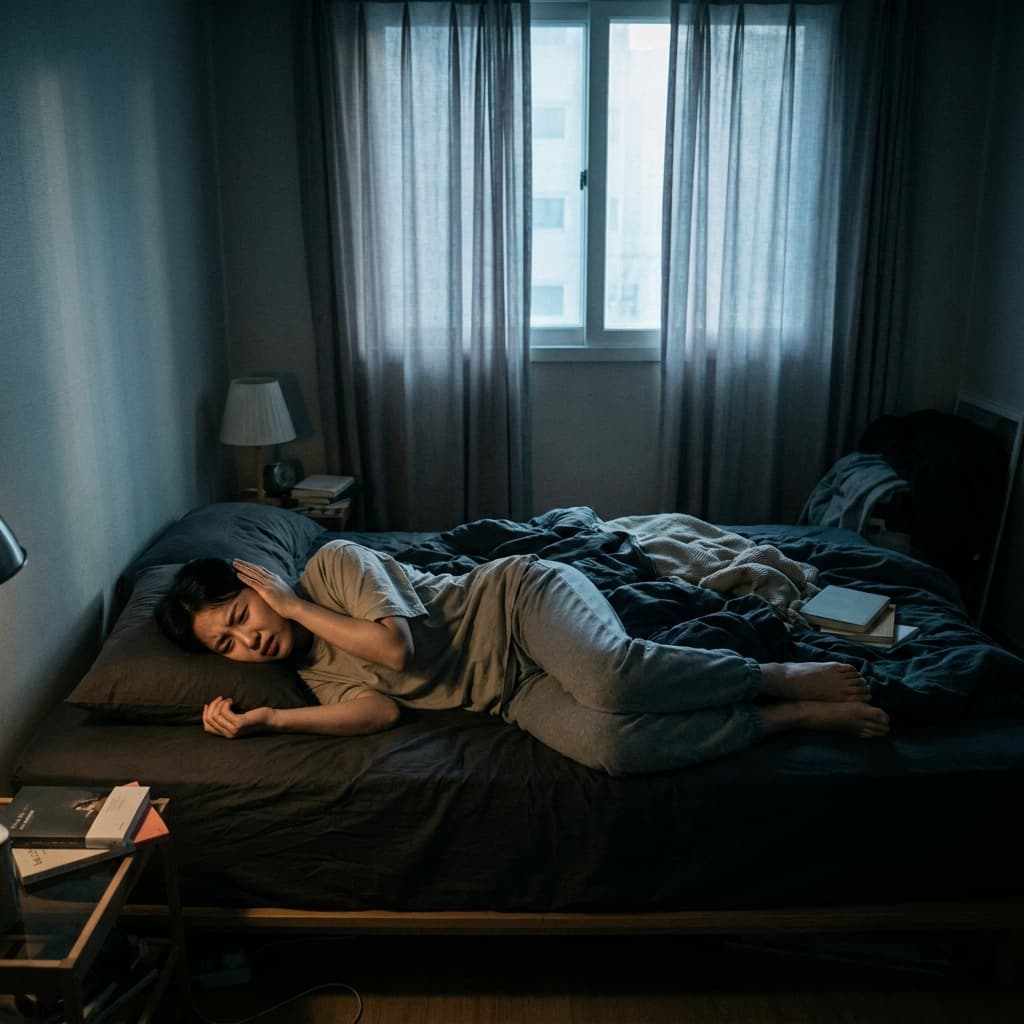
Do you hear your heartbeat in your ear Could it be the sound of your heart
Hello. This is Dalimchae Oriental Medicine Clinic. # I hear my heartbeat in my ears, is it my heart sound? One day, you suddenly hear a thumping heart sound in your ears, or a whooshing pulse sound? Are you having a restless night because of the anxiety? As the night gets quieter, the sound in your ears becomes clearer, which can significantly reduce the quality of life, threatening your daily life as well as your psychological stability. In particular, those who complain that they hear pulse sounds in their ears often visit a hospital worried that it might be a major illness, but they often feel frustrated because no special abnormality is found in the examination. 💡 **Key Answer** The 3 most common causes of hearing pulse sounds in your ears: ① Autonomic nervous system imbalance / ② Tension in the muscles around the head and neck / ③ Inner ear blood flow abnormality (unknown pulsatile tinnitus) Dalimchae Clinic calms the excessive excitement of the brain and body through **autonomic stabilization** and restores the fundamental balance. ## Why do I hear my heart thumping in my ears? Noise heard in the ear can be divided into subjective tinnitus and objective tinnitus. Unlike common tinnitus like beeping or cicada sounds that only the patient can hear, hearing sounds like a pulse that can be heard from the outside or sounds related to blood flow is called **pulsatile tinnitus**. Pulsatile tinnitus accounts for about 10% of all tinnitus and can be divided into vascular and non-vascular causes. Vascular causes may include arteriovenous fistulas and carotid atherosclerosis, but despite close examination, no special cause is found in about 30% of pulsatile tinnitus patients. These cases are also called 'somatic pulsatile tinnitus', and they are presumed to occur due to tension in the muscles around the head and neck, myofascial trigger points, or changes in the somatic sensory nerve stimulation of the cerebrum. In the end, it is difficult to see it as just a problem with the ear, and it suggests that it is deeply related to the overall balance of our body. ## What is the relationship between tinnitus and autonomic imbalance? Many studies have revealed that tinnitus is not just a problem of the ear but is deeply related to systemic factors, especially the **autonomic nervous system**. The autonomic nervous system regulates all organ functions in our body and is easily unbalanced by stress, sleep deprivation, and overwork. If the sympathetic nerve is excessively hyperactive, the brain cannot rest and becomes sensitive, amplifying hearing signals, which becomes the cause of worsening or chronic tinnitus symptoms. A study published in the journal Evid Based Complement Alternat Med in 2013 by a research team at Kyung Hee University Korean Medicine Hospital clearly shows the autonomic nervous state of tinnitus patients. In this study, heart rate variability (HRV) parameters were compared and analyzed between 40 tinnitus patients (19 acute, 21 chronic) and 40 healthy controls. As a result, in the tinnitus patient group, the power of the high-frequency component (HF) and total power significantly decreased (p\<0.05), and the low-frequency to high-frequency ratio (LF/HF) significantly increased (p\<0.05). This means that tinnitus patients show decreased parasympathetic activity and sympathetic overactivity (vagal withdrawal and sympathetic overactivity). In particular, chronic tinnitus was found to have a stronger influence on the autonomic nervous state than acute tinnitus. The researchers concluded that these results provide evidence that Korean medicine treatments such as acupuncture and qigong training can improve tinnitus by having a positive effect on cardiac autonomic function regulation. Based on this data, Dalimchae Clinic Incheon Branch approaches and treats tinnitus not just as a symptom of the ear, but as a brain overactivation and systemic circulation problem caused by autonomic nervous system imbalance. ## Does Korean medicine help with pulsatile tinnitus of unknown cause? Pulsatile tinnitus, the cause of which is difficult to find even in modern medical examinations, can cause great frustration to patients. However, in Korean medicine, such tinnitus has been interpreted and treated from various perspectives, such as tension in the head and neck muscles, energy and blood circulation disorders, and autonomic nervous system imbalance. A case report by a research team at Ebian Korean Medicine Clinic published in the Journal of Korean Medicine in 2023 shows the possibility of Korean medicine treatment for pulsatile tinnitus of unknown cause. This study reported the results of acupuncture and acupotomy treatment on 3 patients with pulsatile tinnitus where no structural abnormality was found. As a result of the treatment, the visual analog scale (VAS) score significantly decreased from 7 to 0, 5 to 1, and 6 to 0 for each patient. The researchers suggested that acupotomy treatment could be helpful in improving symptoms, especially for pulsatile tinnitus patients who show clear head and neck muscle stiffness. As such, Dalimchae Clinic, as an **Incheon pulsatile tinnitus clinic**, understands the symptoms and causes of each patient closely to provide customized treatment. ## The brain's warning light, tinnitus comes when the autonomic nerves cannot rest Dalimchae Clinic interprets tinnitus symptoms such as "I hear my pulse in my ears" not as simple noise, but as an emergency signal from the brain and autonomic nervous system. A brain that cannot rest and is overactive like an overheated engine reacts sensitively to even minute signals, and this appears as abnormal noise heard in the ears. The treatment at Dalimchae Clinic Incheon Branch focuses on **autonomic stabilization**. If the balance of the autonomic nerves is broken, the brain cannot rest. Tinnitus is like a warning sound that the brain's fatigue is extreme. The core of the treatment is to lower the heat of the nervous system and create an environment where the brain can rest—this is called "Su-seung-hwa-gang" in Korean medicine. To this end, we use herbal medicine prescriptions, acupuncture, pharmacopuncture, and Chuna therapy tailored to each individual's constitution and symptoms to stabilize the excessively hyperactive sympathetic nerves and induce the activation of parasympathetic nerves. When the balance of the autonomic nerves is restored in this way, the brain recovers its ability to filter noise on its own and no longer reacts oversensitively to tinnitus. In addition to tinnitus, those who complain of headaches, dizziness, and sleep disorders often experience autonomic nervous system imbalance together. Dalimchae Clinic provides integrated treatment for these related diseases to help recover overall health. --- ### **Is my autonomic nerve okay? Pulsatile tinnitus self-checklist** If 3 or more of the items below apply, pulsatile tinnitus due to autonomic imbalance is suspected and active management is required. If 5 or more, immediate professional Korean medicine diagnosis and treatment are recommended. * You hear the sound of your pulse or heart thumping in your ears mainly. * The tinnitus sound feels louder in a quiet night or when lying down. * The neck, shoulders, and around the jaw are often stiff and painful. * When stressed, the tinnitus sound gets louder or worsens. * You feel anxiety or restlessness for no particular reason. * You get tired easily and don't feel refreshed even after sleeping. * You often have headaches or dizziness. * You are sensitive to blood pressure changes, or your heart often palpitations. --- ### **FAQ. Frequently asked questions about pulsatile tinnitus** **Q. Can pulsatile tinnitus heal on its own?** A. Some mild pulsatile tinnitus can naturally improve through stress management or rest. However, if symptoms persist or hinder the quality of life, the cause must be identified and appropriate treatment must be provided to prevent chronicization and expect improvement. **Q. What kind of tests are done at an Incheon pulsatile tinnitus clinic?** A. At Dalimchae Clinic Incheon Branch, for accurate diagnosis of pulsatile tinnitus patients, we combine Korean medicine examinations such as pulse diagnosis and abdominal diagnosis with objective tests such as heart rate variability (HRV) test, body composition analysis, and thermography. Through this, we identify the cause of symptoms from various angles and establish a personalized treatment plan. **Q. I have both pulsatile tinnitus and general tinnitus, can they be treated together?** A. Yes, pulsatile tinnitus and general tinnitus often have commonalities in fundamental causes such as autonomic nervous system imbalance or brain overactivation. Therefore, Dalimchae Clinic's autonomic stabilization treatment covers both types of tinnitus and helps improve symptoms through overall physical balance recovery. **Q. How long does pulsatile tinnitus treatment take?** A. The treatment period varies depending on the patient's symptom severity, cause, individual constitution, and lifestyle habits. Usually, after intensive early treatment aimed at symptom relief, a management stage for recurrence prevention and health maintenance is followed. Dalimchae Clinic will guide you through the expected treatment period and process through sufficient consultation. --- Symptoms such as "I hear my pulse in my ears" are not problems that can be solved by enduring. You no longer have to ignore the signals your body has been sending for a long time. If you approach in the right direction, the body responds faster than you think. Bring your symptoms exactly as they are. Dalimchae Clinic will find the cause together. Where life blooms. For herbal medicine, it's Dalimchae Korean Medicine Clinic. Check your symptoms similar to mine through the AI consultation on the Dalimchae Clinic website first! This article is health information compiled by Dalimchae medical staff based on questions frequently received in the treatment room. Medical Supervision | Brain and Autonomic Nerve Treatment Standards Dalimchae Clinic Incheon Branch Korean Medicine Doctor Yang Yuchan (Tinnitus Column)