
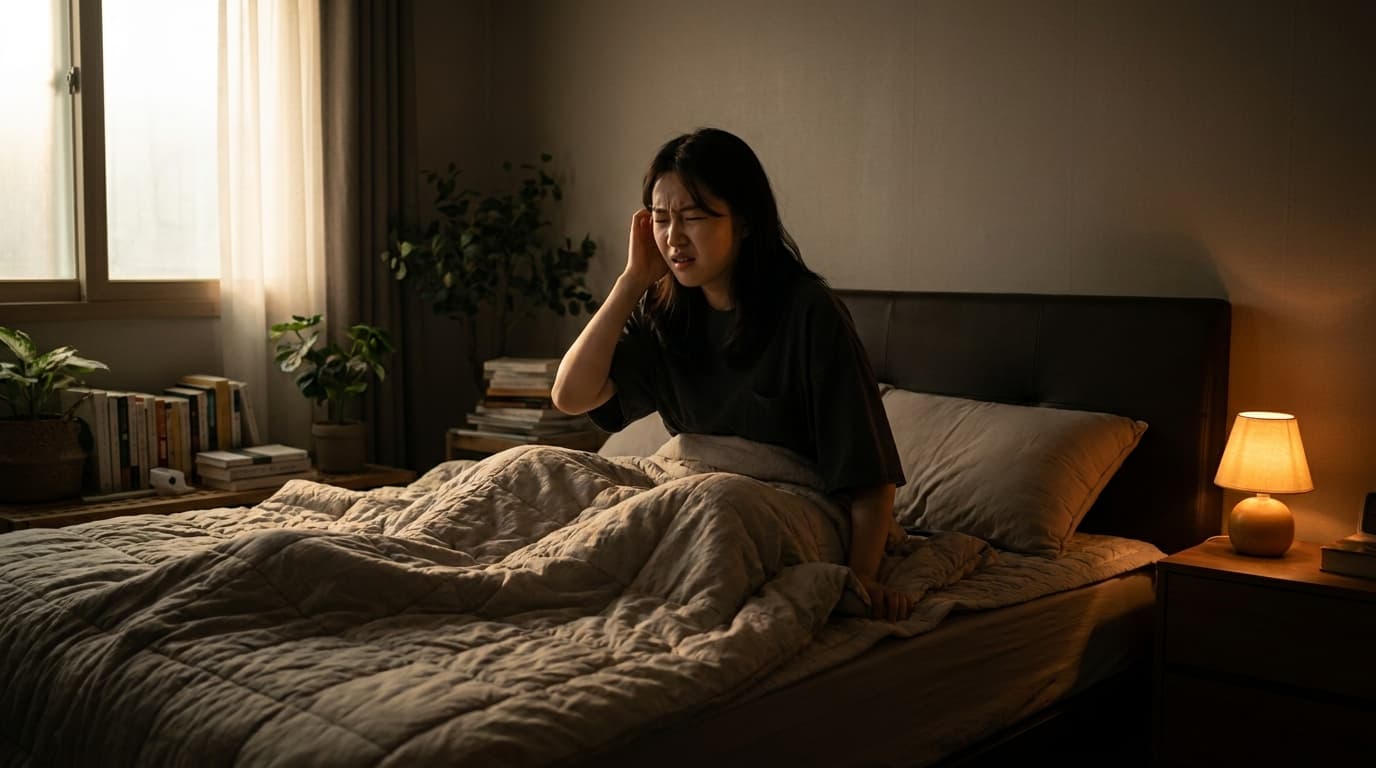
Do You Hear a Beeping Sound in Your Ear? If Left Untreated, It Can Become Chronic.
Hello. This is Dalimchae Korean Medicine Clinic. # Do you hear a beeping sound in your ear? If left untreated, it can become chronic. In the quiet night, as you try to lie down in bed, you hear a "beep" in your ear. At first, you might think it's because you're tired, but over time, sounds like "wing" or "shh" start to get louder and more frequent. You're the only one hearing this sound when there's no noise around, and your frustration and anxiety only grow. Are you experiencing tinnitus symptoms that can only be described as "hearing a beep in my ear"? These ear-ringing symptoms are not just a problem with the ears; they can be an important warning signal from your body. If left untreated, they can become chronic and significantly lower your quality of life, so it's important to find the cause and improve it early. 💡 **[Key Answer]** **3 most common causes of "hearing a beep in my ear":** ① **Autonomic Nervous System Imbalance** / ② **Auditory Nervous System Hypersensitivity** / ③ **Poor Systemic Circulation and Qi/Blood Deficiency** Dalimchae Korean Medicine Clinic resolves the root cause of tinnitus through **autonomic stabilization**, helping the brain and ears regain peace. ## Why do I hear a beeping sound in my ear? The true cause of tinnitus is elsewhere. Many people tend to think of tinnitus as only a problem with the ears. However, tinnitus, where you hear a beep, is often a signal that not only the auditory organs themselves but also the balance of our bodies has collapsed. In particular, the imbalance of the "autonomic nervous system," which reacts sensitively to stress and tension, is drawing attention as a key cause that triggers and worsens tinnitus. The autonomic nervous system is an important system that regulates all unconscious functions of our body. It's responsible for heart rate, digestion, temperature regulation, and even the ability to cope with stressful situations. When the sympathetic nerve among these autonomic nerves is excessively active, auditory signals transmitted to the brain are unnecessarily amplified, or errors occur in the sound filtering function, resulting in noises such as beeping or winging that don't actually exist. This is like an overheated engine malfunctioning. This autonomic imbalance is closely related to various lifestyle habits of modern people, such as lack of sleep, chronic stress, overwork, anxiety, and depression. ## Tinnitus can be treated with Korean medicine to stabilize the autonomic nervous system and restore peace to the ears. If no special abnormalities are found in Western medical examinations, or if you continue to hear beeps or ear-ringing symptoms despite drug treatment, Korean medicine treatment can be a good alternative. In Korean medicine, tinnitus is viewed as a result of systemic imbalance rather than just an ear problem, and the focus is on treating the fundamental cause. **A 2013 paper published by a research team at Kyung Hee University** analyzed the state of the autonomic nervous system of tinnitus patients compared to a healthy control group. This study was a retrospective chart review comparing heart rate variability (HRV) parameters of 40 tinnitus patients (19 acute, 21 chronic) and 40 healthy controls. As a result, the high-frequency component (HF) and Total Power of heart rate variability significantly decreased in the tinnitus patient group (p \< 0.05), and the low-frequency/high-frequency ratio (LF/HF ratio) significantly increased (p \< 0.05). This means that tinnitus patients exhibit decreased parasympathetic nerve activity and sympathetic nerve overactivity. In particular, it was confirmed that autonomic nervous system changes appear more clearly in chronic tinnitus patients. The researchers concluded that these results suggest that Korean medicine treatments such as acupuncture and qigong training can have a positive effect on tinnitus by regulating heart autonomic function. Based on these data, Dalimchae Korean Medicine Clinic Incheon Branch focuses on creating an environment where the brain and ears can rest away from excitement by restoring the balance of the autonomic nervous system. **A randomized, patient-assessor double-blind, sham-acupuncture controlled study by Kyung Hee University medical staff published in the Journal of Alternative and Complementary Medicine in 2012** also shows the potential of Korean medicine treatment for tinnitus. This study involved 33 adult patients with chronic (6 months or more) unilateral tinnitus who received real or sham acupuncture treatment twice a week for 5 weeks, for a total of 10 times. Tinnitus Handicap Inventory (THI) and Visual Analogue Scale (VAS) scores were evaluated at the end of treatment and after 3 months. As a result, the real acupuncture group showed significant improvement in THI scores at both the end of treatment and after 3 months compared to before treatment (p=0.004), and in particular, a significant interaction between time and group was observed in VAS scores (p=0.017). Furthermore, significant long-term changes were confirmed in Speech Discrimination (SD) up to 3 months later (p=0.011). The researchers suggested through these results that real acupuncture treatment can significantly improve subjective tinnitus discomfort and speech discrimination in chronic tinnitus patients over the long term. These research results support the importance of autonomic stabilization and systemic balance recovery treatment aimed at by Dalimchae Clinic as an Incheon tinnitus clinic. Dalimchae Clinic notes that if the balance of the autonomic nervous system is broken, the brain cannot rest. When the sympathetic nerve is active due to excessive stress or overwork, the brain is always in a "warning light" state, reacting sensitively to even minor sounds, which can lead to ear-ringing. We focus on lowering the heat of the nervous system and creating an environment where the brain can rest — in Korean medicine, this is called Suseunghwagang (水昇火降) — to resolve the fundamental cause of tinnitus. ## Tinnitus, do I have it too? Self-diagnosis Checklist If you answer "yes" to 3 or more of the following questions, you may suspect tinnitus and autonomic nervous system imbalance. * **1. The beeping or winging sound in my ears gets louder when it's a quiet night or when I'm stressed.** * **2. I have difficulty falling asleep or wake up frequently.** * **3. My neck or shoulders are often stiff for no reason, and there is tension in my jaw joint.** * **4. I often feel headache or dizziness along with tinnitus.** * **5. My concentration drops, and I feel anxious and restless.** * **6. I react sensitively or am startled by even small sounds.** * **7. Chronic fatigue is not resolved, and my energy is low.** **Judgment Criteria:** * **3-4 items apply:** Suspect tinnitus due to autonomic nervous system imbalance. Seek guidance at an Incheon tinnitus clinic. * **5 or more items apply:** Active autonomic stabilization and tinnitus treatment are needed. We recommend getting a precise diagnosis at Dalimchae Clinic Incheon Branch. ## Tinnitus treatment at Dalimchae Clinic is performed as follows. At Dalimchae Clinic, we do not view tinnitus as just an ear problem but proceed with customized treatment that comprehensively considers each patient's body condition and the balance of the autonomic nervous system. 1. **Accurate Diagnosis:** We closely identify the cause of tinnitus and the patient's systemic condition through consultation, pulse wave tests, and autonomic nervous system tests. We classify the type of tinnitus by comprehensively evaluating stress levels, sleep quality, digestive function, and fatigue levels. 2. **Autonomic Stabilization Herbal Medicine Prescription:** We prescribe individual customized herbal medicine according to the patient's constitution and tinnitus type. This helps stabilize the overactive sympathetic nerve and supplements insufficient Qi and blood to improve the blood flow environment around the brain and ears. The goal is to reduce the intensity and frequency of tinnitus through nerve stabilization and sleep induction. 3. **Acupuncture and Pharmacopuncture Treatment:** Acupuncture is performed on acupuncture points around the ears to promote Qi and blood circulation to the ears and brain and to regulate the hypersensitivity of the auditory nerves. Pharmacopuncture involves injecting refined herbal medicine ingredients directly into acupuncture points, which is effective in relieving inflammation and helping nerve recovery. 4. **Lifestyle Management Guidance:** To increase treatment effectiveness and prevent tinnitus recurrence, we provide detailed management guidelines that can be practiced in daily life, such as regulating caffeine and alcohol intake, establishing regular sleep habits, managing stress, and limiting long-term earphone use. This integrated approach contributes to overall improving the patient's quality of life by improving accompanying symptoms such as insomnia, concentration drops, and anxiety caused by tinnitus. Many people looking for an Incheon clinic are escaping the pain caused by tinnitus and regaining their peaceful daily lives. --- **Q. Can tinnitus with a beeping sound in the ear go away naturally?** A. Temporary tinnitus may disappear on its own with stress relief or sufficient rest. However, chronic tinnitus lasting more than 3 months can be fixed as a state where the brain reacts oversensitively to sound, so it's important to actively treat it to solve the cause rather than leaving it alone. **Q. How long does tinnitus treatment take?** A. The duration of tinnitus treatment varies depending on the duration of the patient's symptoms, severity, accompanying diseases, and lifestyle habits. Acute tinnitus can improve in a relatively short period, but chronic tinnitus or severe autonomic imbalance requires steady treatment and management. You can establish an accurate treatment plan through individual consultation at Dalimchae Clinic, an Incheon autonomic clinic. **Q. I have both tinnitus and hearing loss, can they be treated together?** A. Yes, about 80% of tinnitus patients have hearing loss, and hearing loss is often the main cause of tinnitus. Dalimchae Clinic treats the fundamental cause of both tinnitus and hearing loss together to improve circulation and nerve function around the ears and restore systemic balance, aiming for the alleviation of both symptoms. **Q. Are there any precautions during tinnitus treatment?** A. During tinnitus treatment, it's good to reduce caffeine, alcohol, and nicotine intake and avoid environments with loud noise. It's also important to get enough sleep, manage stress, and maintain healthy eating habits. Improving lifestyle habits according to the medical staff's instructions is a great help in increasing treatment effectiveness. --- Tinnitus with a beeping sound in the ear is not a problem that can be solved by enduring. You no longer have to ignore the signals your body has been sending for a long time. If you approach in the right direction, the body responds faster than you think. Bring your symptoms exactly as they are. At Dalimchae Clinic Incheon Branch, we will find the cause together. Where life blooms. For herbal medicine, it's Dalimchae Korean Medicine Clinic. Check your symptoms similar to mine through the AI consultation on the Dalimchae Clinic website first! This article is health information compiled by Dalimchae medical staff based on questions frequently received in the treatment room. Medical Supervision | Brain/Autonomic Treatment Standards Dalimchae Clinic Incheon Branch Korean Medicine Doctor Min Jihong (Tinnitus Column)