
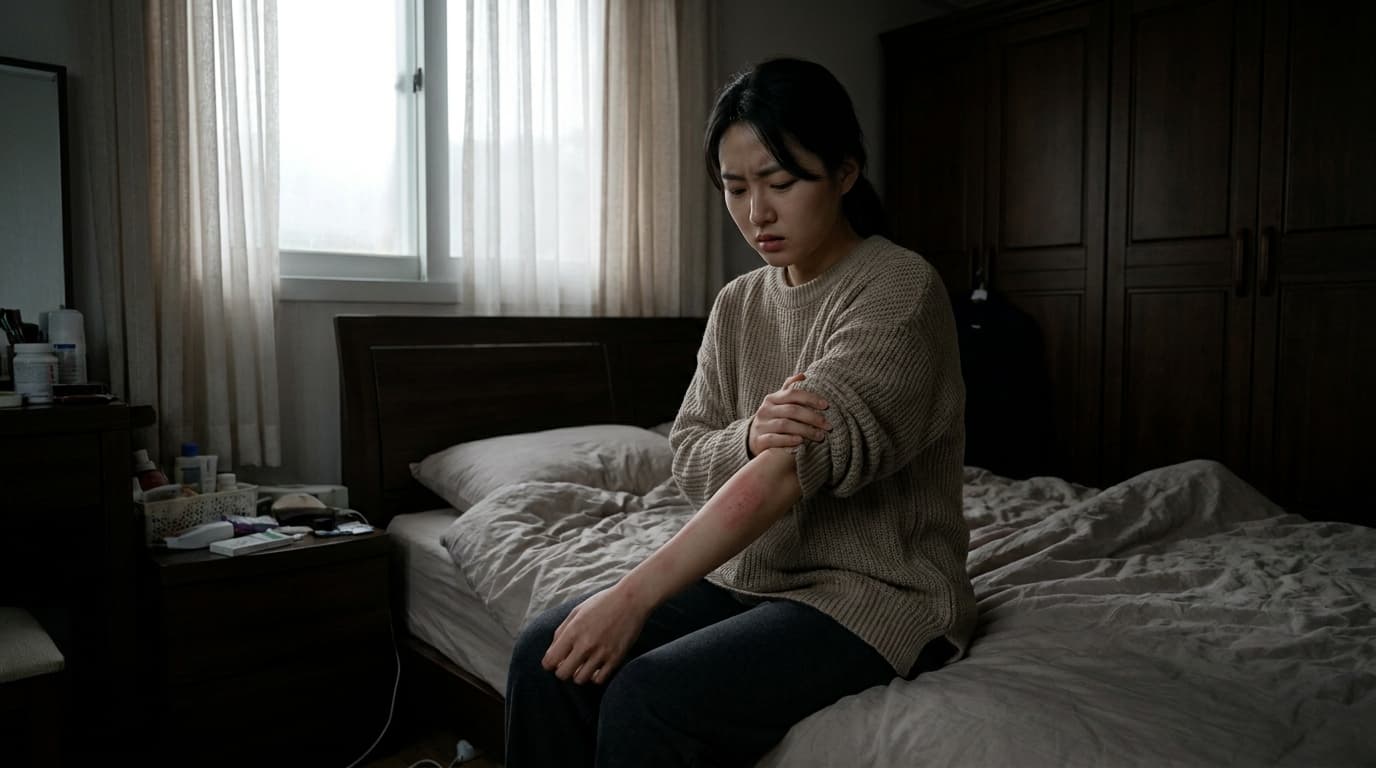
Confused Between Urticaria and Purpura? Know the Real Cause to Stop Chronic Recurrence
Hello. This is Dalimchae Korean Medicine Clinic. # Confused Between Urticaria and Purpura? Know the Real Cause to Stop Chronic Recurrence When red rashes suddenly appear on the skin and you suffer from sleepless nights due to intense itching, it's often hard to clearly distinguish whether it's simple **urticaria or purpura**. While we might just say 'the skin has flared up,' these two conditions actually have completely different causes and mechanisms, making accurate understanding and diagnosis crucial. Even if the symptoms look similar on the outside, the signals our body sends convey different messages. In this column, I will clearly explain the differences between urticaria and purpura, which are easily confused, and present the fundamental causes and Korean medicine solutions for chronic skin problems. 💡 **[Key Answer]** **3 most common fundamental causes of skin rashes like urticaria and purpura:** ① **Immune system hypersensitivity** / ② **Increased intestinal wall permeability** / ③ **Weakened blood circulation and vessel walls** Dalimchae Clinic approaches fundamental treatment to restore immune balance through **gut detoxification** and regain the skin's inherent health. ## Urticaria and Purpura: How Do They Look Different? Both urticaria and purpura are characterized by red rashes on the skin, but a closer look reveals clear differences. First, **urticaria** is characterized by wheals that swell and redden like an insect bite, accompanied by severe itching. These wheals have relatively clear boundaries and generally disappear within a few hours. They typically vanish without a trace within 24 hours and can reappear on different parts of the body. The main cause of urticaria is histamine secreted from mast cells, which increases vascular permeability and causes plasma components to accumulate in skin tissue. On the other hand, **purpura** refers to red or purple spots caused by blood leaking out of the skin due to damage to capillaries. The biggest difference is that it's a spot-like hemorrhage flat on the skin surface, not a raised wheal like urticaria. Purpura exhibits a non-blanching characteristic, where the color doesn't temporarily disappear even when pressed with a finger, and it usually has little to no itching. Especially in the case of allergic purpura (Henoch-Schönlein purpura, HSP), systemic symptoms such as abdominal pain, joint pain, and kidney involvement may accompany it. Thus, while urticaria is temporary vascular dilation and edema, purpura is a fundamental difference in that it is a hemorrhage due to damage to the vessel itself. ## The Real Cause of Skin Rash: Relationship Between Immune System Abnormality and Gut Health? A skin rash is often a warning light signaling internal imbalances rather than a simple surface problem. Especially for skin diseases like **chronic urticaria**, the link between immune system abnormalities and gut health is deep. In Korean medicine, the skin is seen as closely connected to the lungs and stomach, and imbalances in internal organs and weakened immunity are explained as the fundamental causes of skin diseases. Recent research is more clearly showing the impact of gut health on skin immunity. Increased intestinal wall permeability, known as 'Leaky Gut Syndrome,' allows toxins and microbes from the gut to enter the bloodstream, which can trigger systemic inflammatory responses and immune system hypersensitivity. This confusion in the immune system can worsen allergic skin reactions like urticaria or cause damage by triggering inflammation in blood vessels like purpura. In other words, red rashes appearing on the skin may be the result of changes in the gut environment and immune imbalances. In a 2015 study published by Park et al. in the international journal 'Complementary Therapies in Medicine,' the progress of 30 chronic urticaria patients was observed after applying Korean medicine treatment including Gwakhyangjeonggi-san. As a result of an average of 57.30 days of treatment, the patients' Urticaria Activity Score (UAS) significantly decreased from an average of 5.10 before treatment to 1.63 after treatment (p\<0.001), and 46.67% of patients reported that symptoms had completely disappeared. The researchers analyzed that these results were related to the gastrointestinal protection activity, antioxidant, and antidepressant effects of Gwakhyangjeonggi-san, suggesting the importance of herbal medicine treatment that improves gastrointestinal function in treating chronic urticaria. Also, in a randomized double-blind placebo-controlled study published by Lin et al. in 'Evidence-Based Complementary and Alternative Medicine' in 2018, herbal medicine compound prescriptions (Sopung-san and Cheongsangbangpung-tang) were applied to 56 chronic urticaria patients. After 56 days of treatment, the herbal medicine treatment group showed significant symptom relief in the weekly Urticaria Activity Score (UAS7) compared to the placebo group (herbal group 9.9 ± 9.2 vs. placebo group 15.6 ± 10.8, p = 0.038). Especially in this study, the level of interferon-γ, an inflammation-related cytokine, showed a tendency to decrease by about 30.8% from the baseline in the herbal medicine group (p = 0.013), suggesting that herbal medicine can positively affect immune response regulation. These research results support Dalimchae Clinic's treatment philosophy of approaching skin diseases holistically as problems of gut health and the immune system. We go beyond simply suppressing symptoms appearing on the skin to correct imbalances deep within the body so the skin can recover its health on its own. For those looking for a chronic urticaria clinic in Incheon, this fundamental approach can be of great help. ## Chronic Urticaria and Purpura: Why Do They Recur and Worsen? Many people think acute **urticaria or purpura** disappears naturally or is easily controlled with medication, but it is diagnosed as **chronic urticaria** when it lasts for more than 6 weeks or repeats. About 80-90% of chronic urticaria is classified as chronic idiopathic urticaria with no specific known cause, in which case symptoms repeat for months to years, greatly reducing the patients' quality of life. Purpura is also often related to immune responses, so steady management is important once it develops. The reason for frequent recurrence is trying to solve only the problems on the skin surface. Steroids or antihistamines temporarily relieve inflammation and itching but do not improve the body's immune imbalance or gut health issues. It's like forcedly pressing down on a boiling kettle lid. If the fundamental cause isn't solved, symptoms can recur or worsen anytime depending on external stimuli or internal environment changes. Especially, stress, lack of sleep, irregular meals, and certain foods are known as common factors that worsen chronic urticaria and purpura. ## How Does Korean Medicine View and Treat Urticaria and Purpura? At Dalimchae Clinic, we approach various skin diseases including urticaria and purpura with the principle of **gut detoxification** treatment. Our gut is more than a simple digestive organ; it's the 'second brain' where more than 70% of immune cells reside and a key organ for immune regulation. The gut must be healthy for the blood to be clean and for the skin to maintain health. We see that toxins accumulated in the intestinal wall travel through the blood to create systemic inflammation, which is expressed on the skin in forms like urticaria or purpura. Therefore, it is important to strengthen the gut's detoxification function and restore damage to the intestinal mucosa to help discharge waste and toxins from the body. This leads to the process of stabilizing immune hypersensitivity, improving blood circulation, and helping restore damaged vessel walls. Dalimchae Clinic's **gut detoxification** treatment goes beyond simply removing toxins to focus on creating a beneficial bacterial environment in the gut, restoring digestive function, and building the body's self-healing power. Through this, the skin reacts less sensitively to external stimuli and creates an environment where it can regulate inflammation and regenerate on its own. In this process, we maximize treatment effects by correcting the body's imbalance through herbal prescriptions tailored to the patient's constitution and symptom type, and by combining acupuncture, pharmacopuncture, and lifestyle management as needed. At Dalimchae Clinic Incheon, we aim for recurrence-free skin health by closely diagnosing each patient's gut health status and establishing a customized treatment plan. ### Could It Be Me? Urticaria/Purpura Self-Checklist Check how many of the following items apply to you. * Red rashes suddenly flare up on the skin and are very itchy. * The rash appears and disappears within a few hours and reappears elsewhere. * The color of the red spots does not fade even when pressed with a finger. * The rash has been accompanied by abdominal or joint pain. * Symptoms frequently recur or persist chronically even when taking antihistamines. * Gut-related problems such as indigestion, constipation, or diarrhea are frequent. * Skin symptoms worsen when stressed or tired. * Skin rashes tend to worsen specifically after eating certain foods. **Judgment Criteria:** * **3 or more apply:** Skin disease due to gut health and immune imbalance may be suspected. It is recommended to review holistic Korean medicine treatment. * **5 or more apply:** It's highly likely a chronic skin problem. Immediate visit is recommended for accurate diagnosis and fundamental treatment. --- ### FAQ **Q. Does urticaria/purpura disappear naturally?** A. Some acute urticaria may disappear naturally, but chronic urticaria or purpura lasting more than 6 weeks is hard to expect to heal naturally. If left alone, symptoms may worsen or become chronic, lowering the quality of life, so active treatment is necessary. **Q. Is diet management important for urticaria/purpura?** A. Yes, it's very important. Certain food additives, instant foods, crustaceans, and trigger foods can worsen urticaria and purpura symptoms. Since it's directly linked to gut health, diet management tailored to each individual's constitution is essential for fundamental treatment. **Q. Can children receive Korean medicine treatment for urticaria/purpura?** A. Of course. At Dalimchae Clinic, we help treat urticaria and purpura in children through safe herbal prescriptions and treatment methods suited to their age and weight. Focusing on improving children's immunity and gut function can also positively affect growth. **Q. When should I visit the Incheon clinic for chronic urticaria?** A. It is recommended to consider Korean medicine treatment when symptoms do not improve despite taking antihistamines, when they recur immediately after stopping medication, or when symptoms persist for more than 6 weeks and progress to chronic. Visit Dalimchae Clinic Incheon for fundamental cause treatment when systemic symptoms like digestive problems, fatigue, and stress accompany the skin symptoms. --- Urticaria and purpura are not problems solved by enduring. You no longer have to ignore the signals your body has been sending for a long time. If you approach in the right direction, the body responds faster than you think. Bring your symptoms exactly as they are. At Dalimchae Clinic, we will find the cause together. Where life blooms. For herbal medicine, it's Dalimchae Korean Medicine Clinic. Check your symptoms similar to mine through the AI consultation on the Dalimchae Clinic website first! This article is health information compiled by Dalimchae medical staff based on questions frequently received in the treatment room. Medical Supervision | Skin Disease Treatment Standards Dalimchae Clinic Incheon Branch Korean Medicine Doctor Yang Yuchan (Purpura Column)