
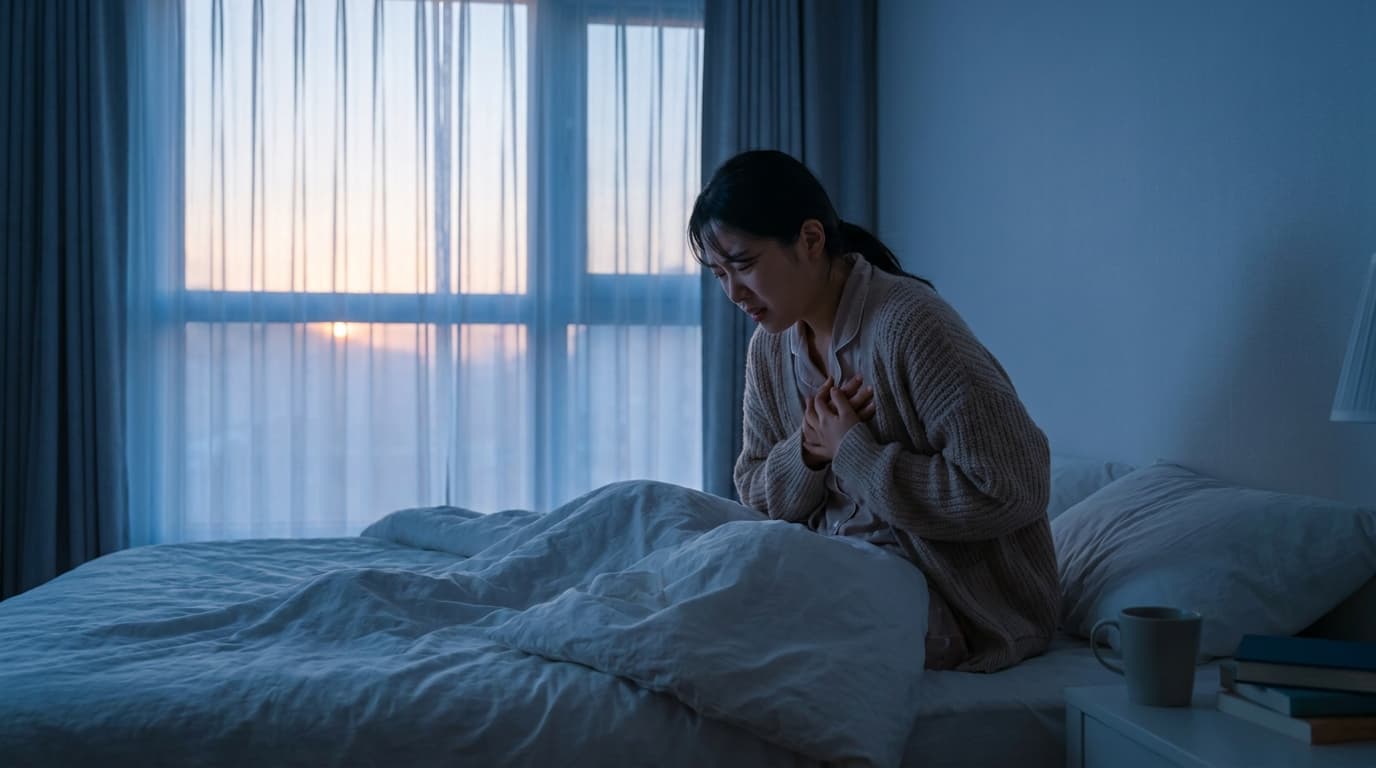
Chest Tightness and Tears Every Time I Go to Work It Is a Signal from Your Exhausted Autonomic Nervous System
Hello, this is Dalimchae Korean Medicine Clinic. # Chest Tightness and Tears Every Time I Go to Work? It Is a Signal from Your Exhausted Autonomic Nervous System. Do you feel a suffocating tightness in your chest the moment you open your eyes every morning and step over the office threshold? If you are experiencing moments where tears flow from unexplained sorrow, you may be suffering from a deep emotional pain that cannot simply be dismissed as 'being tired' or 'stressed'. Many office workers living in modern society pretend to go about their daily lives as if nothing is wrong, but inwardly they are in a state of psychological exhaustion, such as burnout syndrome. It is important to recognize the warning signals sent by your body and mind and respond appropriately. 💡 **[Key Answer]** The 3 most common causes of **chest tightness and tears every time you go to work**: ① **Accumulation of chronic work stress** / ② **Autonomic nervous system imbalance** / ③ **Psychological exhaustion due to emotional labor** Dalimchae Clinic calms your overheated nervous system and helps you regain the power to recover on your own through **autonomic stabilization treatment**. ## Why do I feel chest tightness and tears every time I go to work? Chronic stress in office workers and the resulting emotional difficulties are often described by the name 'burnout syndrome'. Burnout syndrome is defined by the World Health Organization (WHO) as 'a syndrome resulting from chronic workplace stress that has not been successfully managed', highlighting its close connection to work. Chest tightness or tears appearing on the way to work are not simply emotional problems, but may be complex physiological reactions of our body to stress. When continuously exposed to various stressors such as excessive workload, workplace conflict, and uncertain futures, the balance of our autonomic nervous system easily breaks. The autonomic nervous system independently regulates vital functions such as heartbeat, digestion, respiration, and body temperature regardless of our will. In stressful situations, the sympathetic nervous system is hyperactive, tensioning the body, which can lead to somatic symptoms such as chest tightness, heart palpitations, and anxiety. At the same time, increased secretion of the stress hormone cortisol makes emotional regulation difficult, causing reactions where one easily feels gloomy or tearful even over minor matters. If this state persists, it is accompanied by sleep disorders or chronic fatigue where sleep is disrupted at night. ## What is the relationship between burnout syndrome and office worker depression? Burnout syndrome and office worker depression are closely linked. Chronic job stress can be a major cause of depressive symptoms, a trend particularly prominent among Korean office workers. According to a 2023 study published in the *Annals of Occupational and Environmental Medicine* following 1,837 male workers at a Korean manufacturing plant for two years, increased or persistently high job stress was significantly associated with the incidence of new-onset depression. In particular, high job demand increased the risk of new-onset depression by 4.34-fold (95% confidence interval: 2.37-7.96). This means that higher job demand increases vulnerability to depression. Furthermore, a study of 8,522 Korean workers published in *International Archives of Occupational and Environmental Health* in 2008 analyzed insufficient social support (OR = 1.58, 95% CI = 1.52, 1.66) and discomfort in the work environment (OR = 1.25, 95% CI = 1.18, 1.32) as important risk factors for depressive symptoms. These research results emphasize the importance of job stress management and social support, suggesting that deep burnout syndrome can develop into depression. Based on these data, Dalimchae Clinic Songdo branch goes beyond simply alleviating symptoms to comprehensively consider the environment and psychological state of patients, approaching the root causes of job stress. Restoring autonomic balance so body and mind can recover on their own is Dalimchae Clinic's treatment philosophy. ## Why Autonomic Stabilization Matters: Allowing the Overheated Brain to Rest Chest tightness and tears when going to work are strong warning lights that our autonomic nervous system, especially the brain, is overheated and failing to rest properly. Continued exposure to stress leads to excessive activation of the sympathetic nervous system, stimulating the brainstem to induce increased heart rate, vasoconstriction, and muscle tension. Just as an automobile engine stops functioning when overheated, our brain struggles to perform properly under continuous tension. Dalimchae Clinic Songdo branch focuses on stabilizing this overheated autonomic nervous system and creating an environment where the brain can get sufficient rest. In Oriental medicine, this state is diagnosed as 'heart heat' (심열) or 'liver qi stagnation' (간기울결), aiming to lower nervous system heat and smooth Qi and blood circulation to restore body balance. Lowering nervous system heat and creating an environment for the brain to rest is called 'Su Seung Hwa Gang' (수승화강) in Oriental medicine—the principle of making the head cool and the lower body warm to harmonize overall physical function. In fact, research results show that oriental medical treatment is effective in easing stress responses. A 2004 study published in *Human Psychopharmacology: Clinical and Experimental* reported that the herbal prescription Ondamtanggamibang significantly decreased blood pressure, norepinephrine, and cortisol levels in 40 medical students under test stress. It also showed positive changes in psychological variables such as anxiety, depression, stress, and emotional states, likely achieved through stabilization of the sympathetic nervous system. Such oriental medical treatments help improve physical and mental symptoms caused by job stress by restoring autonomic balance. Songdo Autonomic Clinic Dalimchae provides customized treatments tailored to individual symptoms and constitutions based on such scientific evidence. ## How Severe Is My Burnout Syndrome? Self-Diagnosis Checklist Check the items below and count how many apply to you. * Chronic fatigue is felt even after waking up in the morning. * Strongly dislike going to work, and experience chest tightness or anxiety even before commuting. * Loss of interest or passion for work, frequently feeling lethargic. * Tasks that were once handled easily now feel burdensome, decreasing work efficiency. * Irritability or anger over minor things, with severe mood swings. * Conversation with colleagues or family feels bothersome, frequently wanting to be alone. * Frequent unexplained physical pains such as headaches, indigestion, dizziness, or muscle aches. * Deteriorated sleep quality, such as difficulty falling asleep or frequently waking up. * Loss of appetite or binge eating, along with weight changes. * Skepticism about one's work, feeling everything is meaningless. **[Judgment Criteria]** * **3-5 items apply:** Suspected early burnout. Starting autonomic imbalance management recommended. * **6-7 items apply:** Moderate burnout stage. Expert consultation and oriental complex treatment review needed. * **8+ items apply:** Severe burnout state. Immediate medical help and treatment recommended. Start recovering your exhausted body and mind with Songdo Clinic Dalimchae. ## FAQ: Resolving Your Questions About Burnout Syndrome **Q. Can burnout syndrome improve naturally?** A. Mild burnout in its early stages can naturally improve with sufficient rest and stress management. However, if symptoms become chronic or are accompanied by depression, sleep disorders, or somatic symptoms, professional help is necessary. **Q. Can burnout syndrome be treated with oriental medicine?** A. Yes. Oriental medicine treats the root causes of burnout as autonomic nervous system imbalance and decreased function of internal organs. Through personalized herbal prescriptions, acupuncture, moxibustion, cupping, and pharmacopuncture tailored to individual constitutions and symptoms, we stabilize the autonomic nervous system and strengthen overall physical function to aid recovery. **Q. How long does burnout treatment take?** A. Treatment duration varies depending on symptom severity, chronicity, and individual recovery capacity. Generally, with steady treatment and lifestyle improvements, meaningful improvement can be expected within months, and steady management is important. **Q. I have headaches and dizziness along with chest tightness when going to work. Can they be treated together?** A. Yes. Autonomic imbalance due to burnout can be accompanied by various physical symptoms such as headaches, dizziness, and tinnitus. Dalimchae Clinic Songdo branch comprehensively diagnoses and treats these related symptoms to achieve overall health recovery. Chest tightness and tears when going to work are not problems solved by enduring them. You no longer have to ignore the signals your body has sent for a long time. Approaching in the right direction makes the body react faster than you think. Bring the symptoms you are experiencing as they are. Dalimchae Clinic will find the cause together. The place where life blooms. Herbal medicine is Dalimchae Korean Medicine Clinic. Check symptoms similar to yours first through Dalimchae Clinic website AI consultation! Medical supervision | Brain and autonomic nervous system treatment standard Dalimchae Clinic Songdo branch Korean medicine doctor Oh Hyun-min (Depression Column)