
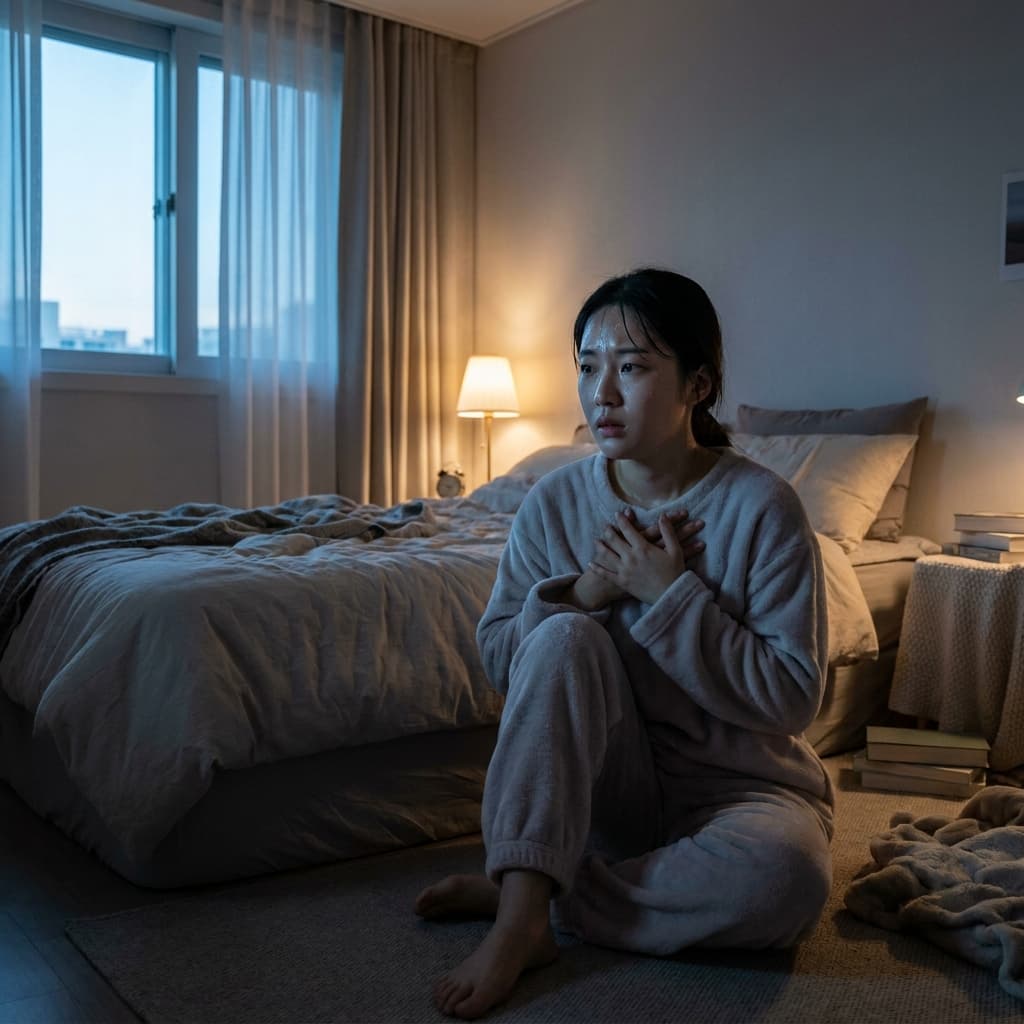
Chest Tightness and Cold Sweats When Commuting Autonomic Dysfunction
Hello. This is Dalimchae Korean Medicine Clinic. # Chest Tightness and Cold Sweats When Going to Work: Is it Autonomic Dysregulation? Sudden discomfort in a normal daily routine can be bewildering. In particular, if you repeatedly experience **chest tightness, cold sweats, and anxiety** specifically on your way to work or at the workplace, it is difficult to dismiss it as simple stress. When these symptoms become chronic, they can lead to a fear of work itself, causing great difficulty in daily life. Even though the body's warning signals are clear, many people feel frustrated when they receive a "normal" diagnosis after being examined at a hospital. 💡 **[Key Answer]** 3 most common causes of "chest tightness and cold sweats when going to work": ① **Sympathetic Nervous System Overactivity**: The body becomes excessively tense in stressful situations, showing reactions such as increased heart rate, sweating, and rising blood pressure. ② **Brain's Excessive Guarding Response**: The brain recognizes a specific situation (e.g., going to work) as a threat and continuously maintains a state of alert. ③ **Accumulation of Chronic Anxiety and Stress**: Unresolved stress and anxiety put a burden on the autonomic nervous system, breaking its balance. Dalimchae Clinic resolves the root cause of these symptoms through an autonomic stabilization treatment approach that relaxes the brain's tension and restores the body's recovery power. ## Why do chest tightness and cold sweats occur specifically on the way to work? Our body has an autonomic nervous system that regulates life activities on its own. The autonomic nervous system operates automatically regardless of our will, maintaining the body's homeostasis by controlling heart rate, breathing, digestion, sweating, and body temperature regulation. This autonomic nervous system consists of the sympathetic nervous system, which is responsible for activity and tension, and the parasympathetic nervous system, which is responsible for rest and relaxation. These two nerves achieve balance like a seesaw, leading the harmony of our body. However, problems occur when the balance of the autonomic nervous system is broken due to persistent stress, overwork, and lack of sleep. In particular, if the sympathetic nervous system is excessively activated, our body reacts as if it were in a crisis even in situations that are not actually dangerous. Symptoms such as a rapid heartbeat, shortness of breath, rising blood pressure, and cold sweats appear. As the specific situation of going to work repeatedly acts as a stress factor, the body learns this as a threat and begins to react hypersensitively. ## Autonomic Dysregulation, how does Korean medicine view it? Korean medicine identifies autonomic dysregulation as a state where the harmony between mind and body (心身) is broken, and considers the flow and balance of the human body as a whole rather than just following each symptom. In particular, imbalances in the autonomic nervous system caused by stress are seen as an important cause. Autonomic dysregulation can be suspected when a patient complains of physical discomfort along with mental symptoms such as anxiety and depression, even when there are no special abnormalities in examinations. Dalimchae Clinic Incheon Branch uses objective indicators such as HRV (Heart Rate Variability) tests to diagnose and treat autonomic dysregulation, closely analyzing the activity and balance state of the autonomic nervous system. Through this, we accurately identify each individual's physical condition and stress response pattern, and establish a customized Korean medicine treatment plan. ## Autonomic Dysregulation, what is the scientific evidence for Korean medicine treatment? Korean medical treatment is proving effective in improving physical and mental symptoms by regaining the balance of the autonomic nervous system through several studies. A case study published in the journal **『Medical Acupuncture』** in 2024 reported the effect of acupuncture treatment on anxiety-related symptoms. The study, conducted on 10 patients with Generalized Anxiety Disorder (GAD), showed that after receiving acupuncture treatment twice a week for 4 weeks, GAD-7 (Generalized Anxiety Disorder scale) and BPQ-SF (Body Perception Questionnaire-Short Form) scores significantly decreased. In particular, it suggested a mechanism by which acupuncture treatment regulates excessive activation of the sympathetic nervous system by activating the vagus nerve and improving heart rate variability (HRV) and heart rate coherence (HRC). The researchers concluded that acupuncture treatment could be an effective therapy for sympathetic stress and anxiety-related symptoms. These results show that the acupuncture treatment applied at the Incheon autonomic nervous system clinic can improve the fundamental regulatory ability of the autonomic nervous system beyond simple symptom relief. In addition, a review paper published in the journal **『Frontiers in Neuroscience』** in 2022 summarized the effects of acupuncture treatment on autonomic nervous system regulation by analyzing studies published in PubMed over the past 20 years. This study explains that acupuncture stimulation activates sensory nerve fibers, the spinal cord, and complex neural networks in the brain through specific acupuncture points. It reported that this effectively alleviates symptoms related to autonomic nervous system dysfunction, such as migraines, depression, insomnia, and functional dyspepsia. The researchers concluded that the autonomic nervous system is one of the therapeutic targets of acupuncture treatment and that acupuncture mediates the action of restoring homeostasis. This supports the idea that the autonomic stabilization treatment pursued by Dalimchae Clinic can play an important role in regaining our body's balance based on scientific evidence. Based on this data, Dalimchae Clinic approaches symptoms such as work fear, chest tightness, and cold sweats caused by autonomic dysregulation with the principle of autonomic stabilization treatment. By restoring the balance of the autonomic nervous system that connects the brain and body, we help patients better deal with stress and regain a healthy daily life beyond simply relieving discomfort. ## What is different about Dalimchae Clinic's autonomic stabilization treatment? Dalimchae Clinic focuses on **autonomic stabilization**, which is the core of autonomic dysregulation. When the balance of the autonomic nervous system is broken, the brain cannot rest and always maintains a state of alert. Like an overheated engine, the entire body is in a state of tension and reacts sensitively even to small stimuli, appearing as various symptoms such as chest tightness, cold sweats, indigestion, sleep disorders, dizziness, and headaches. Dalimchae Clinic Incheon Branch aims to lower the heat of the nervous system and create an environment where the brain can rest comfortably. In Korean medicine, this is explained by the concept of 'Suseunghwagang (水昇火降)', which restores the natural energy flow of the body by keeping the head cool and the lower abdomen warm. To this end, through herbal medicine prescriptions tailored to individual constitutions and symptoms, we lower unnecessary heat in the body, improve qi and blood circulation, and stabilize the mind and body. In addition, we perform a combination of complex treatments, such as placing needles on acupuncture points to strengthen the regulatory function of the autonomic nervous system, and promoting body circulation through moxibustion and cupping to relax tensed muscles. Through these treatments, we correct the unstable autonomic nervous system and cultivate the power for our body to recover on its own. ## Could I have autonomic dysregulation? Self-diagnosis checklist If 3 or more of the following items apply to you, you may suspect autonomic imbalance. * ◻ I often feel chest tightness and anxiety for no particular reason. * ◻ I get cold sweats or my hands and feet get cold when I am tense or stressed. * ◻ I cannot fall asleep easily even after going to bed, or I wake up often and don't feel refreshed in the morning. * ◻ Digestion doesn't go well and my stomach feels bloated, or I repeat diarrhea and constipation. * ◻ I often have headaches or feel dizzy for no particular reason. * ◻ My neck or shoulders are often stiff and sore, and I suffer from chronic fatigue. * ◻ I get easily startled by small things, or my heart often palpitations. * ◻ There are no special abnormalities in examinations, but my body continues to feel uncomfortable. **If 3 or more items apply**: Autonomic imbalance suspected → We recommend precise diagnosis and treatment consultation at Dalimchae Clinic. **If 5 or more items apply**: Active treatment needed → It is important to find an Incheon anxiety disorder clinic and start treatment for fundamental autonomic recovery. --- ### FAQ **Q. How long does it take for symptoms of anxiety and chest tightness whenever going to work to improve?** A. The improvement period for autonomic dysregulation symptoms can vary depending on an individual's constitution, the severity of symptoms, and stress management. Sufficient improvement can be expected if steady treatment and lifestyle improvements are combined. **Q. Can autonomic dysregulation also be treated with Korean medicine?** A. Yes, autonomic dysregulation is viewed and treated as a problem of mind-body balance from a Korean medicine perspective. It is effective in improving symptoms by regulating the autonomic nervous system and increasing general recovery power through herbal medicine, acupuncture, and moxibustion. **Q. Can chest tightness and cold sweats heal naturally?** A. If it's a symptom due to temporary stress, it can naturally improve through rest. However, if symptoms repeat or interfere with daily life, it is highly likely that the autonomic imbalance has become chronic, so it is good to consider active treatment. **Q. I have autonomic dysregulation along with panic disorder and anxiety disorder. Can they be treated together?** A. Yes, autonomic dysregulation is closely related to panic disorder and anxiety disorder, and they often occur together. Dalimchae Clinic's autonomic stabilization treatment deals with the root causes of these symptoms together, so simultaneous treatment is possible. --- Discomfort like chest tightness and cold sweats specifically when going to work is not a problem that can be solved by just enduring. You no longer have to ignore the signals your body has been sending for a long time. If you approach in the right direction, the body responds faster than you think. Bring your symptoms exactly as they are. At Dalimchae Clinic, we will find the cause together. Where life blooms. For herbal medicine, it's Dalimchae Korean Medicine Clinic. Check your symptoms similar to mine through the AI consultation on the Dalimchae Clinic website first! This article is health information compiled by Dalimchae medical staff based on questions frequently received in the treatment room. Medical Supervision | Brain/Autonomic Treatment Standards Dalimchae Clinic Incheon Branch Korean Medicine Doctor Yang Yuchan (Autonomic Dysregulation Column)