
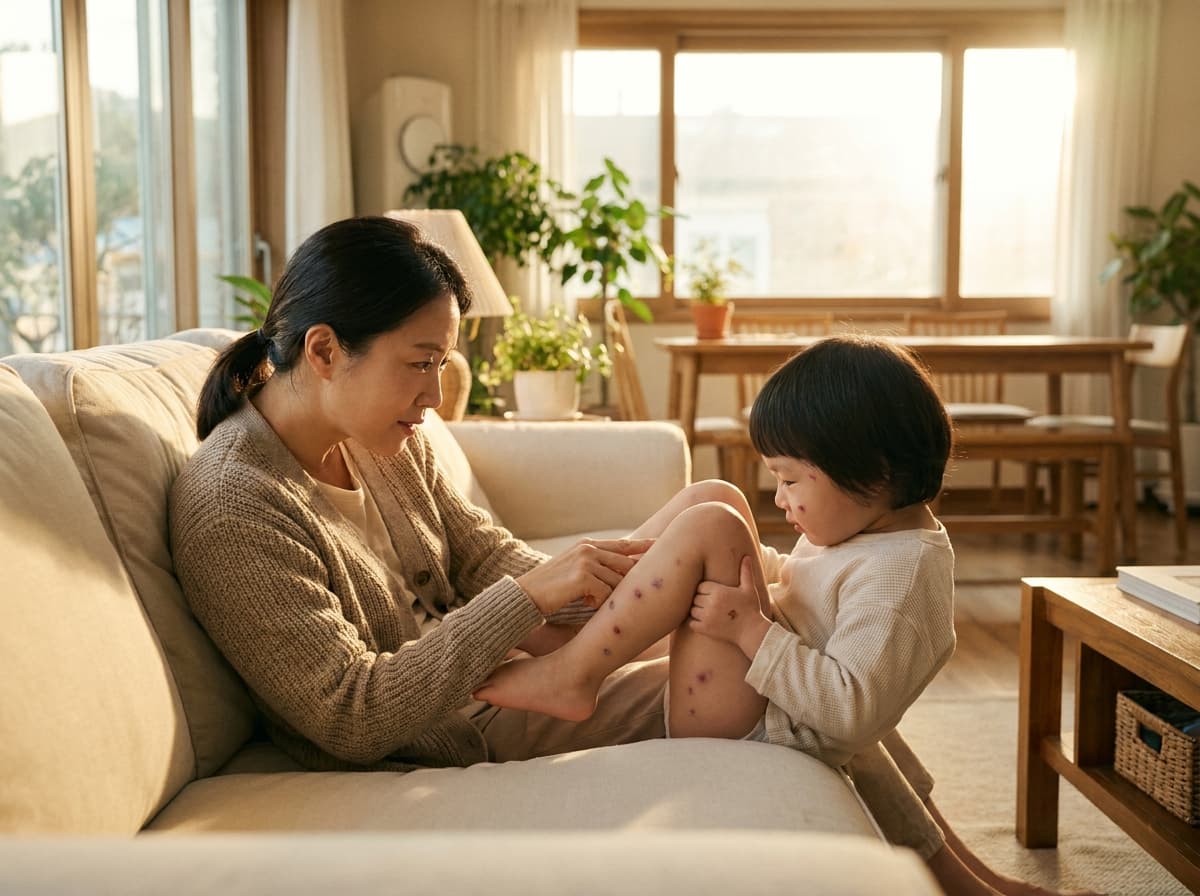
Bruise-like Spots on My Child's Legs, Could It Be Purpura?
Hello. This is Dalimchae Korean Medicine Clinic. # Bruise-like Spots on My Child's Legs, Could It Be Purpura? If reddish or purple spots like bruises suddenly appear on the legs of a child who was playing healthily, parents' hearts will drop. At first, they are small and few, so you might think it's okay, but as time passes, the number of spots increases, the size grows, and if joint pain or abdominal pain is accompanied, anxiety is bound to grow even more. Especially since it's an uncommon symptom in children, you might wonder, "What on earth happened to my child?" and it's highly likely to be "Purpura." 💡 **[Key Answer]** **3 most common causes of "bruise-like spots on my child's legs":** ① **Immune System Disturbance** / ② **Vascular Inflammation** / ③ **Decreased Digestive Function** Dalimchae Korean Medicine Clinic resolves the fundamental cause of immune disturbance through **intestinal detoxification** and restores vascular health to prevent the recurrence of purpura. ## Red Spots on Our Child's Legs, What is Purpura? Purpura refers to bruise-like spots caused by blood leaking from small blood vessels under the skin. In particular, 'Henoch-Schönlein Purpura (HSP),' in which blood vessels become inflamed due to an immune system abnormality, is a type of vasculitis most commonly seen in children. It often appears after a respiratory infection like a cold, and while bruise-like spots mainly appear on the legs, in severe cases, they spread to the buttocks, arms, and trunk. These purpuras do not appear only as skin symptoms but can also cause gastrointestinal symptoms such as joint pain and abdominal pain, and in severe cases, they can even invade the kidneys and cause hematuria or proteinuria, so caution is needed. In Western medicine, symptom relief is attempted with drugs such as steroids, but there are reports that there are limits to preventing side effects or renal complications during long-term use. ## Immune Disturbance and Vascular Inflammation, the Real Causes of Purpura. The core cause of purpura is close to an autoimmune reaction in which our body's immune system is disturbed and mistakenly recognizes its own blood vessels as foreign substances and attacks them. This immune response causes inflammation in the blood vessels, causing blood to leak out, which appears as red spots on the skin, i.e., purpura. Then, why is the immune system of children disturbed? In Korean medicine, this is seen as deeply related to 'intestinal barrier damage' resulting from the accumulation of toxins in the body and the weakening of digestive functions, beyond simple external virus penetration. The intestine is one of the largest immune organs in our body, and when the intestinal barrier is damaged, incompletely digested food residues or toxins can enter the blood, causing systemic inflammatory reactions and immune system disturbances. In particular, children often have immature immune systems and weaker digestive functions than adults, so these problems can occur more easily. ## Purpura, Domestic and Foreign Research Tells the Possibility of Korean Medicine Treatment. The effectiveness of the Korean medicine approach in treating purpura is being confirmed through several clinical studies. In a study published in the 'Journal of Pharmacopuncture' in 2014, the results of sole administration of the herbal medicine 'Jarotang (JRT)' to 5 patients diagnosed with Henoch-Schönlein Purpura (HSP) were reported. These patients showed symptoms of Yin deficiency, and some were cases that did not improve even with steroid treatment. As a result of the study, after administration of Jarotang, symptoms such as purpura on the lower limbs, abdominal pain, and joint pain all improved, and they remained without recurrence for 6 months. The researchers concluded that Jarotang is effective in treating HSP by nourishing Yin, tonifying Qi, and cooling blood-heat. In addition, a systematic literature review and meta-analysis study published in the journal 'Complementary Therapies in Medicine' in 2015 analyzed the effect of herbal medicine treatment on 1112 children (1-16 years old) with Henoch-Schönlein Purpura without kidney damage. This study included 15 randomized controlled trials (RCTs), and auxiliary herbal medicine treatment significantly reduced the incidence of kidney damage (RR 0.47, 95% CI 0.31-0.72) and shortened the disappearance period of purpura, joint pain, and abdominal pain. This suggests that Korean medicine treatment can have a positive effect not only on improving the main symptoms of pediatric purpura but also on preventing serious complications. Similar results are reported in domestic studies. A domestic clinical paper analysis study published in the 'Journal of Korean Medicine Ophthalmology & Otolaryngology & Dermatology' in 2019 reviewed domestic clinical papers on the Korean medicine treatment of purpura and vasculitis over the past 20 years. As a result of the study, it was concluded that a significant number of patients visiting for purpura are children and adolescents, and that Korean medicine treatment has enough meaning to be used as a substitute or to lower the dependence on Western medicine treatment. This study revealed that medicinal herbs such as licorice, angelica, hoelen, and peony were frequently used in the treatment of purpura. Based on this data, Dalimchae Korean Medicine Clinic Songdo Branch is solving the root of purpura through 'intestinal detoxification' treatment that stabilizes the immune system of children and restores fundamental vascular health. ## Dalimchae Korean Medicine Clinic's Intestinal Detoxification Treatment, Pulls Out the Root of Purpura. Dalimchae Clinic understands that purpura is not just a skin problem, but a complex problem resulting from the imbalance of our body's 'intestine-immune-vessel' axis. In particular, intestinal health, which is responsible for more than 70% of immunity, is important. Toxins and inflammatory substances accumulated in the intestinal barrier spread throughout the body through the blood, damaging blood vessels and inducing immune hypersensitivity reactions. This has a similar occurrence mechanism to other chronic skin diseases such as atopy or hives. Dalimchae Clinic's 'intestinal detoxification' treatment focuses on breaking this vicious cycle. It aims to restore the damaged intestinal mucosa, discharge toxins accumulated in the body, and calm vascular inflammation by correcting the broken immune balance. We carefully select herbal medicines according to individual constitution and symptom stage so as not to burden the child's delicate body, and if necessary, combine Korean medicine treatments such as acupuncture, moxibustion, and pharmacopuncture to maximize the treatment effect. Treatment that helps calm the hypersensitivity of the nervous system and allows the brain and intestine to communicate healthily is essential for boosting immunity. Excessive stress or fatigue also becomes a factor that worsens intestinal health and can cause purpura. Dalimchae Korean Medicine Clinic Songdo Branch creates an environment where the child's body can recover itself by considering these overall health conditions. ## Our Child's Purpura, Check it Out Right Now! You can check what kind of situation our child's purpura is in through the following checklist. * Small red or purple spots (bruises) are visually confirmed on the legs or top of the feet. * The color of the spots does not disappear even when pressed with a finger. (Difference from dermatitis/erythema) * The spots appeared within 1-3 weeks after suffering from an upper respiratory infection such as a cold or flu. * They complain of pain in joint areas such as knees and ankles along with the spots. * It is accompanied by digestive symptoms such as abdominal pain, vomiting, or diarrhea. * If the amount of activity increases or if standing for a long time, the spots become darker or new ones appear. * Previously suffered from purpura and improved, but it has recently recurred. * Hematuria (red urine) or proteinuria (foamy urine) has been observed in the urine before. **Judgment Criteria:** * **If 3 or more apply:** It is a suspected stage of purpura or immune imbalance. For an accurate diagnosis, consider a consultation at a Songdo purpura Korean medicine clinic. * **If 5 or more apply:** The possibility of purpura progression is high, and it can develop into serious situations such as kidney complications, so immediate review of complex Korean medicine treatment is recommended. ## Frequently Asked Questions (FAQ) **Q. How long does it take for a child's purpura?** A. The treatment period for purpura varies greatly depending on the severity of symptoms, accompanied symptoms, recurrence, and individual immune status. Light cases can improve within 1-2 months, but in chronic or recurring cases, steady treatment for more than 3 months may be required. **Q. Is purpura also treated with Korean medicine?** A. Yes, purpura can be improved through herbal medicine treatment, which has effects such as immune stabilization, anti-inflammation and sedation, removal of blood stasis, and stabilization of vascular permeability, and treatments such as acupuncture and moxibustion. In particular, it focuses on lowering the recurrence rate by approaching the fundamental cause of immune system disturbance. **Q. Can bruise-like spots on a child's legs heal naturally?** A. In light cases of purpura, it may improve naturally, but there are many cases where symptoms worsen or recur. In particular, if the symptoms persist for more than 2 weeks, the spots spread to the upper body, or joint pain/abdominal pain/kidney symptoms are accompanied, it is better to receive an expert's consultation. **Q. I have purpura and atopy together, can they be treated together?** A. Yes, purpura and atopy both often result from immune imbalance and intestinal health problems, so they can be treated together. At Dalimchae Clinic, we conduct treatments that improve the fundamental causes of the two diseases simultaneously by strengthening the immune system and reducing inflammation in the body through intestinal detoxification. Bruise-like spots keep appearing on my child's legs. Like this, the signals the body sends from a child must never be ignored. Enduring or neglecting for a long time only worsens the symptoms and leads to a path of chronic disease. If you approach in the right direction and manage steadily, a child's body reacts faster than you think and can regain health. Bring the child's symptoms you are experiencing exactly as they are. At Dalimchae Korean Medicine Clinic Songdo Branch, we will find the cause together and help the child regain a healthy daily life. Where life blooms. For herbal medicine, it's Dalimchae Korean Medicine Clinic. Check your symptoms similar to mine through the AI consultation on the Dalimchae Clinic website first! This article is health information compiled by Dalimchae medical staff based on questions frequently received in the treatment room. Medical Supervision | Skin Disease Treatment Standards Dalimchae Clinic Songdo Branch Korean Medicine Doctor Oh Hyun-min (Chronic Skin Disease Column)