
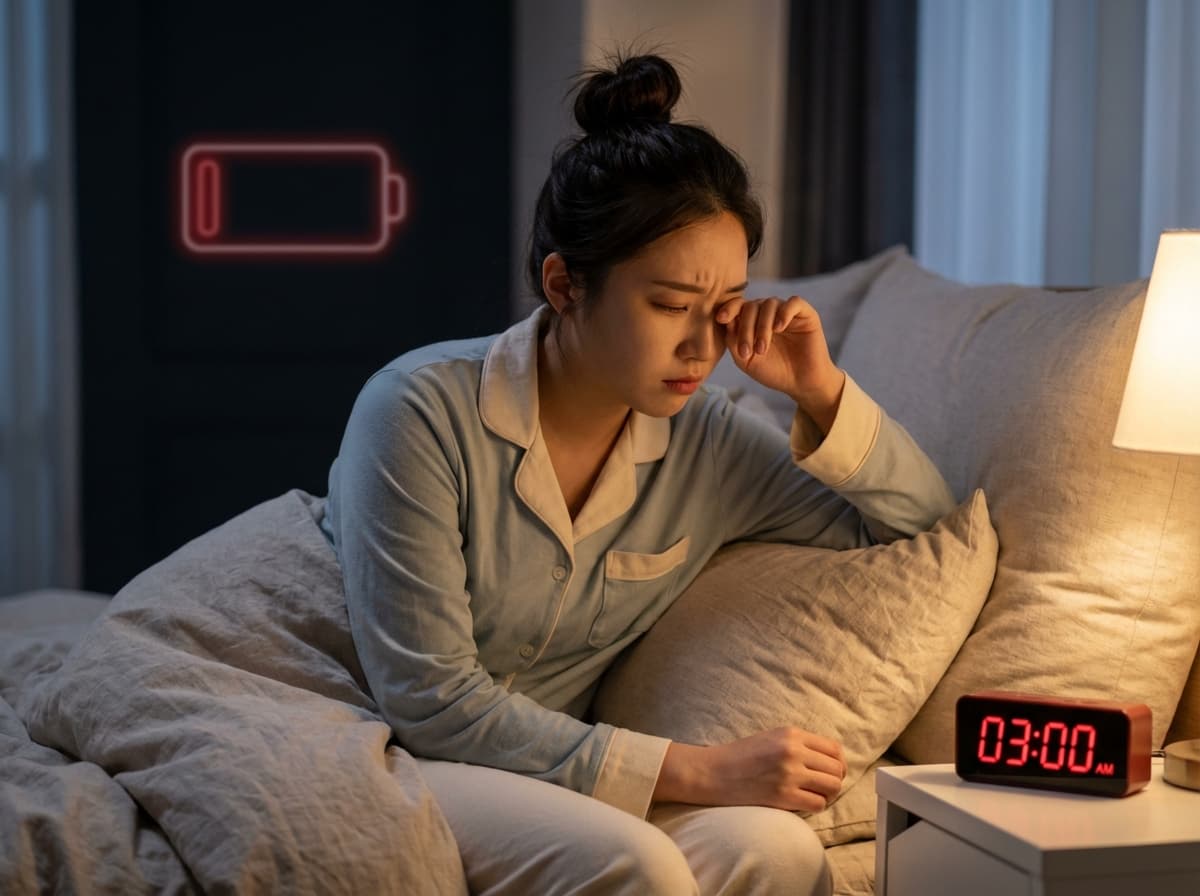
Why You Wake Up at Night with Normal Blood Tests: Based on Sleep Maintenance Research
Hello, this is Dalimchae. "Falling asleep isn't hard, but I always wake up at 2-3 AM." "Even when I try to sleep again, my heart pounds and racing thoughts keep me up all night. My blood tests and thyroid results are normal, which is so frustrating." This is a common distress shared by many who visit our clinic for sleep issues. Rather than assuming it's just fatigue or relying on sleep aids, it is time to fundamentally revive your sleep rhythm based on scientific data. Today, Dalimchae explains why you wake up despite normal tests and provides solutions proven by academic papers.

🚨 The real cause machines missed: Depleted 'blood (energy)' and broken 'autonomic nerves' The reason for waking up despite normal blood tests is often the depletion of energy (blood/fluids) needed to keep you asleep and 'autonomic imbalance.' As we age or accumulate overwork, the energy supporting our body decreases. You might fall asleep early because you're exhausted, but because you lack the 'fuel' to sustain deep sleep through the night, you wake up early. Furthermore, if your 'sympathetic nervous system' (body's alarm) is overactive due to stress, the problem worsens. While the body is exhausted, the brain stays aroused, waking you up at small noises or temperature changes. In Korean medicine, this is seen as a collapse of Suseunghwagang (水升火降), where heat surges to the head.
📘 Sleep disorders machines can't find, improvement data proven by papers Let's check how an integrated approach helps maintain sleep through academic data. 📊 [Research Data: Effect of Complex Treatment on Sleep Maintenance Disorders] According to a 2022 study in the 『Journal of Korean Oriental Neuropsychiatry』, those with sleep maintenance issues who received complex treatment showed a significant decrease in nightly awakenings. Specifically, the sympathetic over-excitation index decreased while total sleep maintenance time increased (p<0.05), proving the brain stabilizes itself for better sleep quality.
🌿 We don't force sleep; we create an environment to stay asleep (Dalimchae Process)
- Step 1: Precision Diagnosis (Brainwave/Autonomic Test & Pulse/Abdominal Diagnosis): Beyond a questionnaire, we numerically identify sympathetic over-excitation and observe internal energy depletion and organ flow.
- Step 2: 'Cranial Nerve Pharmacopuncture' to Clear Blocked Nerves (Cheongyeol-ansim & Sogan-haeul): Immediately releases head/neck pressure to calm runaway sympathetic nerves and lower surging heat.
- Step 3: '1:1 Customized Herbal Medicine' to Refill Fuel (Bosin-ikjeong): We firmly refill the body's fundamental energy and blood (Bosin-ikjeong), the biggest cause of sleep interruption. We aim to build the physical strength to sleep soundly until morning.
💬 Sleep Maintenance Disorder FAQ Q1. Is waking up at night simply due to age? Aging is a factor, but 'autonomic collapse' from stress is often a bigger issue. Quality can be improved regardless of age by restoring balance and fluids. Q2. Can I sleep deeply after quitting sleep aids? Since aids forcibly suppress the brain, long-term use weakens your natural sleep power. Our treatment aims to restore 'basic physical strength' to sleep on your own. Q3. How long does treatment take? Early symptoms can stabilize in 1-2 months. Chronic cases usually require 3 or more months of steady management.
"Waking up at night is a distress signal from your brain saying it has run out of fuel to sustain sleep." Don't despair because tests are normal. With Dalimchae's dimensional diagnosis and customized care, regain your lost clear and comfortable morning.
Where life blooms. Health is Dalimchae. Medical Review | Dalimchae Incheon Branch Medical Team
Check your similar symptoms first with Dalimchae's website AI consultation!